
This video tutorial teaches how to get sun stars, sun streaks, or starbursts while filming towards direct sunlight.
Sun stars, sun streaks, or starbursts is the name given to the visual attribute of the long, golden streaks produced by sunlight.
They add tremendous and dynamic texture to a frame. Intentionally shooting sunbursts can convey a summery vibe and also serve as a juxtaposition of warmth to a shot filmed in a cold environment. They also help to create depth in your footage.
Though you’ve probably shot many sun stars by mistake (and probably loved the look), here are some outstanding tips on how to get them while filming in direct sunlight.
What Are Sun Stars?
They are often found within landscape shots when the photographer photographs during the early morning or evening. Additionally, you’ll find them used in cinema, especially for sweeping landscape vistas.
The property that causes this effect is optical diffraction. Sunbursts or sun stars appear because of the bending of light around an object. Your camera’s lens (at the appropriate aperture) is able to capture this little bit of visual magic.
The term “diffraction spikes” is the technical description of sun stars, and the theory and study of diffraction spikes have implications in meteorology and astronomy, as well.
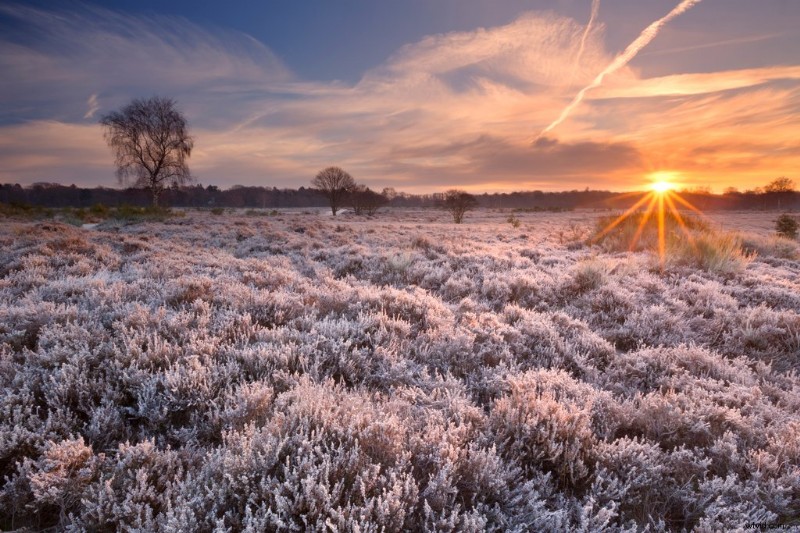
Esteemed cinematographer Emmanuel Lubezki made stunning use of sun stars in the film The Revenant (for which he won the Oscar for Best Cinematography).
Say you’re out filming, you have a beautiful landscape composition lined up, and it’s golden hour, but something doesn’t feel right. Maybe it feels like you’re missing something that gives your composition the wow factor.
Without any additional components, a few sun streaks can visually give the image a more cinematic feeling. As seen in the video tutorial, just a simple shot of an actor walking up a coastal path becomes more cinematic with sun stars.
How to Get Sun Stars
So, how do we get them? I know that we often associate cinematic imagery with a shallow depth of field. But, to produce sun stars, we need to ditch the wide aperture. Instead, use a narrow aperture from f/11 all the way to f/22.
This is because the star streaks are caused by light passing through a small aperture and diffracting across the lens’s aperture blades. When you’re using a narrow aperture—let’s say from f/10 onward—the aperture or the opening is less curved, giving you a more defined edge along with the blades, resulting in a more defined starburst.
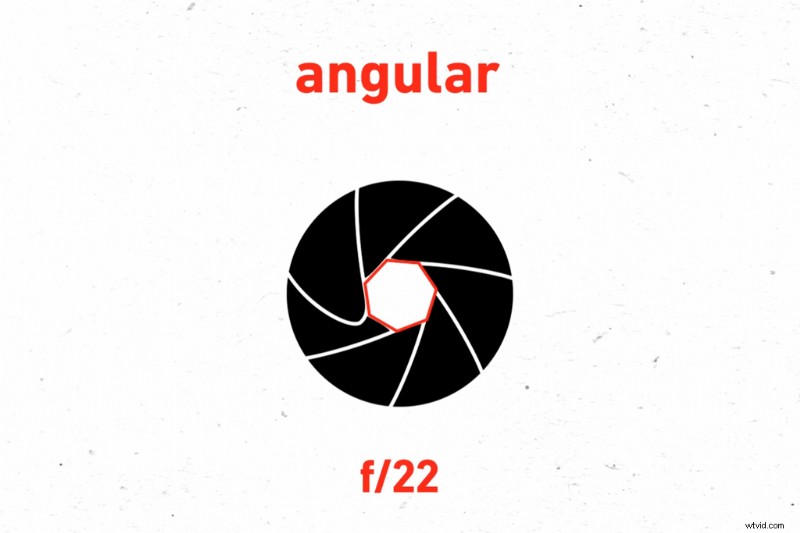
Take a look at the images below. Each shot was filmed at the same time, in the same position, but each image was filmed using a different aperture.
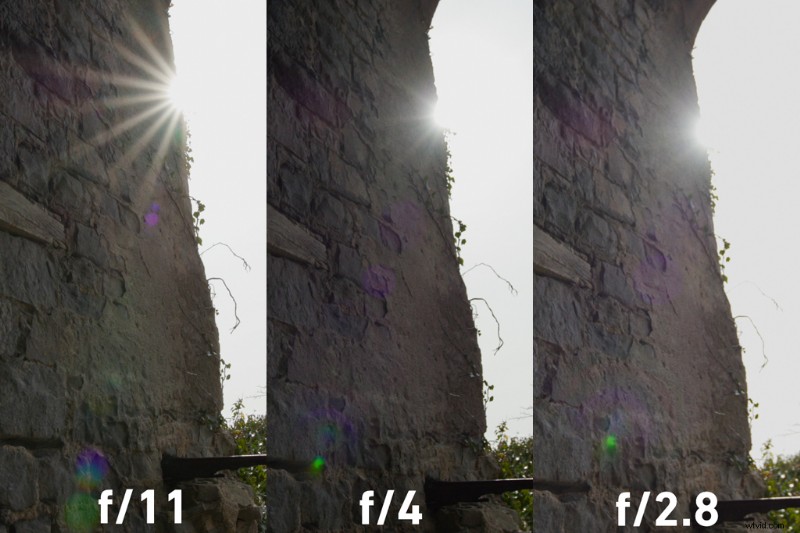
- At f/11, the sun star is well-defined when it comes into view.
- At f/4, the streaks are just noticeable.
- At f/2.8, they hardly exist.
Therefore, it’s pivotal to use a narrow aperture when trying to obtain sun stars. Of course, this will drastically decrease your exposure.
However, when you acknowledge that you’ll only really be filming for sun stars in exterior locations, this becomes less of an issue when the sun is in direct view.
Hide the Sun’s Ever-So-Slight Edges
Setting the aperture beyond f/10 is just one component. The second is having the sun hit the edge of something. This could be a building, tree branches, or even a person’s shoulder.
While, in practice, you could set your aperture to f/16, aim towards the sky, and get some form of visible sun star, the best results come from when the sun is just slightly hidden by something. This is because the star is caused when the sun hits an object, and the light is dispersed from its natural direction, then mixed with the defined edges of the aperture. Combined with the contrast of the foreground object, that will produce a better-looking sun star.
As noticed in various landscape photographs that capture streaks, the sun is slightly behind something. In the case of the picture below, it’s the horizon.
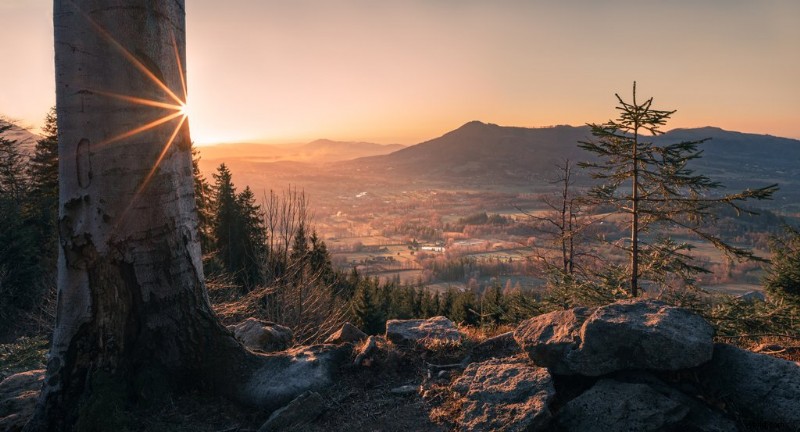
As seen in the video, I often find that some of the better results come from when you move in and out of position to bring the streaks alive.
Watch out for Clouds
Additionally, you don’t want any ambient diffusion from clouds to get the best results. Even if it’s a blue-sky day and cloud cover is minimal, just the softest cloud will spoil the effect.
You need direct sunlight to get the best streaks.
Cover image via Petr Kahanek.