
In the market for a new boom pole? We’ve rounded up key considerations, techniques, and the best boom pole models for any budget.
Lavalier microphones, booms, and on-camera microphones are a few options for capturing audio while filming.
Lav mics are used on actors or during interviews for unobtrusive audio capture and can be good, but they aren’t necessarily suitable for every situation as you need a mic for each person on camera.
Onboard camera microphones are another popular choice, but you’re limited to where you can place your subject/s relative to the camera and the quality isn’t always the best.
On set, you’ll often see a boom operator capturing audio, which is then fed to a sound recordist who will correctly adjust the audio recording levels to suit the scene. A boom can also be fed directly into most cameras, making it a great choice for those with a smaller crew.
Let’s look at different boom pole models, manufacturers, and the accessories that can be a lifesaver on set. We’re also going to discuss some techniques that can help your sound quality and arm fatigue on a long shoot day.
Things to Consider Before Purchasing a Boom Pole
With so many different models and specs on boom poles, it’s essential to consider these key factors when getting ready to purchase.
Length: The length can play a significant factor in a boom pole. Being able to adjust the length quickly and on-the-fly can be crucial for many productions, especially documentary or guerilla-style filming. If you’re in a tight space, you’ll need a boom pole that collapses to a compact size.
Weight: The one thing that’s the same for all boom poles is that an operator will have to hold it, usually above their head, for many hours. So, weight should be a key consideration when purchasing a boom pole.
Boom poles can also be mounted to C-stands for productions that have more interview or static type set-ups, and in that case, weight might not be as important to you.
Internal coiled mic cable: An internal XLR cable to carry the mic signal from the mic to the recording equipment is ideal. Not all boom pole models have this feature built-in, but it can really streamline your setup and reduce the amount of gear and cables you need to carry to set on your shoot day—keeping you a bit more nimble.
Materials: Stability is key—having little to no flex in a pole is vital. We’ve all seen booms creep into the frame. No one likes this. Having a more stable boom pole can help the boom operator immensely.
Imagine the extra muscles it takes to wrangle a boom pole that’s bending and seems to have a mind of its own—making an already difficult job much more difficult.
Comfort and Grip: Think about how you will be working with your boom pole. You’ll want to find something that has solid grip points and offers comfort during use if you’ll be holding it for hours on end. Alternatively, if you plan to mount your boom pole using a C-stand, grips might get in the way.
Compact Boom Pole Recommendations
KE79CCR – K-Tek Avalon Aluminum KE79 Traveler Boom Pole
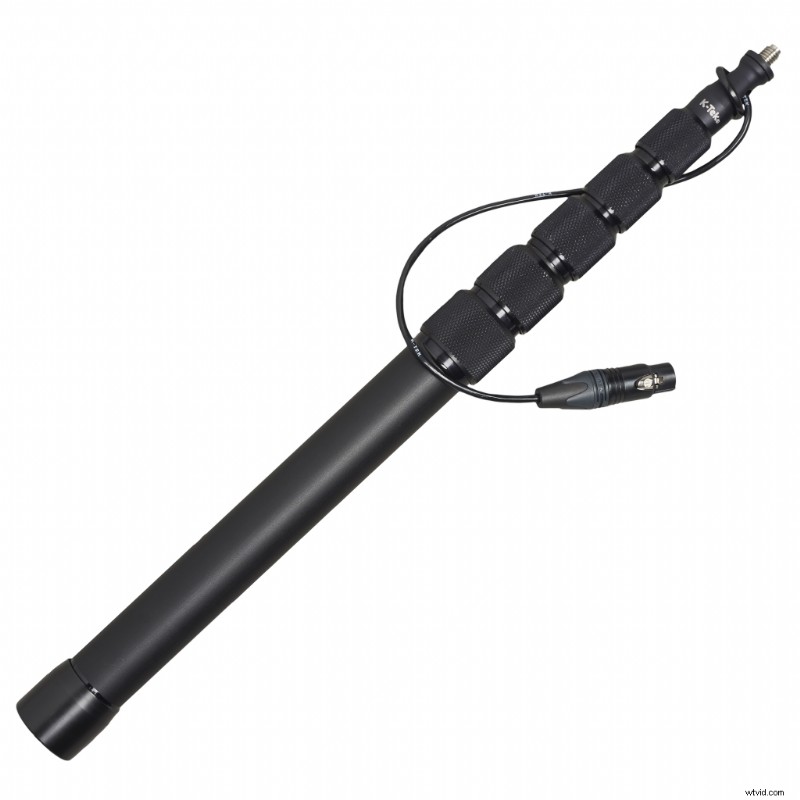
The K-Tek KE-79CCR is an excellent option if a smaller size matters but you’re unwilling to compromise build and material quality.
With six aluminum sections that telescope between 1’8″ – 6’7″ (0.54 – 2.04m), it can easily be stored in any gear bag or case.
The pole also features an internally coiled cable and right-angled XLR connection at the base of the pole, making setup on set a breeze.
KE79CCR – K-Tek Avalon Aluminum KE79 Traveler Boom Pole key specs:
- Collapsed length: 1’8″ (51cm)
- Extended length: 6’6″ (198cm)
- No. of sections: 6
- Product weight: 1.452lbs (659g)
- Top attachment: 3/8″ – 16 male thread
- Bottom attachment: Male 3-pin XLR; Straight exit / right angle options available
More recommendations for compact poles:
- RØDE Mini Boompole
- VDB Pocket QT Boom Pole
Budget Boom Pole Recommendations
Neewer Portable Stretchable Handheld Microphone Boom Pole (NW-7000)
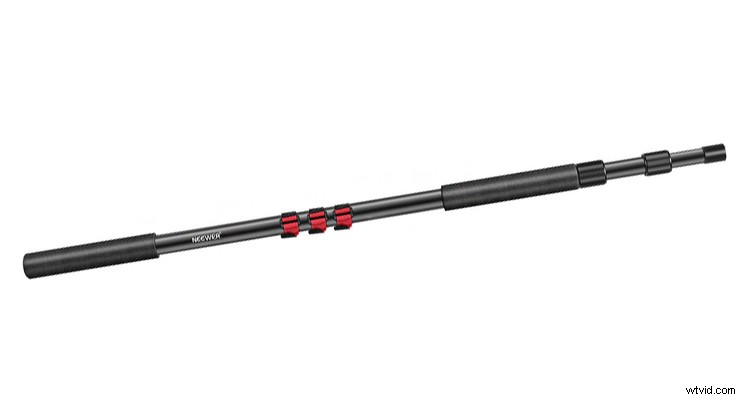
If you’re on a budget or new to the world of booms, then the Neewer NW-7000 is a solid pickup. The NW-7000 is affordable, offers a good range of lengths, and doesn’t feel as if it’s built with super cheap materials. All while offering the best performance vs. price ratio. It’s not a bad-looking design either with its black and red colorway.
Extending from 3ft to 8ft, it should give you all the range you need for any project. These extensions are broken down into three different sections to fit your needs.
Overall, it’s a solid boom pole, especially for newcomers who want something of good quality for a fraction of the premium poles.
Starting with something like this is a smart way to learn and develop your skills; in the future, you can upgrade to something with more features and a more reputable brand.
Neewer Portable Stretchable Handheld Microphone Boom Pole (NW-7000) key specs:
- Standard 5/8″-27 threads with a solid brass male end and internal 3/8″-16 threads.
- Ergonomically spaced and comfortable EVA rubber hand grips. (1) Fixed hand grip at base of the pole, (1) sliding hand grip allows for custom set-ups.
- Three telescopic rods extend the boom length from 3.1-8.1′. Length settings lock/unlock utilizing a twist-and-lock system.
- Made of aluminum alloy, it’s lightweight and reduces operator fatigue associated with longer shoots.
More recommendations for budget poles:
- LyxPro MPL-10
- On-Stage MBP7000
- Koolertron Black-20
Overall Best Boom Pole Recommendations
RØDE Boompole Pro
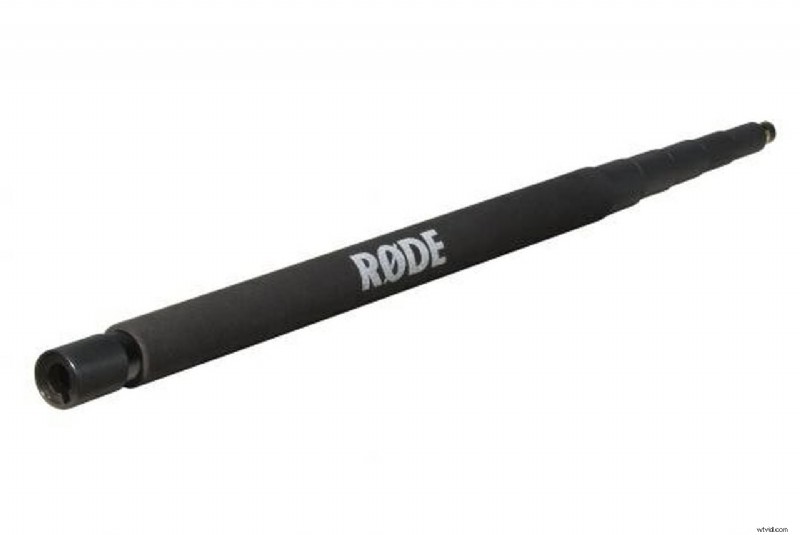
Built with the well-renowned RØDE NTG3 in mind, the Boompole Pro has quickly become a fan favorite within production teams for its high-quality build and materials, strength, little-to-no flex, and weight.
With its ease-of-use, swift extension via a simple twist, and little-to-no lock-ups, the Boompole Pro is a joy to use.
This pole has the perfect combination of weight, size, and durability. Made from carbon fiber, it’s only 535 grams in weight and can extend from 2.7ft to 9.8ft. This is perfect for any situation or microphone setup.
The RØDE Boompole Pro is easily my top recommendation. If you want the best of the best and/or value high-quality materials and professional-grade equipment, then you can’t beat it.
RØDE Boompole Pro key specs:
- Lightweight carbon fiber design
- Suitable for shotgun microphones
- Extends from 2.7 to 9.8.’
- Five sections
- Intuitive twist-lock mechanic
- Weight: 535 Grams / 18 ounces
- Dimensions (mm) 810 (H) x 40 (W) x 40 (D)
Boom Pole Positioning
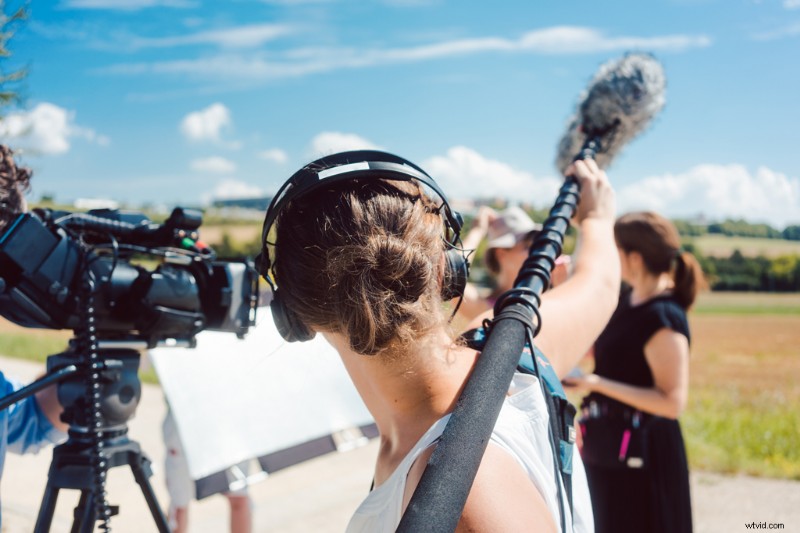
Ideally, you want to be capturing everything the subject is saying. Having the boom angled incorrectly can lead to quiet/muffled audio. To avoid this, hold the boom pole up above the subject out of the camera shot. Aim towards the subject’s face/mouth area and then towards the ground.
Additionally, make sure the boom and microphone aren’t distracting the subject and give them plenty of space to move around freely, if needed.
If you need to boom from below, make sure you switch off anything in the room that could produce vibrations or noise—such as air-conditioning units—to eliminate any background noise within your recording.
Ideally, booming from the side with the microphone front-facing isn’t standard practice, and you’ll most likely not need to do this.
Ambient noise is in a horizontal plane in line with your subject and microphone. Noise will 100% make it into your recording, so avoid this at all costs.
Holding Your Boom Pole Properly
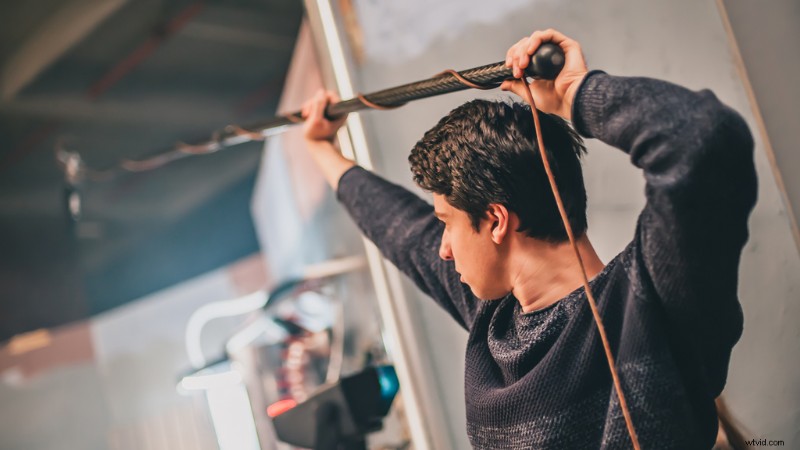
You might think it’s just as simple as lifting the boom arm as high in the air and angling over your subject, which theoretically is true, but following this simple guide will make you maintain focus while not getting fatigued during an all-day shoot.
Boom Pole Cable Management
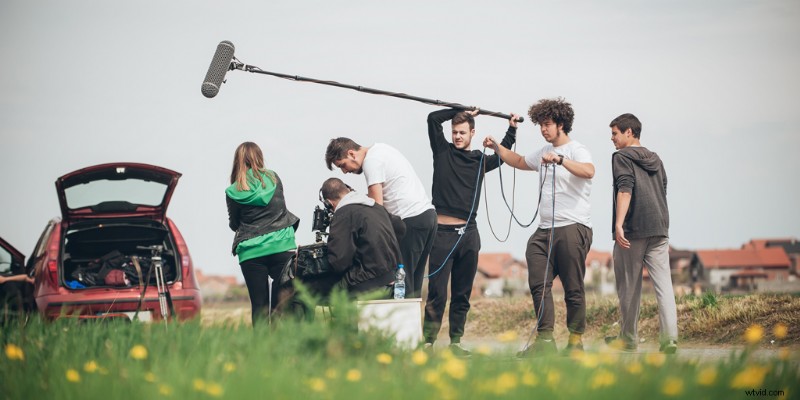
Having proper cable management is key. Even a little bit of unwanted slack attached to a pole can send vibrations to your microphone, especially if you’re swinging the pole around to another subject.
There are booms on the market that let you run your cable internally through the pole, and some are even sold with pre-installed cables already inside them. These cabled boom poles have a coiled audio cable with XLR connectors at each end—ideal for quick setup and tear down.
There are some disadvantages to having a cabled boom pole. It does increase the overall weight through the pole, and you don’t get to choose what type of audio cable type since you’re stuck with what it comes with. Lastly, the cable inside may cause some unwanted rattle, which the microphone could pick up.
Even if you don’t own an internally-cabled boom pole, taking that extra few minutes to tidy and adjust the cable length with little-to-no slack to whatever length your pole will be at could save you from unwanted audio vibrations or problems.
Cover Image via Monkey Business Images.