
For more than nine decades, Canon has redefined the photography landscape. From its modest beginnings as a Japanese response to Leica to its current leadership in full‑frame mirrorless technology, Canon has consistently pushed the boundaries of optics, autofocus, sensor design, and video capability. Its cameras are trusted by photographers, broadcasters, and filmmakers worldwide for their precision, performance, and relentless commitment to creative freedom.
Hansa Canon (1936): Canon’s First Camera
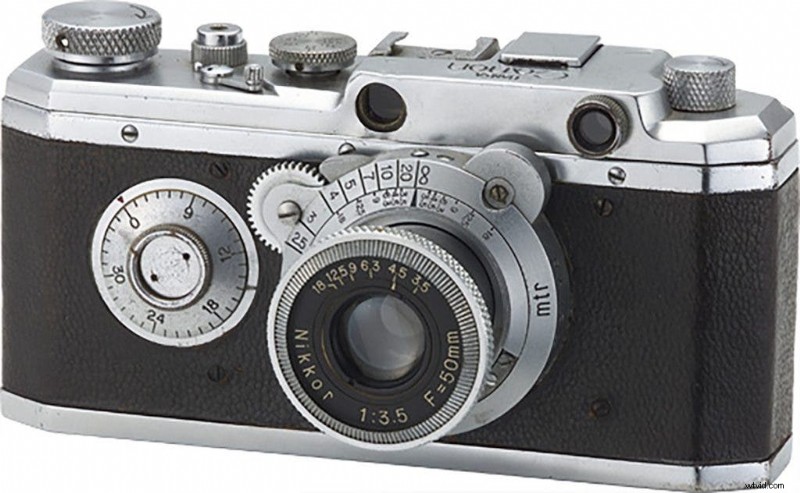
Canon’s journey began in 1933 when a team of Japanese engineers, inspired by German rangefinders such as Leica and Contax, founded the Precision Optical Instruments Laboratory in Tokyo. Their goal: to create Japan’s first 35mm focal‑plane shutter camera. In 1934 they unveiled the prototype “Kwanon,” named after the Buddhist goddess of mercy. Though it never entered the market, the Kwanon marked Canon’s inaugural step toward photographic excellence.
The company’s first commercial release came in 1936 with the Hansa Canon. Developed in partnership with Nippon Kogaku (later Nikon), the Hansa Canon combined Nikon lenses and a Seiki Kogaku‑made rangefinder. Its design closely mirrored Leica cameras while showcasing uniquely Japanese engineering. This collaboration set the tone for Canon’s enduring philosophy of blending European quality with accessible innovation.
Despite wartime disruptions, the Hansa Canon proved Canon’s early capacity for precision and international ambition.
Canon IV Sb (1952): Post‑War Growth
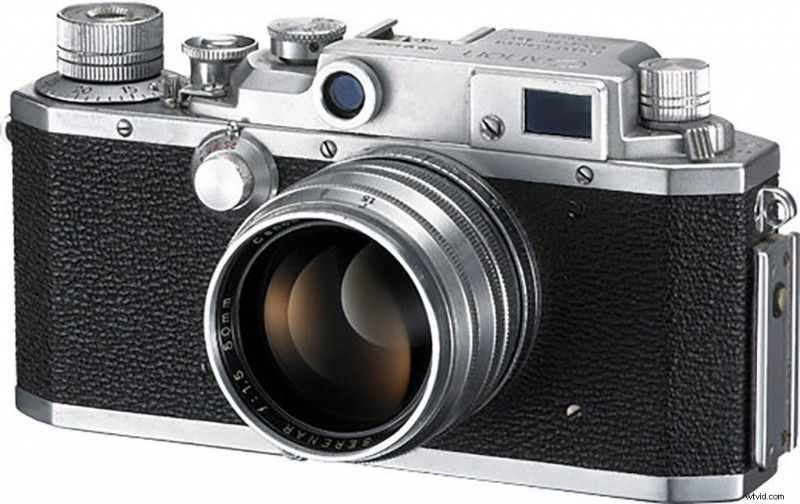
After World War II, Canon rapidly resumed development to meet Japan’s economic resurgence and global demand for high‑quality cameras. The 1952 launch of the Canon IV Sb marked a pivotal moment. It was among the first Canon cameras to feature flash synchronization and introduced a more ergonomic body, setting new standards for reliability and usability in the consumer market.
Critically, the IV Sb was also one of Canon’s first exports to the United States, laying the groundwork for the company’s global expansion. In 1955, Canon opened its first overseas office in New York, cementing its presence in the West and positioning the brand as a viable alternative to established European makers.
While many Japanese manufacturers were still finding their footing, Canon demonstrated it could match—and in many cases surpass—European quality, providing superior value and sparking its transition from rangefinders to SLRs.
Canon F‑1 (1971): The Professional Leap
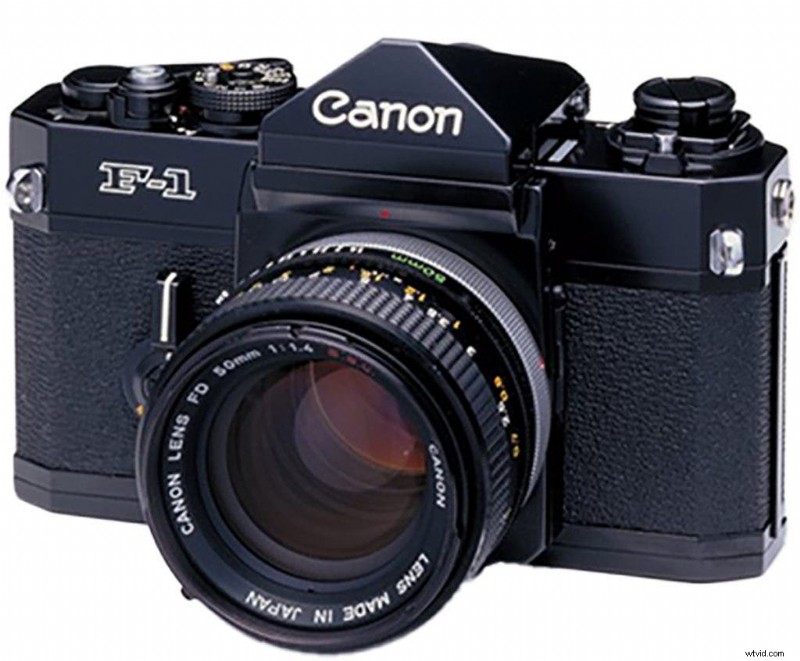
In 1971, Canon entered the professional SLR arena with the Canon F‑1, a rugged 35mm film camera designed to rival Nikon’s F‑series. Built for durability and precision, the F‑1 featured interchangeable viewfinders, focusing screens, motor drives, and data backs.
It was the first Canon camera to adopt the FD lens mount, enabling full‑aperture metering—a technological breakthrough that dramatically improved exposure accuracy. With its solid brass construction, the F‑1 targeted photojournalists, sports photographers, and studio professionals. Canon’s sponsorship of the 1976 Montreal Olympics showcased the F‑1’s reliability under extreme conditions.
Beyond performance, the F‑1 signaled Canon’s emergence as a serious contender in professional photography. Its modularity and expanding FD lens lineup gave professionals the flexibility they needed, establishing a legacy that would evolve into today’s EOS R and Cinema EOS series.
Canon AE‑1 (1976): Technological Revolution
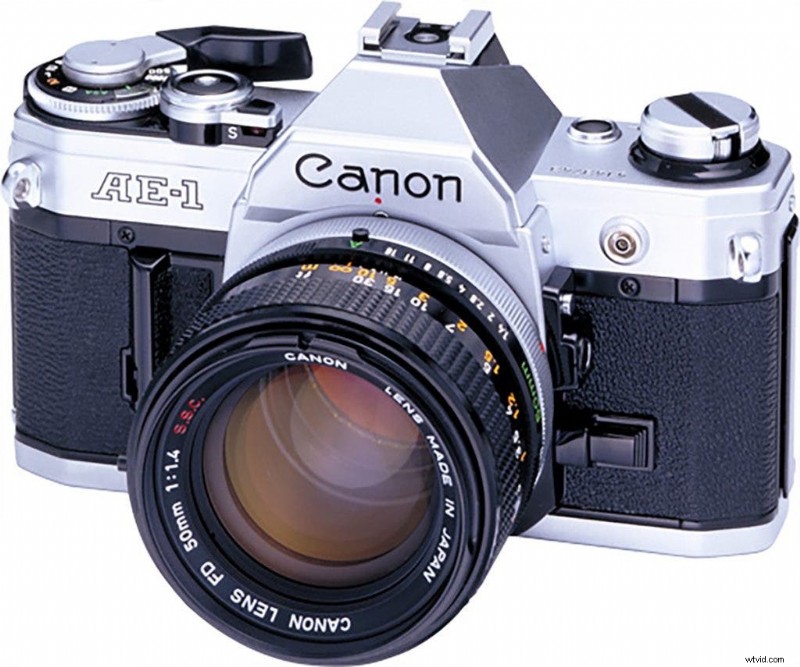
Canon disrupted the industry with the 1976 AE‑1, the world’s first 35mm SLR equipped with a built‑in microprocessor. This landmark innovation introduced shutter‑priority auto‑exposure and digital control to a generation of photographers, democratizing high‑quality imaging for amateurs and aspiring professionals alike.
The AE‑1’s compact design, intuitive controls, and affordable price helped Canon sell over five million units worldwide—an astonishing figure for the era. Its compatibility with the FD lens ecosystem further strengthened customer loyalty.
Strategic marketing amplified its impact: campaigns featuring celebrities and athletes positioned the AE‑1 as the camera for everyday creators. The model proved that cutting‑edge technology could be accessible and cost‑effective—a philosophy that continues to guide Canon’s design ethos.
PowerShot 600 (1996) and EOS D30 (2000): Canon’s Digital Dawn
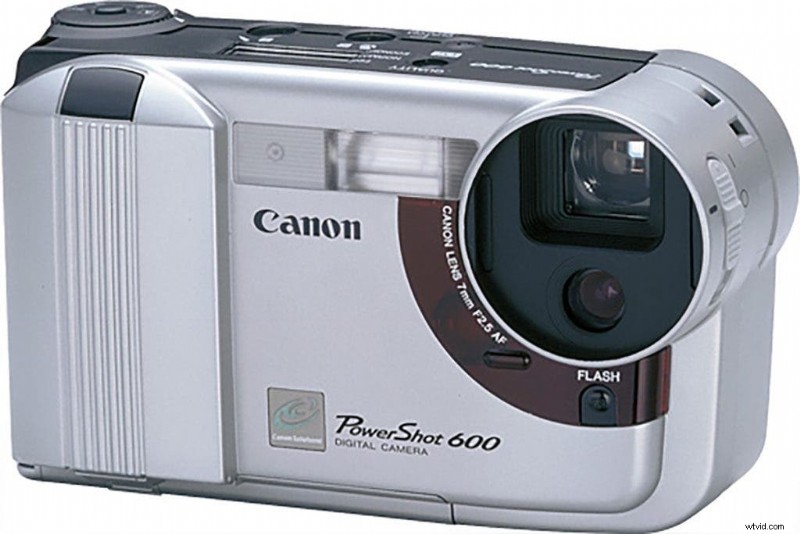
Canon entered the digital age with the 1996 PowerShot 600, a modest 0.3‑megapixel consumer camera that signaled its commitment to digital imaging. The 2000 release of the EOS D30—Canon’s first in‑house digital SLR—introduced a 3.1‑MP APS‑C CMOS sensor, distinguishing itself from competitors using CCDs. Canon’s investment in CMOS technology would later underpin its dominance in sensor performance, especially in low‑light and power efficiency.
The D30 targeted serious enthusiasts and professionals transitioning from film, laying the foundation for Canon’s subsequent DSLR successes throughout the 2000s.
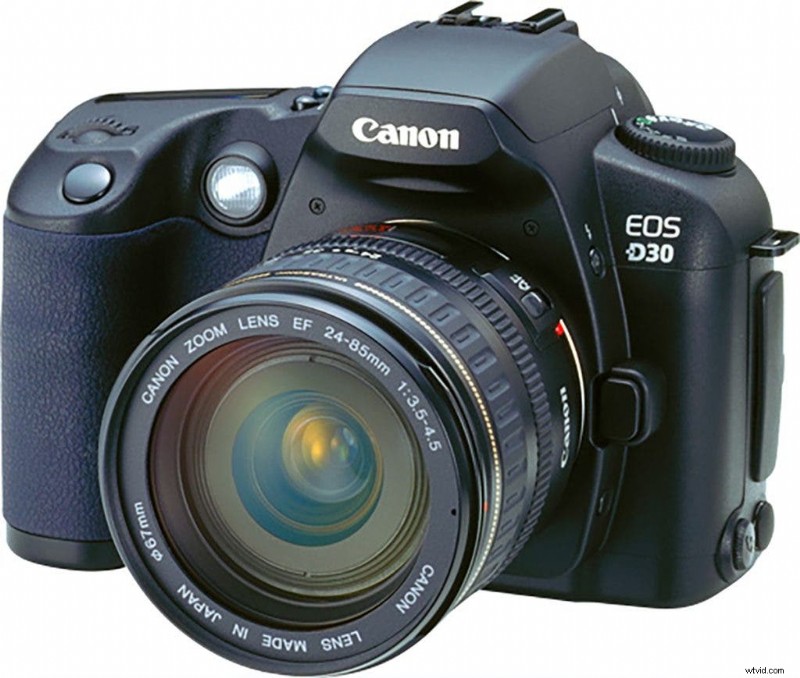 Editor’s note: This was my first DSLR! – Daniel
Later releases such as the EOS 10D, 20D, and the highly popular EOS 5D series brought full‑frame digital imaging to mainstream audiences. Meanwhile, Canon expanded into high‑end video with its Cinema EOS line, gaining traction among filmmakers. These milestones demonstrated Canon’s ability to not only keep pace with industry shifts but to lead them—a pattern that persists in the mirrorless era.
EOS R5 Mark II (2024): The Flagship
Today, Canon’s flagship mirrorless camera is the EOS R5 Mark II—a full‑frame powerhouse built on the RF‑mount system. The R5 Mark II builds on the acclaimed R5, featuring a 45‑megapixel stacked CMOS sensor, dual DIGIC X processors, and a new DIGIC Accelerator. This architecture enables advanced in‑camera AI upscaling to 180 MP, meeting the needs of commercial photographers and wildlife shooters who demand high‑detail cropping.
The autofocus system boasts over 1,000 focus zones with AI‑based subject detection, recognizing humans, animals, vehicles, and even insects. With 30 fps continuous shooting, 8.5 stops of image stabilization, and 8K internal RAW video recording, the R5 Mark II serves hybrid creators who require top‑tier performance in both stills and video.
Durability, heat management, and intuitive controls round out its professional features. Coupled with Canon’s expanding RF‑lens lineup, the R5 Mark II embodies the brand’s commitment to leading imaging technology while delivering reliability and creative freedom.
A Legacy of Innovation and Excellence

From the handcrafted Kwanon prototype to the ultramodern EOS R5 Mark II, Canon’s evolution reflects relentless innovation and visionary thinking. Over the decades, Canon has introduced breakthroughs in optics, automation, sensor design, and video capability. Its cameras have documented Olympic Games, historical events, wars, personal memories, and everything in between.
Canon democratized photography with the AE‑1, elevated it with the F‑1 and EOS‑1D series, revolutionized digital imaging, and now redefines creative expression with RF‑mount mirrorless systems. Through it all, Canon remains true to its mission: helping people capture and preserve the world with clarity, creativity, and confidence.
Sources
Adorama – First Look: EOS R5 Mark II

Amy Touchette
Amy Touchette is a Brooklyn‑based photographer specializing in street portraits. A graduate of the International Center of Photography—where she now teaches—her work has been exhibited internationally, including the National Portrait Gallery in London and MoMA‑Moscow. She has been published in Women Street Photographers (Prestel, 2021) and The New York Times. BuzzFeed described her as a “master of street photography in the busiest of concrete jungles, New York City.” Her second monograph, Personal Ties: Bed‑Stuy, Brooklyn (Schilt Publishing, 2022), was shortlisted for the Lucie Photo Book Award and made the Critical Mass 2021 Top 50. She is represented by Clamp in NYC and Little Big Galerie in Paris, France.