
Over a century ago, Hollywood was a fledgling industry. Today, blockbusters vie for billions while studios pivot between theatrical releases and streaming platforms. That complex landscape evolved from a time when a handful of studios held a near‑complete monopoly.
During the Golden Age, five major studios—MGM, RKO, 20th Century‑Fox, Warner Bros., and Paramount—controlled production, distribution, and exhibition. They owned state‑of‑the‑art facilities, locked talent in long‑term contracts, and drove technological breakthroughs such as sound, color, and widescreen formats.
We’ll explore the era’s origins, its most influential studios, the forces that eroded its dominance, and the lasting innovations that shaped modern cinema.
When Did the Golden Age of Hollywood Begin?
There is no single starting point, but 1915’s The Birth of a Nation is often cited as a watershed moment. Mass production and widespread appeal, however, truly accelerated in the 1920s and 1930s.
The Great Depression forced Americans into theaters as affordable escapism. Historian data show up to 80 million viewers per week during the 1930s, illustrating cinema’s cultural dominance.
By 1939, technological advances in sound, color, and cinematography produced classics like The Wizard of Oz, Gone with the Wind, and Mr. Smith Goes to Washington. The 1920s–1930s outpaced any later decade in the sheer volume of releases.
The Golden Age’s decline began around 1948, culminating in the 1960s.
The “Big Five” Major Studios
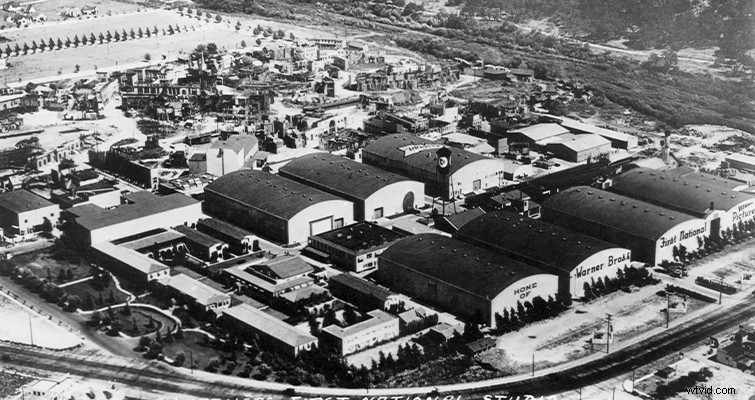
Vertical integration gave the Big Five absolute control: they owned studios, equipment, talent, distribution, and exhibition. This structure enabled unparalleled output and financial success.
MGM
 Image: Original Slats the lion logo via MGM.
Under Louis B. Mayer, MGM dominated the box office in the 1930s. Its “star system” locked legends such as Clark Gable, Greta Garbo, Judy Garland, and Gene Kelly. At its peak, the studio ran 16–18 productions simultaneously, boasting six lots and over 40 cameras.
Notable MGM films:
- The Merry Widow (1925)
- The Big Parade (1925)
- La Bohème (1926)
- The Scarlet Letter (1926)
- The Patsy (1928)
- Perfect Day (1929)
- The Kiss (1929)
- Freaks (1932)
- Mutiny on the Bounty (1935)
- A Night at the Opera (1935)
- The Wizard of Oz (1939)
- Gone with the Wind (1939)
- The Philadelphia Story (1940)
- Gaslight (1944)
- An American in Paris (1951)
- Singin’ in the Rain (1952)
- Forbidden Planet (1956)
- Cat on a Hot Tin Roof (1958)
- Ben‑Hur (1959)
- North by Northwest (1959)
- The Time Machine (1960)
- Lolita (1962)
- How the West Was Won (1962)
Twentieth Century‑Fox
 Image: Opening logo via 20th Century Studios.
Formed in 1935 from Fox Films and Twentieth Century Pictures, Fox rivaled MGM in profitability. Leaders Darryl F. Zanuck and Joseph M. Schenck steered a roster that included Tyrone Power, Gene Tierney, and Shirley Temple.
Notable Fox films:
- The Little Colonel (1935)
- Les Misérables (1935)
- Charlie Chan in Shanghai (1935)
- White Fang (1936)
- Rawhide (1938)
- The Little Princess (1939)
- Young Mr. Lincoln (1939)
- The Adventures of Sherlock Holmes (1939)
- The Grapes of Wrath (1940)
- Rebecca (1940)
- The Mark of Zorro (1940)
- How Green Was My Valley (1941)
- A Tree Grows in Brooklyn (1945)
- Miracle on 34th Street (1947)
- All About Eve (1950)
- The Day the Earth Stood Still (1951)
- The Robe (1953)
- The King and I (1956)
- The Diary of Anne Frank (1959)
- The Hustler (1961)
- The Longest Day (1962)
- Something’s Got to Give (1962)
- Cleopatra (1963)
- The Sound of Music (1965)
Warner Bros.
 Image: Opening logo of The Jazz Singer via Warner Bros.
Warner Bros. pioneered sound with The Jazz Singer (1927). The studio’s early success in musical and gangster films paved the way for stars like Humphrey Bogart and Bette Davis.
Notable Warner Bros. films:
- Where the North Begins (1923)
- Don Juan (1926)
- The Jazz Singer (1927)
- The Desert Song (1929)
- Looney Tunes (1930)
- Merrie Melodies (1931)
- Little Caesar (1931)
- The Public Enemy (1931)
- 42nd Street (1933)
- Gold Diggers of 1933 (1933)
- A Midsummer Night’s Dream (1935)
- G Men (1935)
- Kid Galahad (1937)
- Angels with Dirty Faces (1938)
- The Adventures of Robin Hood (1938)
- Dodge City (1939)
- The Maltese Falcon (1941)
- High Sierra (1941)
- The Strawberry Blonde (1941)
- Casablanca (1942)
- Yankee Doodle Dandy (1942)
- The Big Sleep (1946)
- The Treasure of the Sierra Madre (1948)
- White Heat (1949)
- A Streetcar Named Desire (1951)
- Rebel Without a Cause (1955)
- Rio Bravo (1959)
Paramount Pictures
 Image: Original opening logo via Paramount Global.
Founded in 1912 by Adolph Zukor, Paramount pioneered block booking—bundling films to secure theater distribution. This practice contributed to the landmark 1948 antitrust case.
Notable Paramount films:
- Wings (1927)
- The Love Parade (1929)
- Tom Sawyer (1930)
- Morocco (1930)
- Huckleberry Finn (1931)
- Dr. Jekyll and Mr. Hyde (1932)
- Movie Crazy (1932)
- A Farewell to Arms (1932)
- Duck Soup (1933)
- Alice in Wonderland (1933)
- Cleopatra (1934)
- Hop-a-Long Cassidy (1935)
- Gulliver’s Travels (1939)
- Road to Singapore (1940)
- Hold Back the Dawn (1941)
- Double Indemnity (1944)
- Sunset Boulevard (1950)
- The Greatest Show on Earth (1952)
- Shane (1953)
- Roman Holiday (1953)
- The War of the Worlds (1953)
- Rear Window (1954)
- White Christmas (1954)
- Sabrina (1954)
- The Man Who Knew Too Much (1956)
- The Ten Commandments (1956)
- Vertigo (1958)
- Psycho (1960)
- Breakfast at Tiffany’s (1961)
- The Man Who Shot Liberty Valance (1962)
RKO
 Image: Opening logo via RKO Pictures LLC.
RKO Radio Pictures emerged in 1928 from a merger of RCA’s theater chain and Joseph P. Kennedy’s studio. It produced landmark films like King Kong and Citizen Kane and distributed Disney’s first feature, Snow White and the Seven Dwarfs.
RKO also dominated musical‑dance with Fred Astaire and Ginger Rogers and later ventured into horror and noir.
Notable RKO films:
- The Vagabond Lover (1929)
- King Kong (1933)
- Little Women (1933)
- Top Hat (1935)
- Swing Time (1936)
- Snow White and the Seven Dwarfs (1937)
- Bringing Up Baby (1938)
- Room Service (1938)
- The Hunchback of Notre Dame (1939)
- Pinocchio (1940)
- Citizen Kane (1941)
- Dumbo (1941)
- The Pride of the Yankees (1942)
- Tarzan and the Amazons (1945)
- The Bells of St. Mary’s (1945)
- Dick Tracy (1945)
- It’s a Wonderful Life (1946)
- Notorious (1946)
- Fort Apache (1948)
- Treasure Island (1950)
- Cinderella (1950)
- The Thing from Another World (1951)
- Alice in Wonderland (1951)
- Oklahoma! (1955)
The “Little Three” Studios
Universal, Columbia, and United Artists had less vertical integration but were pivotal players.
Universal Pictures
 Image: Opening logo via Universal Pictures.
Founded in 1912, Universal created Universal City Studios in 1915—the world’s largest production facility. It pioneered star promotion with Florence Lawrence and King Baggot and became synonymous with horror classics featuring Lon Chaney, Boris Karloff, and Bela Lugosi.
Notable Universal films:
- 20,000 Leagues Under the Sea (1916)
- Foolish Wives (1922)
- The Hunchback of Notre Dame (1923)
- The Phantom of the Opera (1925)
- All Quiet on the Western Front (1930)
- King of Jazz (1930)
- Dracula (1931)
- Frankenstein (1931)
- The Mummy (1932)
- The Invisible Man (1933)
- Imitation of Life (1934)
- Show Boat (1936)
- Three Smart Girls (1936)
- The Green Hornet (1940)
- Flash Gordon Conquers the Universe (1940)
- Hamlet (1948)
- It Came from Outer Space (1953)
- Creature from the Black Lagoon (1954)
- Spartacus (1960)
- To Kill a Mockingbird (1962)
- The Birds (1963)
Columbia Pictures
 Image: Opening logo via Columbia Pictures Industries, Inc.
Founded in 1918, Columbia gained acclaim with screwball comedies, westerns, and the Three Stooges shorts. Director Frank Capra propelled the studio to prominence with It Happened One Night.
Notable Columbia films:
- Lady for a Day (1933)
- The Three Stooges (1934)
- It Happened One Night (1934)
- Mr. Deeds Goes to Town (1936)
- Mr. Smith Goes to Washington (1939)
- Only Angels Have Wings (1939)
- The Lady in Question (1940)
- Meet John Doe (1941)
- Batman (1943)
- The Phantom (1943)
- The Lady from Shanghai (1947)
- All the King’s Men (1949)
- From Here to Eternity (1953)
- On the Waterfront (1954)
- The Bridge on the River Kwai (1957)
- 3:10 to Yuma (1957)
- Anatomy of a Murder (1959)
- Lawrence of Arabia (1962)
- Bye Bye Birdie (1963)
United Artists
 Image: Opening logo via United Artists Digital Studios.
Founded in 1919 by Chaplin, Griffith, Pickford, and Fairbanks, United Artists offered actors control over their work. After a series of leadership changes, the studio achieved success with films like Stagecoach and later with the Beatles, Pink Panther, and James Bond.
Notable United Artists films:
- His Majesty, the American (1919)
- Pollyanna (1920)
- The Mark of Zorro (1920)
- Robin Hood (1922)
- Steamboat Bill, Jr. (1928)
- City Lights (1931)
- Scarface (1932)
- Mr. Robinson Crusoe (1932)
- The Count of Monte Cristo (1934)
- A Star Is Born (1937)
- Stagecoach (1939)
- Wuthering Heights (1939)
- The Great Dictator (1940)
- Marty (1955)
- 12 Angry Men (1957)
- Some Like It Hot (1959)
- The Magnificent Seven (1960)
- The Apartment (1960)
- The Alamo (1960)
- The Manchurian Candidate (1962)
- Dr. No (1962)
- The Great Escape (1963)
- It’s a Mad, Mad, Mad, Mad World (1963)
Factors Accelerating the Decline
The Hays Code
The voluntary Production Code enforced in 1934 imposed strict moral guidelines. While studios resisted initially, the code gradually limited creative freedom and contributed to audience fatigue.
United States v. Paramount Pictures
The 1948 antitrust ruling dismantled vertical integration, forcing studios to divest theater chains. The Paramount Decrees catalyzed the rise of independent producers and art‑house venues, eroding the studios’ monopoly.
The Rise of Television
Post‑war suburban growth and affordable color sets made TV ubiquitous by the 1960s. With audiences moving home, studios pivoted to television production and licensing, further weakening their theatrical dominance.
Legacy of the Golden Age
Technological and artistic innovations born in this era—synchronised sound, 24 fps frame rate, Technicolor, studio lighting, the three‑act structure, widescreen formats, and early 3D—continue to underpin contemporary filmmaking.
These contributions cement Hollywood’s status as a global cultural powerhouse and demonstrate how the Golden Age set the standards for modern cinema.