
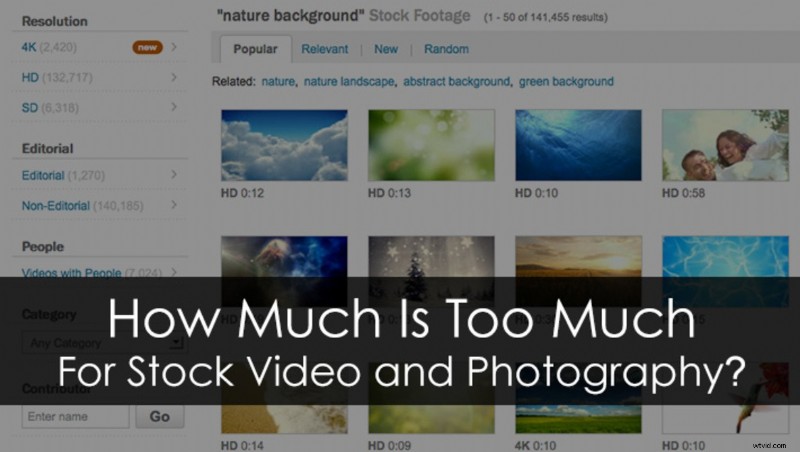
Most of the readers of this site I’d wager fall into the category of content creators, not content consumers. That being the case, rants about not being properly compensated for the hard work put in to producing images comes up every so often. But have you ever been on the other side of that situation?
For those of us who want to do the right thing and acquire media legally and ethically, downloading from a google image search won’t cut it. Sure, no one cares when you embed dancing baby gifs on your mom's website or geocities page, but when you’re putting together a project (regardless of budget) that stands to have a bit more attention, enter stock image and video providers.
As a video editor, I’ve had to purchase stock media clips for corporate projects on numerous occasions. Flyovers of smokestacks or underwater welding were requested the by the client, and they weren’t looking to spend thousands of dollars to have me capture original footage (even though I have my SCUBA certification!) Finding and purchasing a clip from a stock website was a piece of cake.
Before I go further though, not all projects are created equal. In today’s world of affordable gear and online tutorials, anyone with a DSLR is a so-called filmmaker. Professionals and enthusiasts are both undertaking passion projects on their own dime and time, and while it waters down the industry a bit, I think it’s pretty cool to see so many people getting psyched to make films.
What got me really thinking about stock media was an article on Fstoppers about a week ago, noting that a media company called British Pathé released 85,000 newsreels onto YouTube for everyone and anyone to watch, or embed on their website. They also license clips for personal and other uses. I explored their library and discovered some great newsreels from the 1950s that would go great in a documentary that I’m self producing. The cost?
$2,619.73 per minute.
To elaborate, just one minute of newsreel footage, regardless of which clip it was, would cost me over $2,500 for usage in perpetuity, as an online stream only (worldwide.) So basically if I bought a clip for a video project destined to be only on YouTube, and just like their content library would be freely viewable, that clip would cost me more than a brand new 24-70 L II lens.
What British Pathé offers is a bit different from typical stock media, so this might be an apples to oranges comparison... In that case, you know what the Pathé media is actually more like? Public domain news reels, which are often clear to use non-commericially or come with a CC license.
To explore a little deeper into stock media price justification, I visited some of my go-to stock media sites and tried to gauge their pricing models.
Artbeats was simple, but offered no adjustment based on reach, usage, or budget. Their clips were royalty-free, and ranged from $200-$500 depending on the resolution you want (sometimes up to 4k.)
I found that iStockPhoto was close to Artbeats in options and pricing. Video clips were $100-$300 depending on resolution, ranging from 640x360 to full HD.
Shutterstock seemed to be the most affordable of the group, with plenty of HD media at about $80 for a single, royalty-free clip. Again, no specific options, just a single blanket license.
Getty presented the most unique offering. They have pricing for Rights-Managed (or Rights-Ready) and Royalty-Free. RF is a straight forward, but rather expensive set of costs for the clip in question, while RM lets you specify your needs and use, thus determining a price.
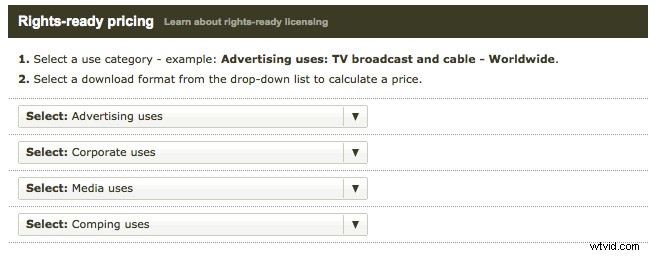
Depending on the selections, I could use a clip for as little as $230 in a web video, or $7,000 as part of a commerical advertisement. This is a fantastic approach and I’d love to see other media providers with options that gauge the facets of what you need a license for. $230 isn't the cheapest, but it's actually possible to afford compared to thousands of dollars.
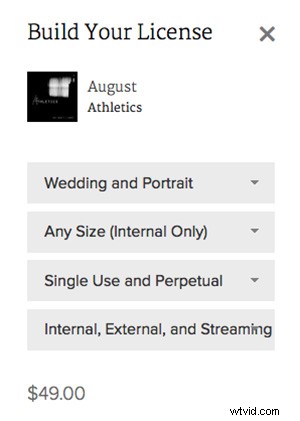
I’ve started to see stock music sites using this approach, and it so happens that music is the media I purchase the most, both personally and professionally. I wrote an article a few years ago about the best sites for both pay and non-pay music, and I still reference it today. Look through those and you will see that the quality often matches the cost, with the free or CC licensed options being “just OK.” One of my favorite pay sites is The Music Bed, and while the songs aren’t free for personal projects, they actually inquire into what your budget is, which can make it a bit more affordable for starving artists such as ourselves.
Besides the aforementioned, I don’t see too many sites vetting a project's budget, or specifying use. I suppose it is easier to just sell media as royalty free and slap a price tag on it without other options for custom licenses or usage restrictions. To me, that’s a glaring omission, especially in today’s world of sites like Vimeo and YouTube, where literally thousands of content creators make interesting work, and share it FOR FREE.
Back to the question though– How much is too much for stock media? My corporate clients either budget for it when they need it, or I simply pass on the cost at the time of purchase. What about the self-financed filmmaker who wants to make a short documentary about green technology is his community, just because he thinks it is an important issue and he enjoys filmmaking? I'm seeing more and more of this type of creative poking around with their camera. So that begs the question: when doing a personal project, do you have any options besides scouring the web for Creative Commons licensed media? CC is fantastic for those creators who don’t have the money to purchase media for non-commerical or otherwise personal work. Have you ever used CC-licensed media? Searching for something decent isn’t always easy, and in the end I often find myself settling on an image or music track that is “just OK,” and rarely “great.” You might think that you get what you pay for, but I just don't think it's that simple.
So, here I sit complaining about the cost of media, when I’m a producer of the exact same kind of content. Am I hypocrite for doing that? I don’t think so, but as a purchaser and creator I understand both sides– and when there is a value and when there isn’t– something most stock sites seem to only loosely grasp. I'd be perfectly willing to license a photo or video clip at a huge break, or even for free, when I know that the project it will end up in is only destined for free public consumption in a short online film (or some other limited, free to the public venue.)