
Fire looks great on camera, but capturing it effectively is more difficult than igniting something and pressing record. Here’s what you need to know.
As the DP on Salem for three years, I gained a ton of experience working with fire as lighting sources on a daily basis. In this video, “Lighting with Fire,” I’ll share one of the most surprising aspects of using fire on the TV series. And that is . . . how dim fire actually is.
Fire is very bright to the eye, but it doesn’t project very far because of the unstructured nature of its light rays. As a result, you need fast lenses and a high ISO setting to get a reasonable exposure. Fortunately, we had both. Panavision “P Vintage” high speed lenses and the incomparable ARRI Alexa HD camera system. There were many times we shot at f 1.4 at 1600 ISO with a 270-degree shutter angle. That’s a setup for a dark world! The other challenge was to create an ambient base that didn’t feel too modern. My Gaffer Peter Clarson and I designed super soft, snooted boxes that used household incandescent bulbs that we then projected through muslin diffusion cloth. These worked great, and we made several of them of various intensities.
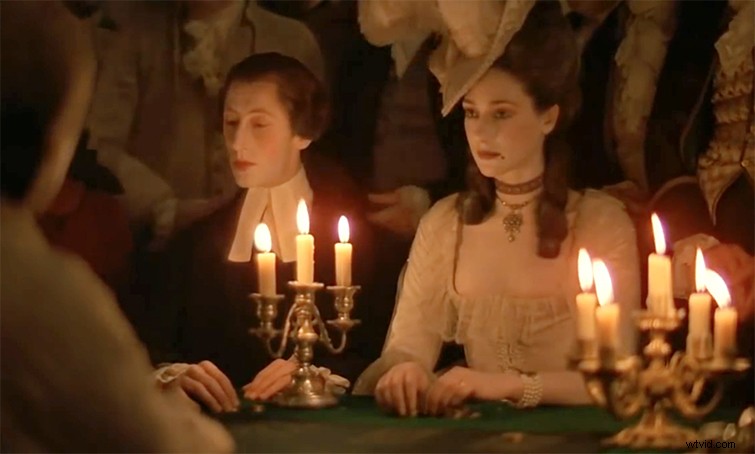
In the video, I also spend some time revealing the techniques used to photograph Stanley Kubrick’s Barry Lyndon. Film stocks were still slow in 1975, so DP John Alcott, BSC pushed his 100 ISO color negative one stop in the lab. By today’s standard, 200 ISO is considered very slow, but Alcott also had a revolutionary f .7 50mm spherical lens! (For a quick reminder, here is the progression of f stops from f 5.6 on down: 5.6, 4, 2.8, 2, 1.4, 1, 0.7.) Shooting at f .7 at 200 ISO is equal to f 1.4 at 800 ISO. They also used multiple-wick candles — far brighter than the usual store-bought ones.
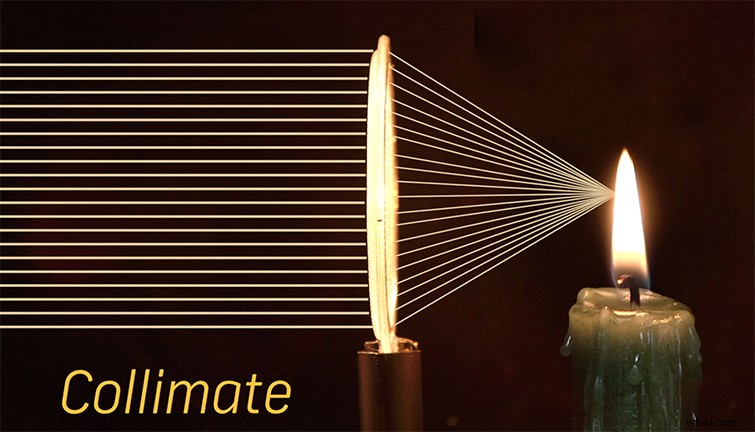
I also spend some time on how fresnel lenses add power to lanterns in lighthouses by “collimating” the light rays. You can demonstrate this with an old brass “boat signal” fitted with a simple Fresnel lens. Fresnel lenses have been the integral optical component to movie lights for 100 years.
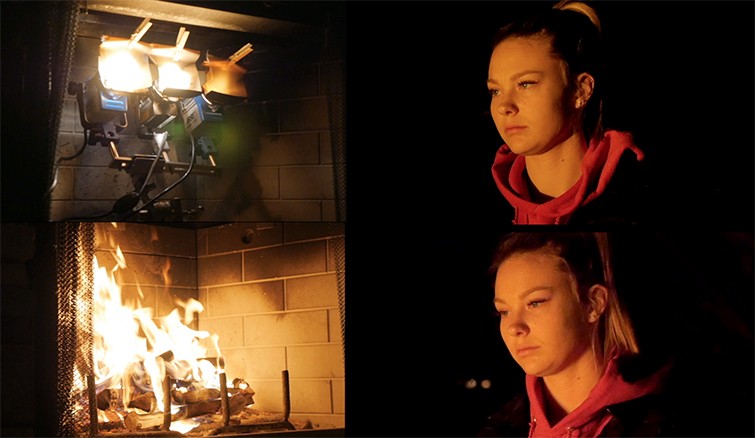
Finally, I talk about how we used flicker boxes and 3 small 150W fresnel lamps to substitute the fire light when the fireplace is off camera. The quality of the light is superior, it’s quiet, and the set stays much cooler.
If you haven’t filmed with fire as a light source, don’t be surprised by how dim it is. It’s why I stress shooting some tests before you begin your project.
Good Luck, and don’t forget a fire extinguisher!