
Starships as Dynamic Set Pieces
In science‑fiction cinema, starships are more than backdrop—they shape plot, character, and world‑building. Crafting a believable vessel requires careful attention to propulsion, life support, aesthetics, and narrative function.
Why Starships Matter
Beyond the thrill of interstellar travel, a starship becomes a character in its own right. It influences crew dynamics, determines pacing, and can even drive the story’s emotional core. A well‑designed ship feels like a living organism that the audience can trust.
Design Fundamentals
While each universe sets its own rules, several core concepts recur across franchises:
- Propulsion – Whether warp, hyperdrive, or fusion, the engine determines speed, safety, and visual language.
- Fuel & Power – Fuel type and capacity create narrative tension and realism.
- Gravity & Habitability – Artificial gravity or lack thereof shapes interior design and crew behavior.
- Structural Integrity – How a ship survives atmospheric entry, radiation, and battle damage.
These principles guide both practical effects and digital design, ensuring coherence across a production.
Propulsion Design
Scope dictates propulsion choices. Galaxy‑spanning stories demand faster‑than‑light (FTL) systems such as Star Trek’s warp drive or Star Wars’ hyperdrive. Solar‑system narratives like The Expanse rely on efficient fusion engines that still require realistic travel times.
Example: Event Horizon features a reactor located far from crew quarters, a standard for high‑power engines that would otherwise expose personnel to hazardous radiation. 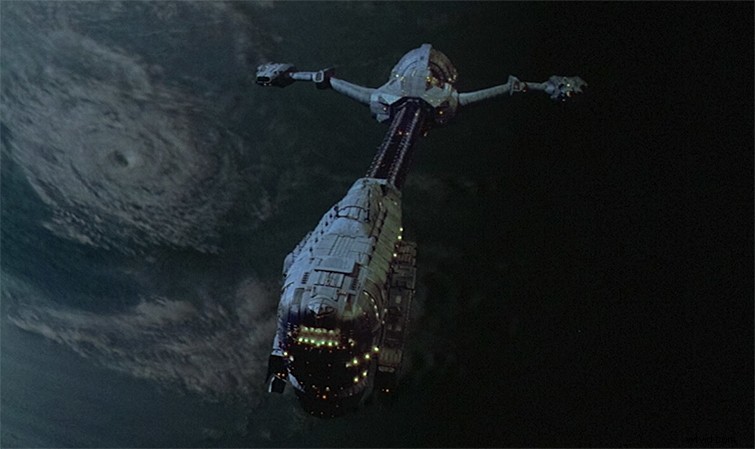 The Event Horizon’s reactor is positioned far from the primary crew quarters. (Image via Paramount.)
Fuel
Fuel strategy adds urgency. In The Expanse, the Epstein Drive uses fusion pellets—efficient but finite—creating story stakes when supplies dwindle. Even in short‑range missions, sub‑FTL engines consume fuel, reinforcing the need for resource management.
Example: Icarus II from Sunshine requires a one‑mile heat shield for solar entry, illustrating form directly serving function. 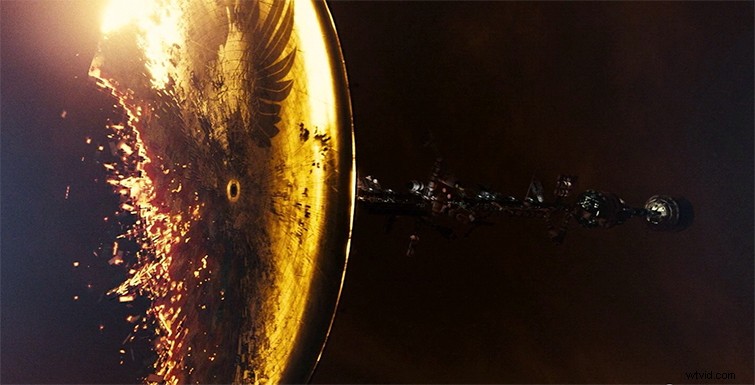 Icarus II’s design follows its singular mission to the sun. (Image via Fox Searchlight.)
Gravity
Artificial gravity varies by realism level. The Expanse uses magnetic boots because spin‑generated gravity is impractical. Other films default to ambient gravity for narrative simplicity, sometimes depicting failures for dramatic effect.
Example: The Midnight Sky rotates its Aether module to simulate gravity, but such rotating sections often face plot‑driven breakdowns. 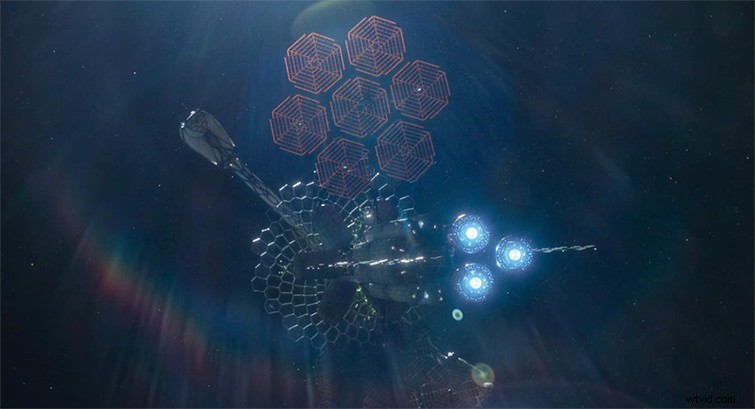 In The Midnight Sky, the Aether’s rotating module creates artificial gravity. (Image via Netflix.)
Structural Considerations
Planetary excursions demand sturdy hulls that withstand atmospheric re‑entry. The Hermes from The Martian was assembled in orbit, avoiding the catastrophic stresses of a single‑piece launch. Similarly, Serenity from Firefly can hop between planets, showcasing a versatile structural design.
Example: Hermes is engineered for space assembly, not gravity‑based operations. 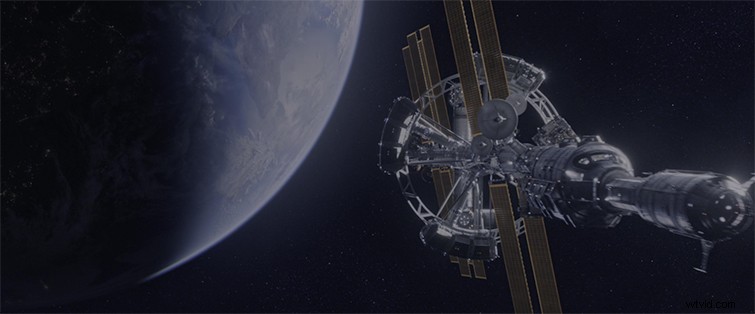 Hermes was built in space and not intended for gravity environments. (Image via 20th Century Fox.)
Iconic Starships & Their Design Logic
U.S.S. Enterprise
Gene Roddenberry’s vision paired with designer Matt Jeffries produced a vessel that feels cohesive from every angle. Jeffries applied the rule of thirds, resulting in an aggressive, future‑ready silhouette. The Enterprise’s aesthetic remains iconic, blending aeronautical elegance with functional elements like aft‑mounted warp nacelles.
Example: The Enterprise’s layout exemplifies form following function while remaining visually compelling. 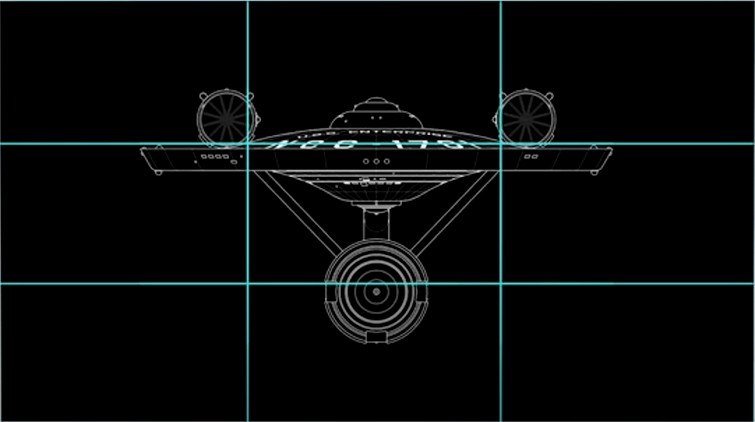 The Enterprise follows the rule of thirds for visual balance. (Image via EC Henry.)
Discovery One (2001: A Space Odyssey)
Stanley Kubrick and Arthur C. Clarke collaborated on a vessel that could survive interplanetary travel without FTL. Discovery One’s long truss and remote nuclear reactor embody practical design, while the rotating gravity flywheel reflects realistic physics. The ship’s minimalist look underscores its function as a research platform.
Example: Discovery One’s original concept included nuclear pulse propulsion, but the final design eliminated visible propulsion fins to avoid implying atmospheric flight. 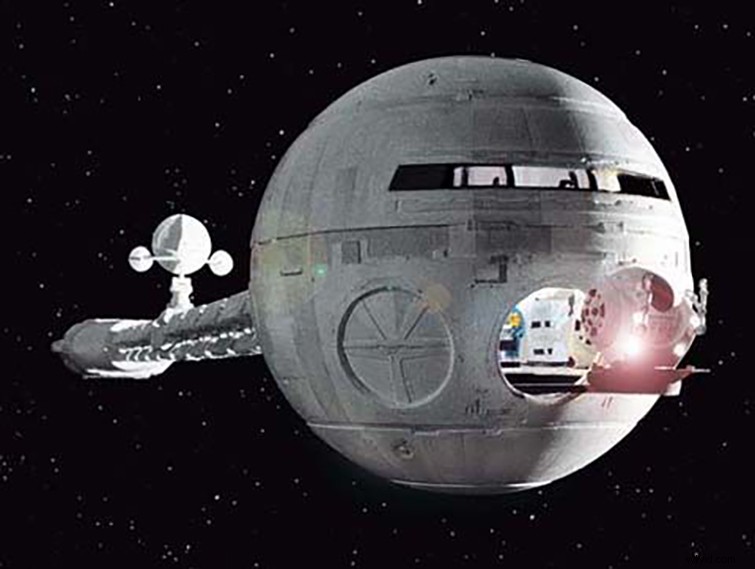 Discovery One’s design reflects functional constraints. (Image via Metro‑Gwyn‑Mayer.)
Event Horizon
As a horror‑sci‑fi hybrid, Event Horizon’s architecture is both functional and symbolic. Its reactor remains distant from crew quarters, and its hull lacks aerodynamic features, emphasizing the ship’s otherworldly purpose. The design also incorporates gothic elements—drawn from Notre Dame Cathedral—to mirror its descent into a cosmic abyss.
Example: Event Horizon’s design reflects both function and narrative symbolism. (Image via Paramount.)
Imperial Star Destroyer
Colin Cantwell’s design melded aircraft carrier decks with a formidable missile‑armed hull, resulting in a ship that projects power and menace. The iconic shape is angular, reminiscent of WWII naval vessels, reinforcing the Empire’s militaristic aesthetic.
Example: 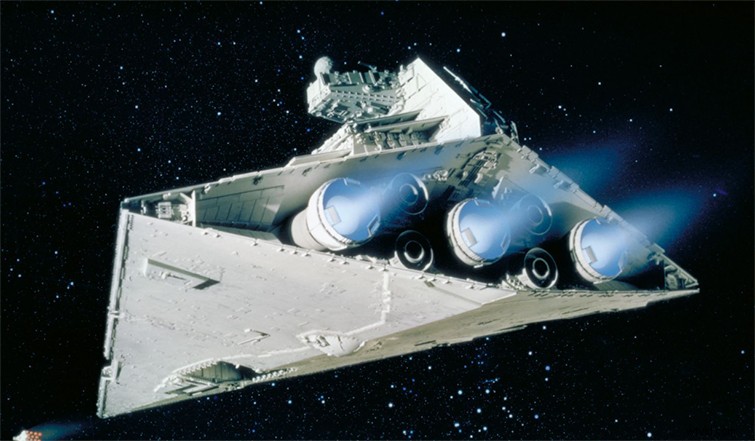 The Star Destroyer’s silhouette conveys dominance. (Image via Disney.)
Borg Cube
Reflecting the Borg’s hive‑mind ethos, the Cube’s geometry is utilitarian, with no defined front or back. Its modular construction—adding components until functional—mirrors the Borg’s assimilation process. The design prioritizes capability over conventional form.
Example: 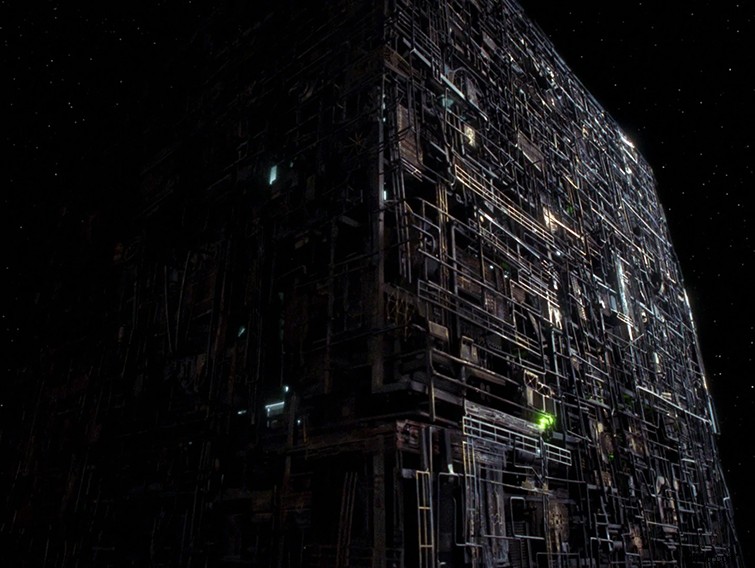 The Borg Cube’s form follows function. (Image via Paramount.)
From Concept to Production
Once a design is finalized, the next steps include:
- Building a physical model or creating a detailed 3D render.
- Developing a script that weaves ship mechanics into narrative beats.
- Acquiring assets—starfields, nebulae, planetary textures—to populate the ship’s environment.
- Testing visual effects for propulsion, gravity, and structural integrity.
Resources such as a free pack of 40+ space assets can accelerate the production pipeline. Additionally, tutorials on planet creation help ground your ship in a believable cosmos.
With these tools, filmmakers can produce a starship that feels authentic, supports storytelling, and captivates audiences.
Cover image via 20th Century Fox.
For further reading:
- The Space Western — Genre’s Unwanted, Weird Cousin
- SPACE KIT: Download 40+ Free Space Textures and Elements
- 5 Tips for Taking Care of Your Lenses in Outer Space
- From the Moon to Galaxies Far, Far Away: Miniatures in Space