
With this quick-tip tutorial, we’ll discuss the benefits of using the polarization filter to reduce reflection and glare.
If you watch more than a few filmmaking videos, you’ll hear how it’s almost essential to own a neutral density filter to shoot at a shallow depth of field while in bright circumstances. Likewise, we’re also seeing an increase in creators using the Pro-Mist series of filters. However, one filter that isn’t talked about as much is the polarization filter. Yet, they may be even more useful than the others.
So, what do they do? In the quick-tip video below, we run through just that.
Polarization in Brief
I once read an interview from an esteemed cinematographer—unfortunately, I cannot remember who it was—who said that they do not concern themselves with the science of a camera. Of course, they’ll learn the core elements to get the best footage from the camera, but there’s not necessarily a need to understand how that camera converts light into color data and so forth—that’s for the camera engineers to study.
The same can be said for polarization filters. There’s a lot of technical science behind what polarized light is and how the filters reduce the polarization, but we don’t need to know the full physics behind the practice to start using the filters. Keeping things brief, let’s look at how they work.
When light comes from a direct source, like the sun, the light—as in the waves of light—are oscillating in different directions and unpolarized. However, when those waves hit a glossy surface, the reflective light only oscillates in one direction, and that direction is usually parallel to the reflecting surface.
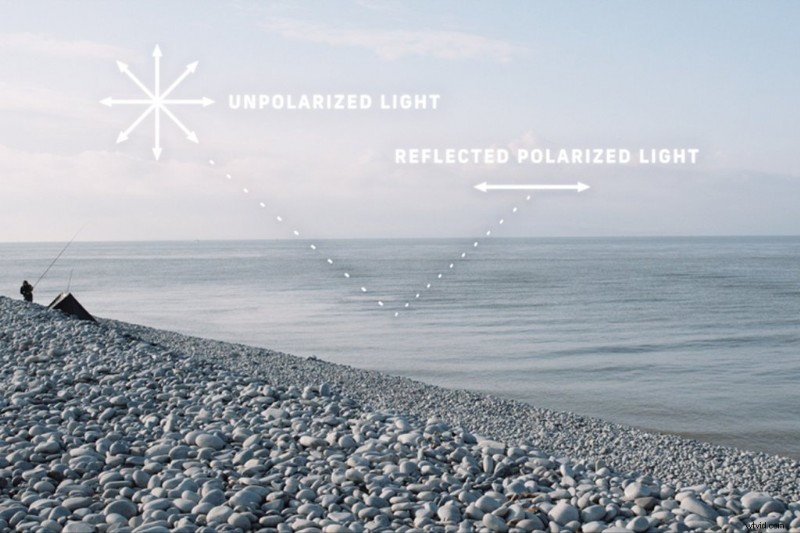
As seen in the video tutorial, the surface of the water is horizontal, and therefore it produces horizontally polarized light. When you rotate the filter so it’s aligned with the direction of the polarization, that light will be reduced, offering more vivid colors and reduced glare.
These filters will reduce (not necessarily entirely remove) the reflections and glare by filtering the polarized light. For the most part, all we’re receiving from the sensor is non-polarized light, which helps to reduce reflections and glare.
Polarization in Action
Let’s create a circumstance. Say we’re making a short crime drama to upload to YouTube. And, for this particular shot, there’s evidence at the bottom of this river.

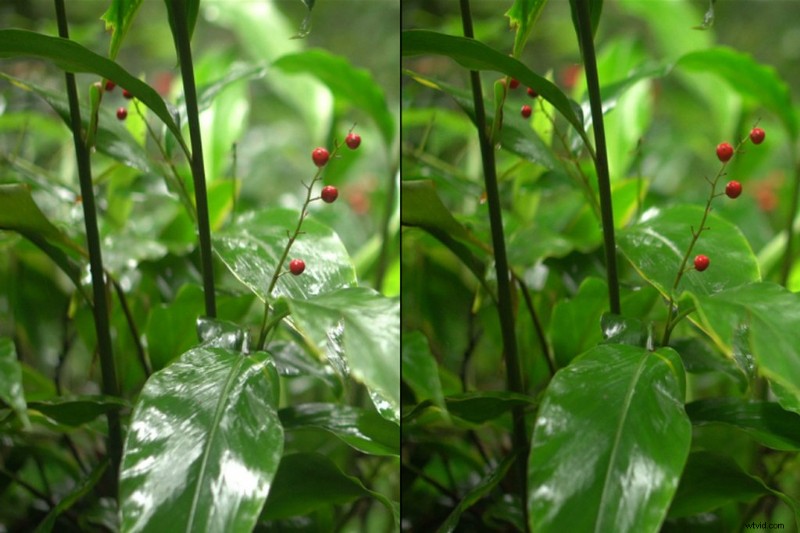
We have a problem as we can’t see into the river. The bright reflection of the sky and trees is overpowering. Instead of waiting for overcast weather or returning at a different time of day, we can use a polarizing filter. In doing so, we can reduce the reflection and see the riverbed.

And, it’s not just water that this is good for, but any reflective surface that has a glare. You can reap the benefits of reducing the polarized light to see more of the object and less of the reflected light, whether that’s plants or product shots.
Direction of Polarization
You might note that the polarizer rotates, but you’re not dialing in the intensity like a variable ND filter. Instead, you are rotating the angle of the polarization. As a result, the polarization isn’t always uniform. As noted in the car example in the video, you can see that as I rotate the filter, the glare is removed unevenly. This is because the surfaces of the car are facing different directions. As a result, the polarized light osculates at different angles.
This is also more predominantly manifested when using a wide-angle lens and a polarizing filter for landscape shots. As a wide-angle lens will cover a large area of the sky, there are too many directions of polarization for the filter to accommodate. As a result, you’ll likely see one area abnormally dark.

Polarization of the Sky
Now, you might be thinking, “Hang on, Lewis! You said that polarized light is created when light waves hit a reflective object. What’s going on with the sky? Why is the sky becoming richer in color?” Well, in blue skies, sunlight is also being scattered and bounced around by the particles in our atmosphere. So, on a particle level, you could say it’s still being reflected. As a result, we’ll see skies at a richer blue. But, due to the directionality of the polarization, your filter is only going to work best when you’re facing ninety-degrees away from the sun.

So how do you figure that out? Simply make a finger gun, and point it towards the sun. Then, rotate your wrist back and forth. Whatever direction your thumb faces during the rotation is a good starting point to face your camera. If you’re going to face directly behind the sun or point towards it, it’s going to have no effect.
It’s also important to note that polarizing filters can absorb one to two stops of light, so keep an eye on your meters for any abnormalities.
For more tips on using lens filters, check out these articles:
- Are Graduated ND Filters Necessary in The Age of Powerful Cameras?
- Everything You Need to Know About Neutral Density Filters
- Video Tutorial: Why You Need Lens Filters for Your Drone
Cover image by Koldunova Anna.