
Key Takeaways
- E-commerce brands have more to gain from AI video than almost any other category, given the relentless volume of content they need across paid social, product pages, and seasonal campaigns.
- AI video performs best in e-commerce for high-volume creative production, product-forward storytelling, and visually rich environments that would be expensive or logistically complex to shoot.
- Not every format is equally suited for full AI generation. Knowing where AI earns its place versus where hybrid production wins is the most valuable judgment call a marketer can make.
- Real work from brands like Full Moon, Scotts, and Poshmark shows what AI video looks like in practice across different formats, goals, and production contexts.
- Working with a production partner who understands both AI tools and e-commerce creative strategy is what separates effective AI video from generic output.
E-commerce brands face a content problem that only compounds over time. More SKUs. More channels. More seasonal moments, more A/B tests, more formats to fill. The demand for video keeps growing, and the traditional production model — one shoot, one timeline, one deliverable — was never built to handle it.
AI video doesn’t just help with that problem. For the right use cases, it fundamentally changes what’s possible. This guide breaks down how AI video fits into the e-commerce content stack, which formats consistently perform, and what real executions look like from brands that have already done it.
Why E-Commerce Is One of the Best Fits for AI Video
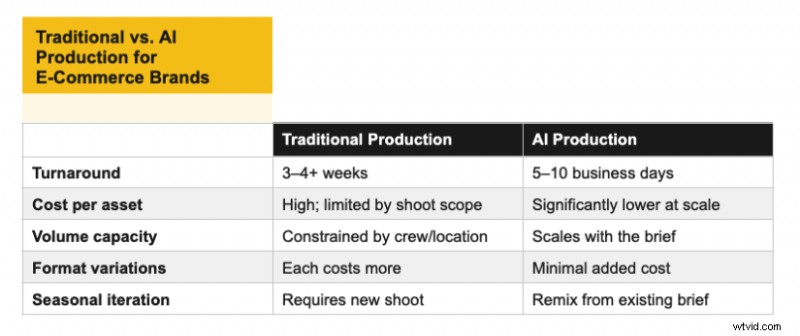
The e-commerce category has a set of structural needs that map almost perfectly onto what AI video production does well. Consider the content math alone: a brand with 50 SKUs, running paid social across three platforms, refreshing creative quarterly, and producing seasonal variations is looking at hundreds of video assets per year. That volume is economically unsustainable under traditional production models.
AI video changes the equation. Turnaround times that once took three to four weeks compress to days. Cost per asset drops dramatically. And because AI generation operates from a creative brief rather than a physical set, iterations and format variations come without the proportional cost increase that kills budgets in traditional production.
There’s also a creative fit. E-commerce creative tends to be product-forward, visually controlled, and repeatable in structure. Those are exactly the conditions where AI generation produces its strongest results. The more defined the visual world, the better the output.
The Video Formats That Work Best for E-Commerce
Not all formats benefit equally from AI. The table below maps the four formats where AI video consistently delivers for e-commerce brands, along with why each one is a strong candidate and where you’d typically deploy it.
| Format | Best For | Why AI Works Here | E-Commerce Example |
|---|---|---|---|
| Product showcase | PDPs, paid social, email | Controlled visuals; repeatable across SKUs without reshoots | Pet food, CPG, supplements |
| Brand/lifestyle ad | Awareness, CTV, OTT | Rich world-building without location shoots or large crews | Home goods, lawn care, outdoor brands |
| Hybrid live action + AI | Social, retargeting | Authentic human performance + AI for specific visual moments | Fashion, resale, apparel |
| Seasonal/promotional | Paid campaigns, email | Fast turnaround to hit narrow launch windows | Retail, D2C, holiday campaigns |
A few notes worth adding: product showcase videos are the most reliable starting point for brands new to AI video. The brief is concrete, the visual requirements are specific, and results are easy to measure. Brand and lifestyle formats require more creative direction to produce output that feels genuinely cinematic rather than generic, but when the brief is strong, the results can be indistinguishable from traditional shoots. Seasonal and promotional formats are where the speed advantage of AI becomes most tangible. Missing a campaign window because production ran long is a real cost, and AI largely eliminates that risk.
Real Examples from Lemonlight’s Portfolio
The examples below aren’t hypothetical use cases. They’re real AI video productions from Lemonlight’s portfolio, each illustrating a different angle on how AI earns its place in e-commerce creative.
Full Moon: When AI Candidacy Is Clear from the Brief
Anyone who has produced video with animals on set knows the reality: the best-planned shoot can unravel the moment a pet decides it’s done cooperating. Retakes multiply. Timelines stretch. Budgets follow.
For Full Moon’s healthy pet food brand video, the question we ask on every project, “where does AI make this better?”, had an obvious answer. A live animal shoot introduces risk that has nothing to do with the quality of the creative and everything to do with the unpredictability of the set. AI eliminated that variable entirely. What replaced it was a pet that hit every mark, held every frame, and embodied exactly the warmth and character the brand needed. No wrangler. No waiting. No unplanned chaos eating into the shooting day.
Full Moon is a strong example of what we call AI candidacy: the discipline of identifying, before production begins, where AI gives the creative team more control rather than less. That judgment, not the technology itself, is what makes the output work.
Scotts: AI Production at Scale for CTV
The Scotts Turf Builder spot was produced as part of Lemonlight’s Universal Ads partnership, a program where we produced over 250 commercials for SMBs at a pace of 10 to 20 new spots per week. That number is worth sitting with. Traditional production at that cadence is logistically impossible for most production companies. AI production, with the right team and workflow, makes it the new normal.
For Scotts, the brand story lives in everyday moments of home and family. A father on his lawn, kids nearby, a backyard that feels genuinely lived-in. Every element generated by AI, shaped by Lemonlight’s production team, guided by a creative brief that specified not just visual direction but emotional tone. The result holds up in a CTV context because the foundation is strong.
CTV briefs require more explicit emotional direction than social briefs. Viewers are leaned back, attention is more sustained, and the stakes for feeling generic are higher. The Scotts spot works because the brief specified something precise: not “outdoor lifestyle” but the quiet satisfaction of a well-kept yard, the feeling of a home that’s been cared for. That level of creative direction is what guides AI generation toward cinematic output.
Poshmark: Where Hybrid Production Gets It Right
The Poshmark spot makes an honest case that full AI isn’t always the answer. For fashion and resale brands where human authenticity is core to the brand voice, and where audiences bring strong aesthetic expectations, live-action production still carries weight that AI generation can’t fully replicate. Asking AI to simulate authentic human behavior in a fashion context triggers exactly the kind of uncanny valley response that undermines trust.
The Poshmark approach was smarter. Traditional production handled the talent, the performance, and the fashion-forward visual language the brand’s audience expects. AI was deployed for one specific, contained moment: the magazine coming to life through animated sequence.
That moment works because it’s narratively motivated. It expresses fashion discovery as a kind of magic, something the live-action footage alone couldn’t communicate. The AI element feels like it belongs because the creative team designed it to belong, using it to express something rather than demonstrate a capability. That discipline separates effective hybrid production from AI that feels tacked on.
The lesson for e-commerce brands: identify the specific visual moment in your brief that needs something extra before production begins. If the story needs a magic moment, plan for AI to own it. If the story needs human authenticity from start to finish, let live action carry it.
What E-Commerce Marketers Get Wrong When Briefing AI Video
The most common mistakes in AI video production for e-commerce aren’t technical. They’re strategic, and they happen before a frame is generated.
Under-specifying the emotional direction. Generic briefs produce generic output. “Upbeat lifestyle feel” is not a brief. The more precisely you can articulate what the viewer should feel at the end of the video, the more the AI generation has to work with. Think of it like directing a human actor: vague direction produces vague performance.
Defaulting to full AI when hybrid would perform better. AI should earn its place in the creative, not be the default because it’s faster or cheaper. For certain formats, especially anything requiring genuine human warmth or talent-led credibility, a hybrid approach where live action sets the foundation and AI amplifies specific moments will outperform a fully generated video.
Not planning format variations from the start. If you need a 16:9 cut, a 9:16 cut, and a 1:1 cut, brief for all three upfront. Adding variations after the fact is where you lose the efficiency gains that make AI video worth doing.
Treating AI as a cost-cutting shortcut. The brands that get the best results from AI video treat it as a creative tool, not a budget line item to minimize. The investment in a strong brief, proper creative direction, and a production partner with real AI expertise is what produces output that actually performs.
Is Your Next Video a Good AI Candidate?
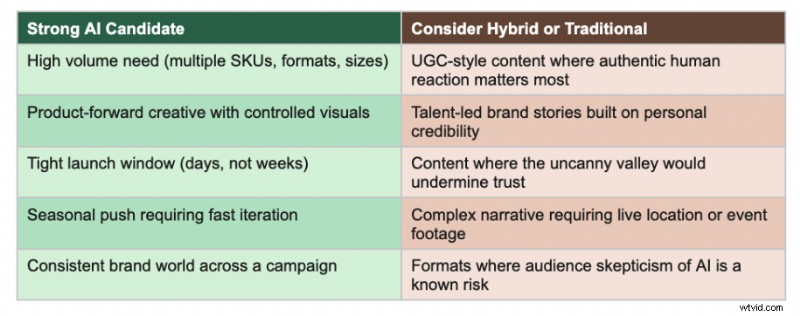
Use this framework as a starting point when evaluating your next brief. It’s not a rigid checklist, but the signals on the left are reliable indicators that AI video will deliver strong results.
Ready to See What AI Video Can Do for Your Brand?
Explore Lemonlight’s AI Video Production services or schedule a call below to speak with one of our experts about how AI video can fit into your e-commerce workflow.
Frequently Asked Questions
How much does AI video cost for e-commerce brands?
Lemonlight’s AI video production starts at $5,000. At that price point, you’re getting a production team that manages creative direction, AI generation, iteration, and delivery, not just access to a tool. For e-commerce brands producing multiple videos per year, the per-asset cost drops significantly with volume engagements.
How long does an AI video take to produce?
Most AI video productions with Lemonlight run on a two-week timeline from approved brief to final delivery. That’s substantially faster than traditional production, and it includes creative development, generation, revision rounds, and final output in all required formats.
Can AI video work for fashion or apparel e-commerce brands?
Yes, though the approach matters. Full AI generation works well for product-forward content, promotional ads, and branded environments. For content where human talent and authentic performance are central to the story, a hybrid model that pairs live-action production with targeted AI elements tends to produce stronger results. The Poshmark example above is the model for how to think about that balance.