
Key Takeaways
- No single AI tool handles the full video production pipeline well. Most professional workflows rely on a curated stack of purpose-built tools.
- The categories that matter most for brands: scripting, storyboarding, video generation, avatar/spokesperson, voice, and post-production.
- HeyGen and Synthesia lead for spokesperson content, but both have meaningful limitations for emotionally driven brand campaigns.
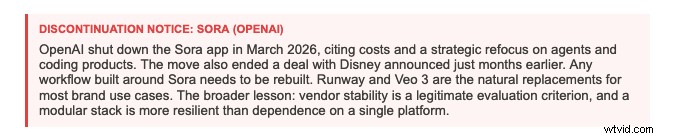
- OpenAI shut down Sora in March 2026. Vendor stability now belongs in your evaluation criteria alongside features and pricing.
- For brands that want one platform rather than a fragmented stack, Hero by Lemonlight covers scripting and storyboarding in a single, production-tested environment.
The AI video tool landscape has exploded. Dozens of platforms now claim they can take a brand from idea to finished video in minutes. Some of those claims are legitimate. Many are oversold. And a few of those tools won’t exist by the time you’re reading this.
That last point matters more than it used to. In March 2026, OpenAI shut down Sora, its flagship video generation app, less than 18 months after launch. The company cited cost pressures ahead of a potential IPO and a strategic pivot toward agents and coding products. If a tool backed by one of the best-funded companies in AI can disappear that quickly, vendor longevity deserves a real place in your evaluation process — not just features and pricing.
This post is a practitioner’s take: what we actually use, what we’ve tested, and where each category earns its place in a real production workflow. Honest assessments. No hype.
Before You Pick Any Tools, Understand the Stack Problem
The biggest mistake brands make when evaluating AI video tools is searching for one platform that does everything. It doesn’t exist. Platforms that promise a complete end-to-end solution almost always make meaningful trade-offs on quality somewhere in the chain. Professional teams don’t pledge loyalty to a single tool — they build a production stack, selecting the right platform for each stage of the project.
The Sora discontinuation makes a related point. When you build a workflow around a single vendor, you inherit their business risk. Runway, Veo 3, Kling — any of them could pivot, raise prices, or shut down. Treating your stack as modular gives you the flexibility to swap one layer without rebuilding everything else.
These tools generate content. They don’t generate strategy, brand judgment, or quality control. The brands getting the most from AI video tools are pairing them with experienced creative direction, not replacing it.
Scripting & Writing
Top picks:
- ChatGPT — fastest for raw ideation and first-draft scripting
- Claude — stronger for nuanced brand voice and longer-form narrative scripts
- Jasper / Copy.ai — marketing-specific templates and workflow integrations
- Hero by Lemonlight — scripting built specifically for video briefs, connected directly to storyboarding so nothing gets lost in handoff
ChatGPT remains the fastest option for raw ideation. Claude handles nuanced brand voice and longer-form narrative scripts particularly well. Jasper and Copy.ai add value through marketing-specific templates, though their output quality has largely converged with general LLMs. Hero takes a different approach: its scripting environment is built specifically for video briefs, connected directly to the storyboarding stage so nothing gets lost in handoff between tools.
Honest note: General LLMs cover the basics well at low cost. Specialized tools earn their price through workflow integration, not raw output quality.
Storyboarding & Pre-Production
Top picks:
- Boords — cleanest UX for team collaboration on storyboards
- Katalist — AI-assisted scene generation to accelerate the visual development phase
- LTX Studio — end-to-end pre-visualization for complex shoots
- Hero by Lemonlight — production-ready outputs built for brand video workflows; scripting and storyboarding in one platform
Hero’s storyboarding tool is built specifically around brand video workflows. Outputs are production-ready, not just conceptual sketches — and because scripting and storyboarding are connected in the same platform, the back-and-forth that typically eats time in pre-production is significantly reduced.
Honest note: Most standalone storyboarding tools require heavy manual input. The real value in this category comes from workflow continuity, not the visual output alone.
Video Generation
Top picks:
- Google Veo 3 — leads the field on cinematic quality and motion realism in 2026
- Runway Gen-3 Alpha — top choice for creative and short-form content; flexible production tool
- Kling 2.6 — cost-efficient pick for high-volume projects where per-clip cost matters
- Luma Ray3 — performs well on product and lifestyle footage
Honest note: Brand-consistent output remains the hardest problem in generative video. Human oversight in post is still necessary across every platform on this list.
Avatar & Spokesperson
Top picks:
- HeyGen — most flexible avatar options; exceptional localization and language-dubbing
- Synthesia — enterprise-grade, polished templates, robust access controls
- D-ID — faster and lighter for high-volume social formats
- Tavus — personalization at scale; strong for dynamic video generation
Looking for HeyGen alternatives or Synthesia alternatives? D-ID and Tavus are the strongest contenders. Tavus wins on personalization; D-ID wins on speed and cost efficiency for social-format content.
Honest note: Avatar tools work well for explainer, training, and localized content. For emotionally driven brand campaigns, human talent still outperforms — the gap is most visible in content requiring real narrative tension or authenticity cues.
Voice & Speech
Top picks:
- ElevenLabs — best overall voice quality and widest language support
- WellSaid Labs — enterprise-grade brand voice cloning, strong consistency for long-form content
- PlayHT — strong multilingual capabilities
- Resemble AI — worth evaluating for teams that need to own a custom voice model
Honest note: Voice quality has largely converged at the top tier. The more meaningful differentiators are licensing terms and API integration capability.
Music & Audio Generation
Top picks:
- Suno — strongest full-track generation
- AIVA — best for cinematic and orchestral needs
- Mubert — excels at adaptive background music for content with variable pacing
- Udio — strong creative range for varied audio needs
Honest note: Audio is frequently overlooked in the AI video conversation, but the wrong music materially undermines otherwise strong video. Licensing clarity also varies widely across platforms — confirm rights before publishing anything commercial.
Editing & Post-Production
Top picks:
- Descript — best for transcript-based editing and repurposing long-form content
- Adobe Firefly — brand-color correction, direct Creative Cloud integration
- Opus Clip — automated short-form clipping at scale
- CapCut AI — highly accessible for social content teams
- Topaz Video AI — upscaling and footage restoration
Honest note: Human editorial judgment matters more in this category than any other. These tools reduce labor; they don’t replace the creative decisions that make a cut feel intentional.
Tool Landscape at a Glance
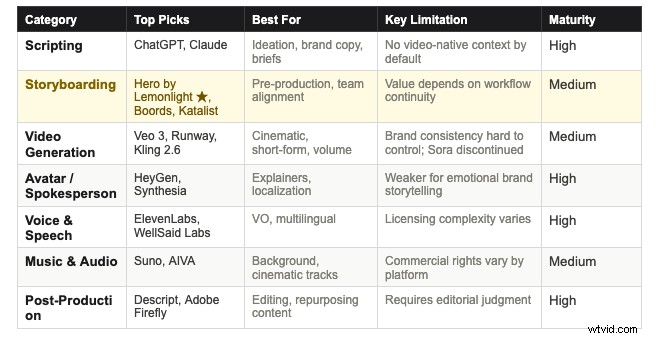
A summary of the full stack by category, recommended picks, and key limitations. Rows highlighted in yellow indicate tools where Lemonlight’s Hero platform is the recommended pick.
What Tools Can’t Do
Every platform on this list generates output. None of them generate strategy. They won’t tell you whether your concept is right for your audience, whether your brand voice is consistent across assets, or whether the final cut will actually perform against your campaign goals. The output is only as good as the judgment guiding it. The brands extracting the most value from AI video tools are the ones pairing them with experienced creative direction — using AI to increase output velocity while keeping human expertise on quality control.
This list is updated quarterly as tools evolve, get discontinued, or are replaced by better options. If you want to stay current without doing the research yourself, Lemonlight tracks the landscape daily — it’s part of how we produce work.
Looking for a production partner rather than a self-serve platform? Let’s talk.