
We may earn revenue from the products featured on this page and participate in affiliate programs. Learn more ›
Ready to dive into close‑up photography with a Canon system camera? Selecting the right macro lens can feel daunting—technical jargon, a wide array of options, and mounting compatibility all add to the challenge. Our comprehensive guide cuts through the noise, presenting the best Canon macro lenses for 2023 across every budget and skill level.
Below are our carefully curated recommendations for both Canon DSLRs and mirrorless bodies:
- Best overall: Canon RF 100mm f/2.8L Macro IS USM Lens
- Best budget: Venus Optics Laowa 25mm f/2.8 Ultra Macro Lens
- Best for beginners: Canon EF‑M 28mm f/3.5 Macro IS STM Lens
- Best third‑party lens: Sigma 70mm f/2.8 DG Macro Art Lens for Canon EF
- Best for professionals: Canon MP‑E 65mm f/2.8 1‑5x Macro Photo Lens
How We Selected the Best Macro Lenses for Canon
Our evaluation focused on lenses that pair seamlessly with Canon’s current lineups—full‑frame mirrorless RF, APS‑C mirrorless EF‑M, and DSLR EF/EF‑S systems. We considered lens performance, build quality, price, and user experience, weighing both Canon’s own offerings and standout third‑party alternatives. Our goal was to present options that serve a broad spectrum of photographers, from hobbyists to commercial pros.
When shooting macro, keep these key techniques in mind:
- Use a sturdy tripod to eliminate camera shake.
- Anticipate the shallow depth of field; focus precisely.
- Opt for lens‑based or hybrid image stabilization if you’ll shoot handheld.
- Control wind and light—small movements can blur fine details.
- Beware of lens shadows when working close.
- Test autofocus on/off if your lens supports it.
- Read the lens manual for specific settings.
- Patience pays off—macro photography often requires fine adjustments.
The Best Macro Lenses for Canon: Reviews & Recommendations
Best overall: Canon RF 100mm f/2.8L Macro IS USM Lens
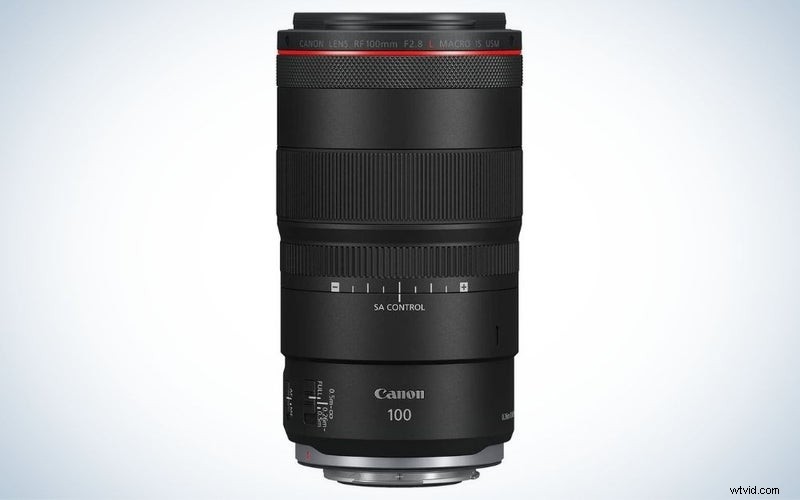
Why It Made The Cut: The first true RF macro lens in Canon’s full‑frame lineup, delivering 1.4x magnification and advanced bokeh control.
Key Features
- Mount / Format: RF‑Mount / Full‑Frame
- Magnification: 1.4:1
- Minimum Focus: 10.2 inches (26 cm)
- Autofocus: Yes (silent, smooth)
Pros
- Unique bokeh control ring for creative background blur
- Bright f/2.8 aperture for low‑light and shallow depth
- Optical IS + hybrid stabilization for crystal‑clear shots
- Dual‑focus system for flexible focus stacking
Cons
- Premium price point
With 1.4x magnification, the RF 100mm captures subjects 40% larger than Canon’s EF macro lenses, making it ideal for high‑resolution EOS R5 or R3 bodies. The integrated IS, combined with the camera’s own sensor‑level stabilization, delivers razor‑sharp detail even in low‑light situations.
Best budget: Venus Optics Laowa 25mm f/2.8 Ultra Macro Lens
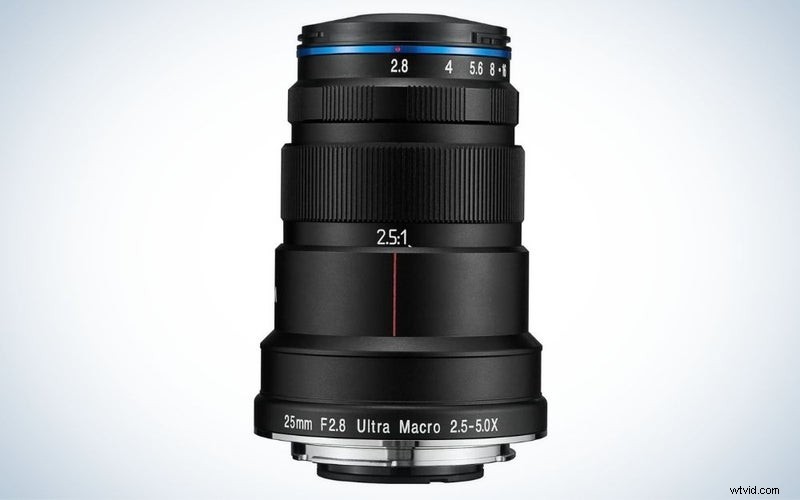
Why It Made The Cut: A versatile, low‑cost macro lens offering 2.5x–5x magnification without compromising on size.
Key Features
- Mount / Format: RF‑Mount / Full‑Frame
- Magnification: 2.5:1 to 5:1
- Minimum Focus: 6.8 inches (17 cm)
- Autofocus: No
Pros
- Inexpensive entry point for macro enthusiasts
- Wide magnification range for creative flexibility
- Ultra‑light and compact build
Cons
- No autofocus or optical IS
- Limited working distance—may cast shadows
While the Laowa 25mm requires manual focus, its 2.5x–5x range is unrivaled for a lens this affordable. The 8‑blade diaphragm yields smooth bokeh, though you’ll need to manage lighting carefully because the lens lacks built‑in stabilization.
Best for beginners: Canon EF‑M 28mm f/3.5 Macro IS STM Lens
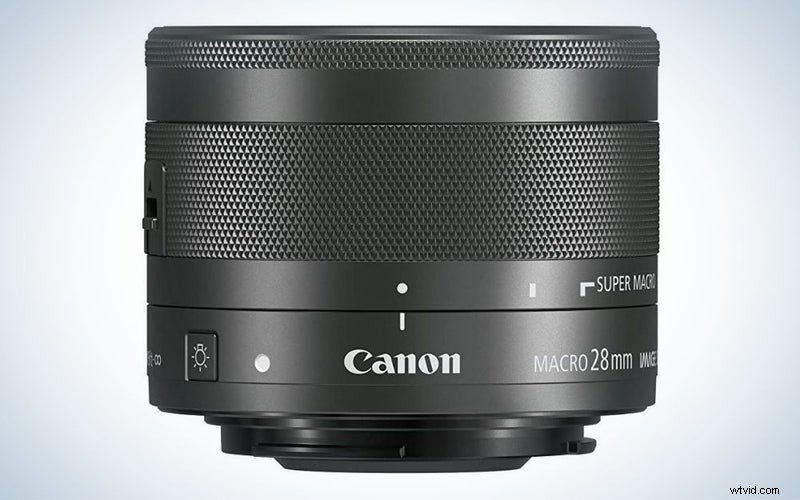
Why It Made The Cut: A compact, user‑friendly prime that introduces macro photography with built‑in LED lighting and hybrid IS.
Key Features
- Mount / Format: EF‑M Mount / APS‑C
- Magnification: 1.2:1
- Minimum Focus: 3.7 inches (9.4 cm)
- Autofocus: Yes (STM)
Pros
- Integrated LED macro light for low‑light shooting
- Hybrid IS for steady handheld images
- Lightweight and portable
- Affordable price point
Cons
- Maximum aperture limited to f/3.5
Its built‑in LED light is a first for macro lenses, providing illumination for insects or dew‑laden subjects. The STM autofocus works smoothly across the lens’s Super Macro mode, making it an excellent starter tool.
Best third‑party lens: Sigma 70mm f/2.8 DG Macro Art Lens for Canon EF
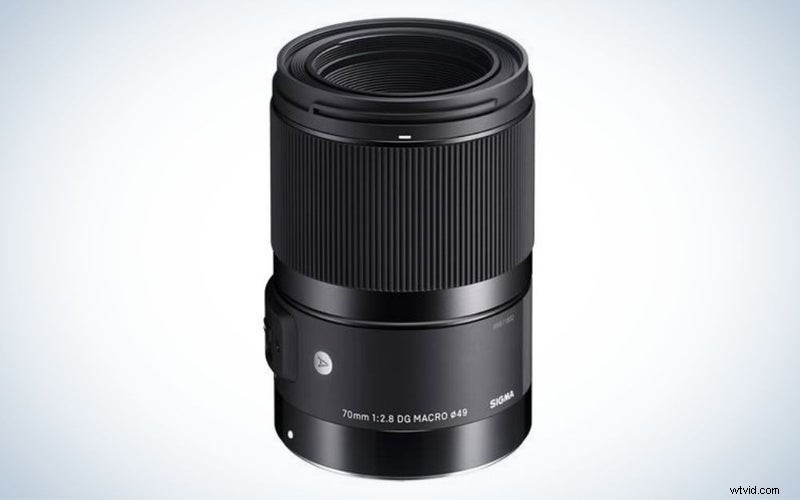
Why It Made The Cut: A robust, sharp macro prime that offers 1:1 magnification and a convenient AF/MF switch.
Key Features
- Mount / Format: EF Mount / Full‑Frame
- Magnification: 1:1
- Minimum Focus: 10.2 inches (26 cm)
- Autofocus: Yes (switchable to manual)
Pros
- Compact and lightweight design
- Excellent edge‑to‑edge sharpness
- Versatile AF/MF switch
- Reliable build quality
Cons
- No lens‑based IS
- Barrel telescopes during focus travel
Suitable for both DSLR and, with adapters, mirrorless users, the Sigma 70mm delivers crisp images and a straightforward AF/MF toggle. Its 1x magnification is ideal for detailed work, while the absence of IS is mitigated by the camera’s sensor‑level stabilization.
Best for professionals: Canon MP‑E 65mm f/2.8 1‑5x Macro Photo Lens
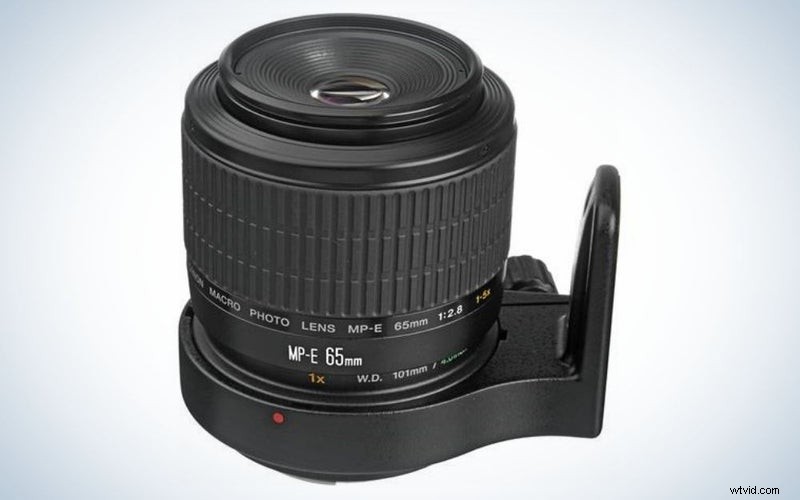
Why It Made The Cut: The only Canon lens that spans 1x–5x magnification, engineered for studio‑grade macro work.
Key Features
- Mount / Format: EF Mount / Full‑Frame
- Magnification: 1:1 to 5:1
- Minimum Focus: 9.45 inches (24 cm)
- Autofocus: No (manual focus only)
Pros
- Extremely versatile magnification range
- Robust construction with floating elements
- Built‑in magnification ring for precise focus control
- Optional macro light and tripod collar
Cons
- High price point
- Manual focus requires skill; no IS
Designed for the professional, the MP‑E 65mm is a dedicated macro tool. Its 1‑5x range and floating lens elements maintain clarity across all focus distances, while the optional macro twin light and tripod collar enhance shooting stability.
What to Consider Before Buying a Canon Macro Lens
Macro photography isn’t just about a lens that’s “close‑up.” It’s defined by a 1:1 (or greater) magnification ratio, meaning the projected image on the sensor matches or exceeds the subject’s real‑world size. This precision sets macro apart from standard lenses.
When selecting a lens, verify:
- The magnification ratio is 1:1 or higher.
- The lens mounts correctly: RF for R‑series, EF for full‑frame DSLRs, EF‑M for APS‑C mirrorless, or EF/EF‑S for APS‑C DSLRs.
- Whether you need autofocus or manual focus based on your shooting style.
- If the lens includes image stabilization—especially important for handheld macro.
FAQs
Can macro lenses be used for other types of photography?
Absolutely. While macro lenses excel at close‑up detail, many are versatile enough for portraits, still life, or even landscape work. However, lenses that cannot focus to infinity are strictly macro‑only.
How much do macro lenses for Canon cost?
Prices range from roughly $200‑$300 for entry‑level models to $1,400+ for high‑end professional lenses.
Are longer focal lengths the best for macro photography?
Longer lenses (90–105mm) offer greater working distance, beneficial when photographing insects or subjects that require a safe buffer. However, they can be heavier and may need a tripod for stability.
Should I get manual focus or autofocus lenses?
Manual focus provides unparalleled precision for macro, but autofocus offers flexibility for other shooting scenarios. Choose based on your primary use case.
Final Thoughts
Macro photography opens a world of detail. For the most balanced experience, the Canon RF 100mm f/2.8L Macro IS USM remains the top pick, offering 1.4x magnification, a powerful bokeh control ring, and integrated stabilization. Whether you’re a beginner or a seasoned pro, our guide helps you choose a lens that matches your creative vision and technical needs.