
Reading Time: 6 minutes
Published: November 25, 2025 | Last Updated: December 19, 2025

What is color space? Definition & Meaning
Color space is the defined gamut that a device—camera, monitor, or projector—can record, display, or print. Every device operates within a limited color envelope, and that envelope is what we call a color space. Knowing which space you are working in ensures that your colors remain consistent from capture through delivery.
How Color Space Works
Each color space is built around three core components:
- Primary colors – the red, green, and blue corner points that set the gamut limits.
- White point – the reference white (commonly D65) that anchors the color balance.
- Gamma curve – the brightness mapping that dictates how shadows, midtones, and highlights are encoded.
How Color Space Handles Light and Color
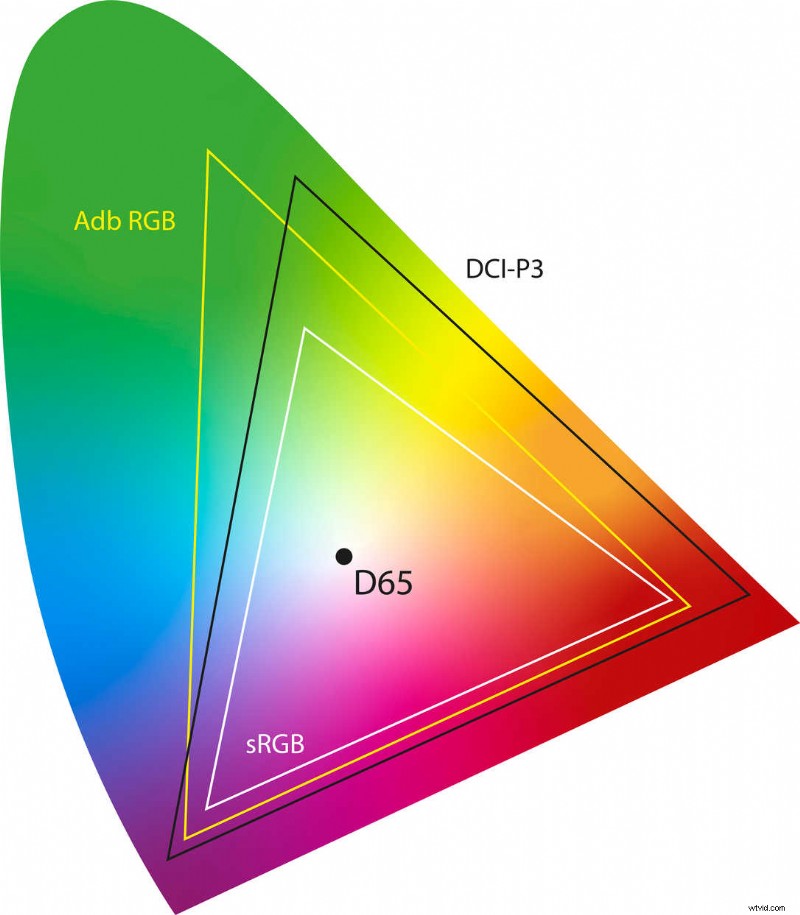 Color Gamut Triangle Comparison. The diagram illustrates how sRGB, DCI‑P3, and Adobe RGB cover distinct portions of the visible spectrum. Each triangle is centered on the D65 white point and plotted over the CIE 1931 chromaticity diagram, which visualizes all colors perceivable by the human eye.
Gamut is the complete set of colors inside a space. A wide gamut, such as Rec. 2020, can contain more saturated reds, greens, and blues than a narrow one like Rec. 709.
Bit depth determines how finely colors are recorded. An 8‑bit image offers 256 levels per channel, whereas a 10‑bit image provides 1,024 levels. Higher bit depth yields smoother gradients and reduces banding in skies or shadows.
This video explains the difference between color space and bit depth.Gamma affects how brightness is stored. Most cinema cameras use log gamma curves (e.g., S‑Log3, V‑Log) that flatten the image and preserve detail in highlights and shadows. To preview or grade log footage, a matching LUT and color space must be applied; otherwise, the image will appear washed out and difficult to assess.
Color space is not the same as a color profile
A color space defines the range of colors you are working with—Rec. 709, DCI‑P3, sRGB, etc.—setting the boundaries for what is possible in your image. A color profile (such as an ICC profile) instructs your system how to render those colors on a specific device, translating the raw values into visible output.
Screen color profiles should not be confused with camera color profiles, which control how footage is recorded—flat, stylized, or raw.
Common color profiles you’ll encounter in film and video workflows include:
- sRGB IEC61966‑2.1 – standard for web and most monitors. Default for unprofiled images.
- Adobe RGB (1998) – a wider gamut than sRGB, used for print and high‑end photography.
- Display P3 – Apple’s implementation of DCI‑P3, used on HDR‑capable displays.
- Rec. 709 – HD broadcast and online video standard, also used as a display profile.
- Rec. 2020 – wide‑gamut HDR profile, paired with PQ or HLG.
- Custom ICC Profiles – generated by monitor calibration tools to correct device‑specific shifts.
If your monitor is using the wrong profile or is uncalibrated, the image may look acceptable on your screen but appear too dark, blue‑tinted, or oversaturated on others.
Common Color Spaces
Each color space has a distinct range, use case, and limitation. Knowing these differences helps you choose the right one for your camera settings, grading timeline, and final export.
Rec. 709
HDTV’s standard and the most widely used format for broadcast and streaming. It offers a narrow color range and limited dynamic range.
sRGB
Nearly identical to Rec. 709, designed for web and desktop displays. Suitable for still images and UI graphics but not ideal for film grading.
DCI‑P3
Created for digital cinema, it delivers deeper reds and greens than Rec. 709. Most HDR monitors support it, providing richer color reproduction.
Rec. 2020
The widest gamut of all common formats, used for HDR video and UHD delivery. Because most displays cannot reproduce the full Rec. 2020 range, tone mapping is applied to make it viewable on Rec. 709 screens.
ACES (Academy Color Encoding System)
Here’s a good video explaining ACES, CSTs, and Resolve Color Management (RCM) along with their differences and practical applications in DaVinci Resolve.ACES is a complete color pipeline designed for film production. It uses a scene‑referred space that records color based on real‑world light. The final conversion to a delivery format—Rec. 709, DCI‑P3, or Rec. 2020—occurs at the end of the workflow.
Using Color Space in Your Workflow
Your workflow should follow a single color space from start to finish. Set your camera’s space and gamma curve, match those settings in editing and grading software, and export using the appropriate delivery space.
Here’s a short video showing the differences between common color spaces used in filmmaking – from camera to monitor to TV.Typical delivery formats include:
- Rec. 709 for web and TV content.
- DCI‑P3 for theatrical releases.
- Rec. 2020 with PQ or HLG for HDR projects.
When settings are mismatched, skin tones shift, highlights blow out, and colors clip or oversaturate—signals that the timeline is interpreting the image in the wrong space or gamma.
Consistency is key: use the same space and gamma across camera, timeline, monitor, and final export.
HDR and Delivery Formats
HDR footage relies on wide color spaces and high dynamic range. Rec. 2020 is the most common color space, but the transfer function (PQ or HLG) is equally important.
- PQ (Perceptual Quantizer) – stores brightness based on human visual perception, used in HDR10 and Dolby Vision.
- HLG (Hybrid Log Gamma) – compatible with both SDR and HDR displays, often used for live broadcast.
Delivery formats include:
- HDR10 – basic HDR format with static metadata.
- HDR10+ – adds dynamic metadata to adjust brightness scene by scene.
- Dolby Vision – employs dynamic metadata and strict calibration requirements.
If your footage is mastered in Rec. 2020 but played on a Rec. 709 screen, tone mapping compresses the image into a smaller range. Poor tone mapping can crush shadows, flatten contrast, or shift color, so always test exports on multiple displays.
Monitoring and Color Management
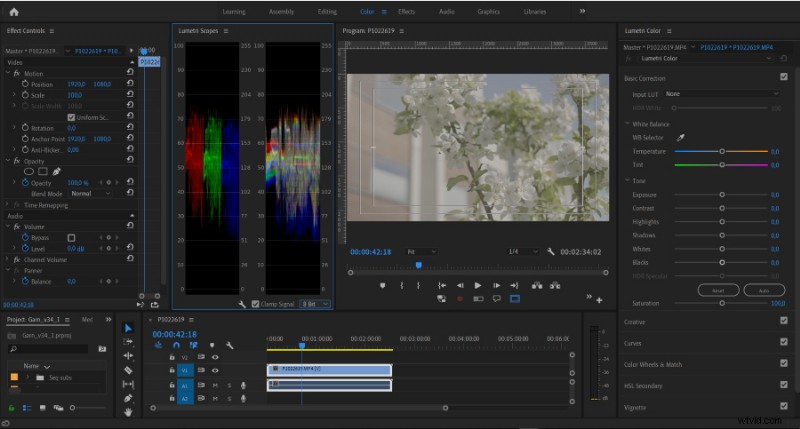 RGB parade in Premiere Pro example.
Once you’ve selected the right color space, proper monitoring is essential. This involves tools and settings that allow you to see and control how colors behave during grading and export. Without correct display calibration, your image may look different on other screens.
LUTs – Use LUTs to preview log footage in Rec. 709. They are for monitoring only, unless you intend to bake the look into your final image. Free LUTs are available here.
Scopes – Vectorscopes and RGB parade help measure color balance and prevent clipping. Here’s a guide to the common scopes.
Reference monitors – Hardware‑calibrated displays that can accurately show Rec. 709, DCI‑P3, or Rec. 2020.
Color transforms – Remap footage between spaces, e.g., converting wide‑gamut log into Rec. 709 while preserving accurate colors.
Color Space Workflow Checklist
This checklist covers the essential steps from camera to export. Use it to keep consistency throughout your workflow.
- Choose your delivery format (Rec. 709, DCI‑P3, Rec. 2020)
- Set your camera to the correct color space and gamma
- Match your editing timeline to your footage
- Preview log footage with LUTs
- Grade on a calibrated monitor
- Export with the correct color space and metadata
Summing Up
Color space defines the envelope of colors your tools can capture, display, and deliver. Using the wrong space can cause shifts, clipping, or loss of detail. By managing color space consistently from capture to export, your film retains the colors you intended.
Read Next: Ready to level up your color work?
Start with our main Post‑Production hub to see how editing, sound, and color come together to build the final cut.
Then explore the full Color Grading section for guides on color theory, contrast, LUTs, scopes, and practical workflows you can use in DaVinci Resolve.