
Perhaps the most dynamic opening scene in the history of film is the aerial sequence from Stanley Kubrick’s The Shining (1980), which was shot from a helicopter by Greg MacGillivray of MacGillivray Freeman Films. Nowadays, a shot like that would probably be captured by a professional drone.
Thanks to small, high-quality digital cameras, professional and personal drones have completely transformed the production industry, letting filmmakers capture shots that were previously unattainable to non-studio filmmakers. To capture aerial footage a few years ago, you had to either book time in a helicopter containing a professional operator, remote head, and bulky HD camera, or, for lower altitudes, rent the services of a small remote helicopter and operator from a company like Flying-Cam or Coptervision. As you can probably guess, helicopters don’t come cheap.
“The recent popularity of drones can be attributed to cost of entry and advancements in technology allowing for more people to offer the service and more producers feeling safer about utilizing them on set,” explains Robert Rodriguez, who founded the Society of Aerial Cinematography in 2013. “That being said, the impact has been significant over the past year in the broadcast, marketing and theatrical markets. Now that producers and filmmakers are more aware of the technology, they’re getting used a lot.”
Professional Drones
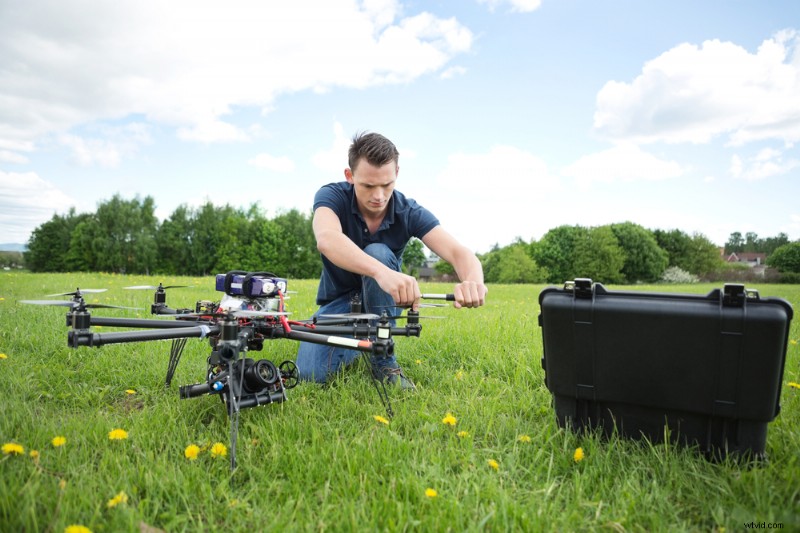
Today’s professional drones have the advantage of working with smaller digital cameras. But for professional work, you’re going to need a drone that is able to carry a camera that’s larger than a GoPro, and for a longer period of time. (Professional cameras like the RED Epic Dragon and ARRI ALEXA Mini weigh roughly five pounds, but can still capture up to 6K resolution and use high-quality PL lenses.)
Most professional productions are hiring professional drone companies with custom-designed drones and skilled pilots who can safely execute a complex shot, such as a chase scene. Unlike the common quadcopter, these professional drones typically contain a larger, multi-propeller configuration, they fly faster, they have better control in wind or rain, and if you lose one motor, you can still safely land it. Hexacopters are popular configurations, containing six motors and propellers. Octocopters are generally the most powerful, and most expensive, and are usually the drones that capture the most dynamic aerial footage.
Freefly Systems’ Alta drone ($8,495) is a popular professional hexacopter drone that can be set up in five minutes and carry payloads of up to 15 pounds, so digital motion picture cameras from ARRI, RED, and Canon can be flown. You can also mount your MōVI rig to the bottom or top for smooth movement and unique angles.
Check out the Alta in action:
Personal Drones
Quadcopters, which contain four propellers, are the most common drones for personal use. They’re generally the least expensive, while still offering decent maneuverability. In 2015, you can buy a basic quadcopter drone with a 720p camera at Toys “R” Us for $90.
But for more serious work, an exciting new personal drone is the Solo from 3D Robotics. Armed with your own GoPro HERO camera, the all-in-one drone has serious computing power, with two integrated Linux computers — one on the drone and one in the controller — giving you control over your GoPro’s controls, plus wireless streaming to your mobile device or through your controller’s HDMI port for live HD broadcasts. 3D Robotics worked with GoPro in creating an advanced gimbal that gives you full control of your HERO camera. You can start and stop recording while your drone is in flight, as well as capture stills and change field of view, frames per second, exposure, and more. Pricing for the Solo starts at $999 and the Solo gimbal is sold separately for $399.
DJI also recently released the Phantom 3 Standard ($799), which is aimed at beginners. Unlike the Phantom 3 Professional and Phantom 3 Advanced, the Standard is accessible to first-time pilots and is easy to get up in the air for capturing stills and video. It contains a new integrated camera that records up to 2.7K video at 30 fps, as well as 12 megapixel stills, using a 94-degree, distortion-free lens. The camera is mounted on a 3-axis gimbal that keeps your camera level and smooth.
The Standard can fly for up to 25 minutes using DJI’s interchangeable Intelligent Flight Batteries, and its built-in GPS remembers your takeoff point; so if your control signal is lost, your Phantom returns to you after a simple command. You can also get a live HD feed on your mobile device, because the Phantom can create its own WiFi network. Working with the remote controller, you can fly your Phantom 3 Standard from more than half a mile away.
Here’s a cool intro for the Phantom 3 Standard:
Drone Rules
There have been recent news stories on drones disrupting air traffic with close calls between drones and commercial flights. There are many rules to learn before you even attempt to fly your drone for the first time.
According to Rodriguez, the biggest misconception about drones is that they fly themselves. “I’ve been flying different types of RC models for over 15 years and I still get very nervous flying around people,” he reveals. “There are differing levels of skill when it comes to flying drones and people approach their training differently as well. An operator needs to learn how to fly the drone in all situations without the use of GPS. I personally wouldn’t hire anyone who’s only been flying for one month for my production, but I know some productions that have.”
Before taking your drone out into the field, you should take a look at some popular FAA (Federal Aviation Authority) questions regarding flying UAS (Unmanned Aircraft Systems). In short, as long as you’re using common sense, you don’t need approval from the FAA to fly your drone for hobby use in unpopulated areas — but you do need approval for business or commercial purposes.
If you want to use your drone on a professional or commercial production, you are going to need approval from the FAA with three methods of certification in different categories. The FAA released regulations and procedures, and there are only a dozen or so companies who are exempted for drone production use — although this number is expected to rise quickly.
“Some producers buy into the ‘fly themselves’ mentality and feel that they can hire based on cost vs. experience,” says Rodriguez. “This can get ugly quick. I’ve received numerous calls from productions trying to save money that used a single operator outfit. You should never sacrifice experience and professionalism over cost, especially with something that can be very dangerous to your cast and crew in the wrong hands.”
Top image: Flying hexacopter with a silhouette of Moscow in the background by alik