
Welsh musician Gruff Rhys has been the creative force behind numerous projects over the past two decades. Originally rising to attention as the frontman of much-loved psychedelic indie-rock band Super Furry Animals, Rhys has gone on to release a series of solo albums, collaborate with acts including Gorillaz and Simian Mobile Disco, and provide soundtrack music for everything from films to video games. His most recent project, however, is also his most ambitious: a multimedia undertaking that comprises a feature film, an album, a book, and a mobile app, American Interior is both a fascinating look at a lesser-known side of American (and Welsh) history and an exploration of the power of storytelling through different mediums.
To create the project, Rhys researched the story of John Evans, a distant relation who came to the US in the late 18th century in search of a mythical lost tribe of Welsh transplants. Next, he followed the path of Evans’ journey, documenting it and performing along the way — all joined by a puppet designed in Evans’ (imagined) image. Even his shows became multimedia experiences, combining PowerPoint presentations and storytelling with more traditional musical fare. Each individual piece of the resulting project can be appreciated on its own, but taken together, they combine to become something truly awe-inspiring. We caught up with Rhys during his latest visit to the States in support of the film/album/book/app to talk more about where the idea came from, and how he was able to deliver on something so ambitious.
Shutterstock: You’ve been traveling around for this project for quite a while now, from having first thought it up and doing the tour to film the movie, and now supporting it. How has the story changed for you over all this time?
Gruff Rhys: It’s still shape-shifting and evolving. I’ve been working on it for two and a half years. The original investigative concert tour in the States was over two years ago, and on that tour, I didn’t have as much material. I was still in the process of writing the songs, and I didn’t have all the slides of the John Evans avatar walking in the landscape that the original John Evans walked in. It’s changed a lot, and the show keeps changing too. I add new slides and drop other ones and learn new songs. I think it’s in better shape now.
When you originally came up with this idea, did you think of it as this whole multimedia project to begin with — that was going to be a film and an album and a book and an app — or did that develop as it went along?
I did a previous project, which was a bit more low-key, called Separado! with the same director, Dylan Goch. That was an investigative concert tour in South America, searching for a guitarist called Rene Griffiths, who was a member of a Welsh speaking community in Patagonia. We had a great time making that film, and we had big plans. I recorded an album of music for it, but I didn’t get it together to release it at the time. And then I had some vague plans for a book, and Dylan wanted to do a kind of film installation of more abstract footage he had. The film did come out, but we didn’t manage to execute any of the other pieces we planned. So when we did the follow-up investigative concert tour, we were more mentally prepared to do all these other things that we thought were also possible.
So you did envision it involving all these different parts right from the beginning?
Yeah, and every element fed each other, in a way. I was interviewing a lot of people for the film, and then I was able to use transcriptions of those interviews for the book. And the tour was central to everything. Because I was on tour, I was able to go and interview people directly, and I also started to record the album on the road in America. So everything was all happening at the same time. We knew we wanted to make a digital element as well, but we held off on deciding what form that would take until toward the end of the project, because we didn’t want to plan something technological that would be obsolete by the time it came out.
Both of your films ostensibly involve distant relations of yours. Is that all truth? If so, is the personal history part of it very important to you when you’re coming up with these ideas?
Yeah, they were kind of tall family tales that I wanted to verify physically. Every family has some more unusual characters, or some stories that just seem completely ridiculous and have been distorted by time, and I was inspired by those kinds of stories to investigate them further. Hopefully, eventually, it’s a trilogy. I always saw it as a trilogy, but I’m in no great hurry to move onto the third one just yet
You’ve been making music for a long time now, and you’ve done a, a lot of different things. Do you feel like you need to come up with more ambitious projects like this in order to keep challenging yourself?
Yeah, I think it’s important to break the formula. It makes it worthwhile for me. And it’s been a very rewarding couple of years, being able to study something and experiment with film and different aspects of songwriting. As long as the songs are at the heart of the project, I’m happy to explore other fields. It keeps it keeps it alive for me, my enthusiasm.
All the exploration of other cultures must provide a lot of inspiration, too — just meeting all these people, and hearing the stories of people who you probably would never interact with otherwise.
It’s been a hugely inspiring time. I mean, it was so intense, and I met so many people. I’m still processing the experience and making sense of it all.
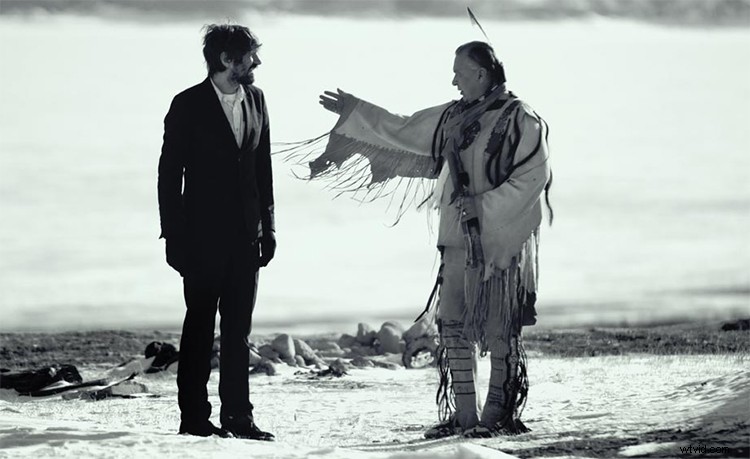
One of the most interesting things in the film is the part spotlighting the native people who have this culture that’s completely disappearing. There was a man who is the last living speaker of his language…
That’s Edwin Benson, a member of the Mandan tribe at the Fort Berthold Reservation — he speaks the Mandan language. And when John Evans visited them, they basically saved John his life. Between 1796 and 1797, he was one of the most isolated people in America and they kept him alive. They were near the height of their civilization at the time. So it was extremely sad to visit them 200 years after John Evans and to find only one speaker left. But it was also a very inspiring visit, because there’s this generation of younger people who want to revitalize the language, and they’re finally getting to teach their own history at the schools. So it was inspiring as well. I’m so glad I got to visit there.
Was it a challenge for you to figure out how to work all of the pieces together and make sure everything got the focus that it needed without staying too heavily in any one area?
That’s what’s great about the app. We had these insightful interviews from the Omaha reservation, and from the Fort Berthold reservation, more to do with the history of the tribes themselves and the political issues they face. The essential narrative of the film was John Evans’ story, which we couldn’t veer off of too much, but with the app, we were able to include all these other elements that feed the story, and go into more detail about the political and social issues. It was great having the book, too, because I was able to go into a lot of detail about the history. And with the music, I was trying to write emotional songs and guess the emotional state of John Evans during his journey.
What was it like for you to put that book together? Have you ever taken on a project like that before?
No. It was very exciting, and it meant I didn’t tour very much for about two years, so I was able to stay at home and see a lot of my kids. I loved writing it, but it was a huge learning experience for me. It’s something that I’d love to do again one day, but I think I was completely unrealistic as to the extent of the task. I had the romantic notion that I could drink a lot of coffee and just write a book. Which is pretty much what I did, but luckily I was completely deluded, so I managed to complete it somehow.
How did you and and Dylan originally start working together for the first film?
Dylan toured for years with Super Furry Animals as a kind of live VJ, doing the visual projections and shooting a lot of original footage. He shot a documentary about the band called American Sasquatch that came out around 2004 on a DVD with a collection of Super Furry Animals music videos. I was inspired by his film to try and think of a way of making a music documentary that had a narrative going through it. So it would be, on one hand, a conventional tour film, but that the tour would be going in a particular direction for a particular reason. Every time I release a record, I do a lot of interviews, so we were talking about using interviews to help build a narrative. That’s what we tried with Separado!, and and then we tried to refine that for American Interior.
Are very interested in history, in general? Or is it specifically these Welsh tales?
I think I must be interested in history. But it’s so interesting looking at history through the lens of a family member, someone who wasn’t part of any elite. It’s been really fascinating learning about all these different elements of American and European and Colonial history through the eyes of a kind of deluded young dreamer.
A project like this could be very overwhelming when you start think about how to approach it. Do you have any advice for somebody who would want to attempt something similar? What would you tell them to do so that they didn’t end up going crazy?
Well, I suppose American Interior is a culmination of about ten years of work, in a way. So it’s just part of a process. The first project I did with Dylan was much smaller. For me, the key has been to just work on a lot of projects and build them. I’ve used each one as the foundation for maybe trying out more ambitious ideas, learning from the previous project. It would have been absolutely impossible for me to do this project previously, but because we’ve done all these other projects, we knew how to approach it so that it wasn’t overwhelming. It was more of a continuation of what we’ve worked on before.
Did you have a good size team helping you to make all of the contacts you needed and set everything up?
Yeah, I had loads and loads of help. The first thing I did was visit my American booking agent after an American tour in 2011, with a map of America. I outlined John Evans’ journey between 1792 and 1799 on the map, and asked him to see if he could book a tour following that journey. And then once the tour was booked, my partner, Cat, who produced the film, was reaching out to a lot of other people to interview along the way. During the journey, I was helped a lot by American friends who I’ve known for many years. My friends Joe and Kelly came along from Michigan and they were helping me phone people up and arrange meetings. And when we went to the Omaha reservation, we made friends there, and we came back to play a show. So the tour kept evolving once we were on it.
If and when you embark on another journey like this, would you want to create this same kind of project, with so many different components? Would you want to do something even more ambitious?
I think the the story itself dictates the medium. For example, the John Evans story, you can easily put enough things for a book into that story. It’s infinite, the amount you could write about John Evans — whereas with our previous film, Separado!, the story didn’t need as much detail. I don’t think every album needs a book and a film and an app, but I think this one did. And if I try and tell a big story again, the story itself will dictate how to approach it.
To learn about upcoming screenings of American Interior and get the album, book, or app, visit american-interior.com.