
Taking lessons from Watchmen and other nonlinear classics, we deconstruct how you can harness the nonlinear style for your film projects.
Long before the 2019 hit show on HBO — or the Zack Snyder faithful big screen adaptation in 2009 — the idea for Watchmen came to writer Alan Moore as a way to repurpose old comics to reflect Cold War anxieties and deconstruct the superhero concept in the original graphic novel series in 1986-1987.
In interviews, Moore has cited the experimental author William S. Burroughs for his use of the nonlinear technique as a way to juxtapose different themes, characters, and storylines. Of Burroughs, Moore says, “He suggested rearranging words and images to evade rational analysis, allowing subliminal hints of the future to leak through.”
The nonlinear style has since appeared in both film and television adaptations of Watchmen — it’s also a popular storytelling device for filmmakers like Christopher Nolan, David Fincher, and Quentin Tarantino. And while it may be tricky to get your head around at times, when done properly, it can be a powerful storytelling and filmmaking device for your short film, feature film, or video projects.
Here’s how to master the nonlinear storytelling technique for your film and video projects.
A Tight Script and Outline
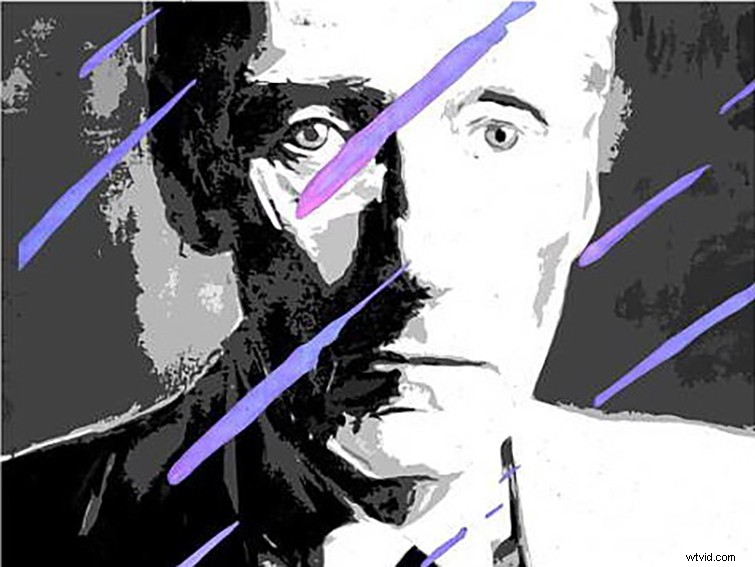
In Burroughs’s “cut-up technique,” the writer takes a finished story; cuts out pages, paragraphs, or sentences; then tosses everything on the ground as a way to randomly reorder the scenes and narrative.
But before you can start making your story into a nonlinear narrative, you need to treat it as a linear one. When done well, nonlinear can be a great device, but more often than not, it comes off as a way to hide a bad script.
You should only turn your great idea into a nonlinear one after you’ve put in the work, gotten your feedback, done your hard rewrites, and created a story that you know can stand on its own. From there, take a solid outline and rearrange certain elements for thematic purposes.
The Script Supervisor and Continuity

If you’re unfamiliar with a script supervisor’s role is, read up on the ins and outs of why you need one. A script supervisor helps not only during pre-production but also on set, making sure everything from lines of dialogue to blocking to hair and makeup stays consistent.
When introducing nonlinear plot devices to your film, it becomes that much more difficult to keep your head on straight. Even if you don’t have the biggest budget or resources for a dedicated script supervisor, having others watching continuity is crucial.
If you want great results like the nonlinear sci-fi love story Eternal Sunshine of the Spotless Mind, every piece of your meticulously crafted sets and characters need to be consistent, even when traveling across time and between dreamscapes.
Consistency of People, Places, and Themes
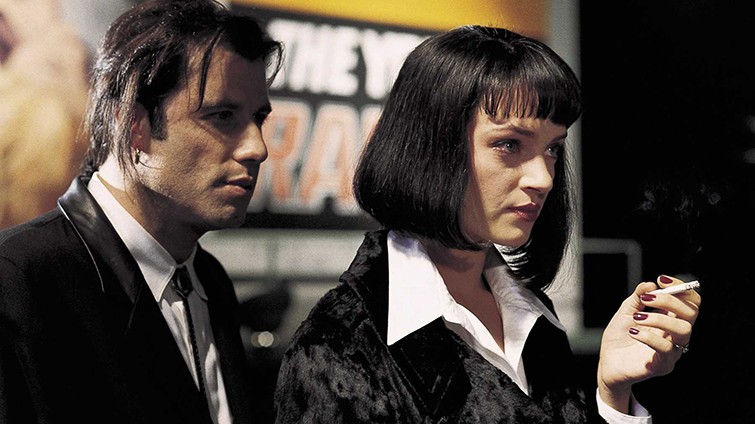
By the 1990s, the nonlinear timeline and narrative technique was becoming popular among many filmmakers. No one auteur seemed to master this technique better than Quentin Tarantino with 1994’s feature Pulp Fiction. While this post-modern film employs a very unconventional structure, rife with homage and self-reflexivity, it also strives for a remarkable sense of consistency across the people, places, and themes.
All the different narratives feel like they’re connected, and in many ways, they are. This is intentional, and it helps that the director is the same person who came up with the idea and penned the script. A complete understanding of the narrative world is essential for the nonlinear device to really feel consistent — like it’s telling a story much bigger than a normal, linear one.
Filming Chronologically vs. Non-chronologically
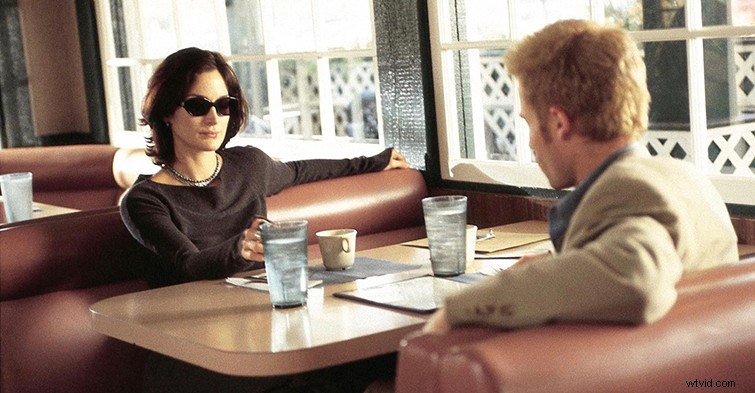
An interesting question many nonlinear filmmakers have to face is the issue of shooting chronologically or not. Traditionally, most films do not get shot in order or scene by scene, simply out of necessity. However, occasionally some directors will try to work this way to help their actors give better performances. With nonlinear projects, though, the question of chronological production becomes a bit trickier.
For films like Christopher Nolan’s Memento, which uses a nonlinear technique that basically tells the story backwards, the idea of filming chronologically actually makes a bit more sense. It really comes down to your story and how much time you want to balance between recreating scenes you’ve already shot, or are able to shoot, in the necessary order.
Don’t Lose Sight of the Beginning or the End
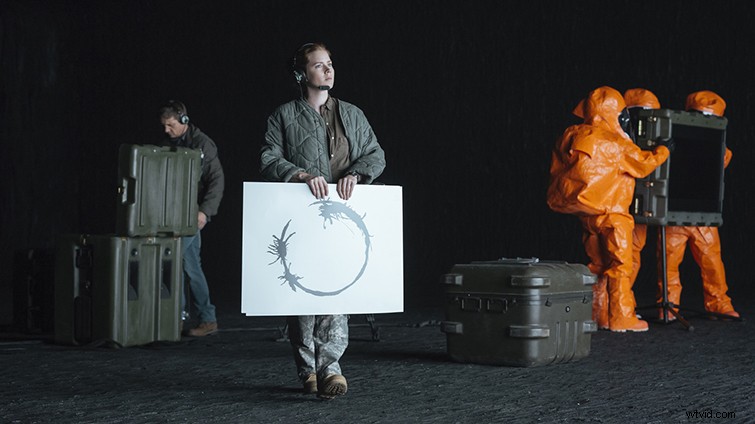
Finally, taking the 2016 sci-fi thriller Arrival as an example, it’s important to never lose sight of the beginning or end of your nonlinear film project. Like any linear project, a film is a journey from point A to point B (with many complications in-between). However, for nonlinear narratives, those points can quickly become confused. Or, in the case of Arrival, they’re actually the same place.
Yet, if the goal is to tell the story of the journey, clearly defining those two points — not just for the narrative, but for your individual characters and their arcs — will help you stay on track, even with the many theoretical challenges of telling a story out of order.
Cover image from Watchmen (via HBO).