
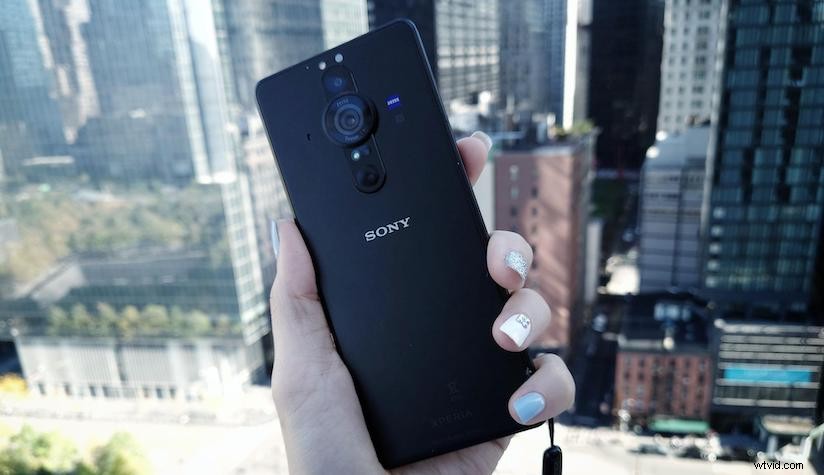
If a Sony RX-100 and a mobile phone had a baby, it would be the Sony Xperia Pro-I mobile phone. Once again, Sony proves that they are making smartphones for the true creators. The “I” in the name stands for “imaging,” and rightly so. This device hones in on the most important attribute of photography: capturing and controlling light.
While other brands are out there trying to get us to compare megapixels, Sony has focused on what really affects image quality — sensor size. The image sensor in this phone is a full inch. Compare that to most mobile phones whose sensors are about one centimeter.
Sometimes, size matters. Bigger sensors capture more light. As a result, the Xperia Pro-I phone has fantastic dynamic range, low light capability, and depth of field. Check out this shot I was able to get (handheld) from before sunrise at the Empire State Building.

As with all Xperia phones, the Sony Xperia Pro-I device allows maximum creative freedom with loads of manual options. The most notable new feature is a mechanical dual aperture, with f2.0 and f4.0 while shooting at a 24mm focal length. The aperture is another determinant of light collection. When there is bright light, you can use the f4.0 to avoid overexposure and keep the subject tack sharp. In low light situations, you can open up to f2.0 to let the light pour in. It’s a feature that means a lot to photographers. This is a type of tech that has been attempted by other brands, but it’s fallen a bit flat because it wasn’t supported by the rest of the hardware. On the Sony Xperia Pro-I, there’s a big, beautiful sensor behind it.
We should also talk about what’s in front of that mechanical dual aperture: the lens. In the past, allowing lots of light in could lead to softness or flares. In order to handle the light properly, you need good glass. The Xperia Pro-I phone uses Sony Alpha imaging technology in its lenses. It’s the only phone on the market with Zeiss T*-coated glass which is specifically designed to reduce flaring and ghosting. As for the lenses included in the Xperia Pro-I phone, there’s three: 16mm, 24mm, and 50mm. This range is perfect for me, as I typically shoot a lot of architecture and cityscapes.
True to the Xperia tradition, Photography Pro also gives us a full range of control over settings like shutter speed, ISO, white balance — and now, aperture. In the photo below, I wanted to capture the sharp contrast of the repeating lines of the Oculus ribs while giving the evening commuters a dream-like quality. Therefore, I had to let in a fair amount of light, but slowly. I manually switched to f4.0, adjusted the ISO down to 100, and slowed the shutter speed down to 1/2. A different smartphone would have tried to “correct” the blur of the people that I was trying to achieve an image that evoked the fugue induced by a long day’s work.

On the display side of the device, there’s a 6.5” 4K OLED screen which is very useful for viewing and editing on the fly:
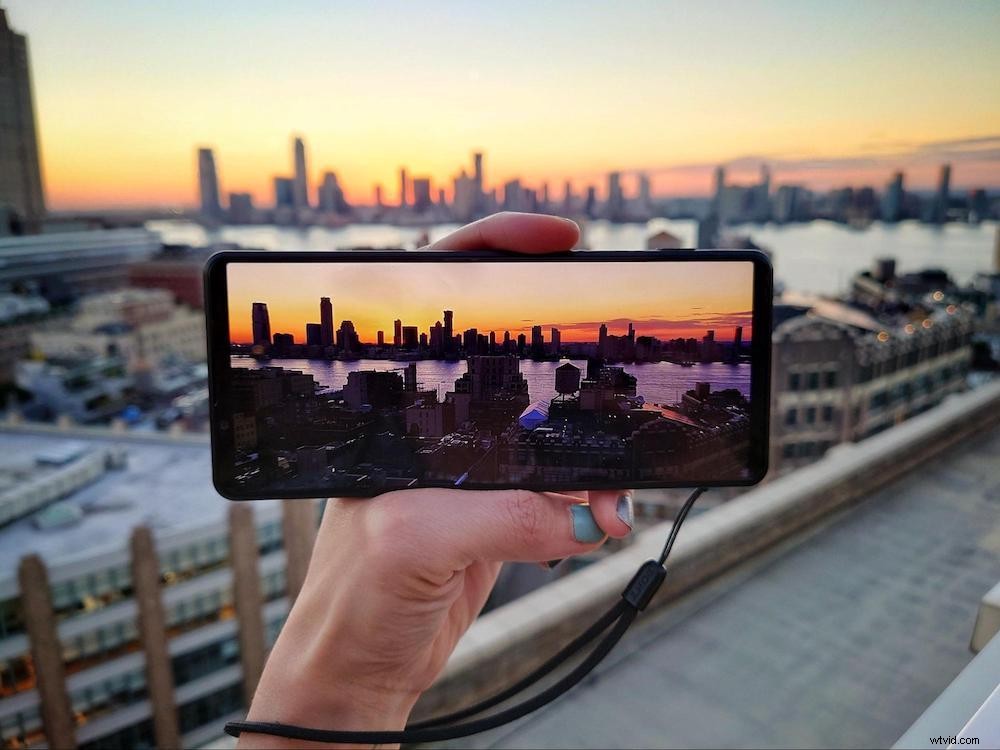
The other thing I’ve always really liked about the Xperia line is their thoughtful attention to detail. On the Sony Xperia Pro-I phone, the embossed shutter button makes it easy to find with your finger as you’re pulling it out of a pocket. You can hold the button down to open up Photography Pro even when the phone is locked, so you’re not wasting valuable seconds. They’ve also added a dedicated round video button. There’s so much incredible tech packed into this device although, I also appreciate the new built-in eyelet for a wrist strap. It keeps the camera handy while I’m walking and secure when I’m leaning over a rooftop to get the shot. It just hits home that Sony really understands how creators use their devices.
I watched the launch of a new phone that was released recently, and the majority of the talk was around machine learning and computational imaging that would automatically mold photos into a mainstream definition of attractive. There’s nothing wrong with that approach, but it struck me how different the Sony mindset is. They seem to be hardware-forward. They give creators the raw tools they need to push limits.
See more of the Xperia Pro-I at AdoramaTV:
The Sony Xperia Pro-I mobile phone will be on pre-sale soon.