
Over the past five years or so, HDR (high dynamic range) has become a huge part of my photography.
Even with the latest advances in camera sensor technology, the dynamic range of the human eye is much wider than any modern camera sensor, and as a result, can only partly interpret the human experience. The goal of HDR photography is to artificially increase the dynamic range of a given photograph, making it as close as possible to the human experience.
I do not consider HDR to be a photography style, but rather, a technology that helps us to extend our creative reach and overcome the limitations of modern photo equipment, specifically a camera’s sensor.
When the dynamic range of the scene we capture exceeds the dynamic range of the camera’s sensor, it results in the loss of information (or details) in both the highlight and shadow areas. HDR technology allows us to separately capture these details from the darker and brighter areas of the scene, and merge that information during the editing process.
Even though every generation of modern camera offers a larger and larger dynamic range that gets even closer to the human experience, HDR technology continues to be an extremely valuable tool to have in your toolkit.
But, those who read my blog and follow me on social media often give me a hard time when I post an HDR processed image with a dynamic range that is not extreme. As a result, I get blamed for using HDR for no reason and am accused of intentionally complicating the editing process.
In this article, I will demonstrate exactly why and how I use HDR when the lighting of a scene is not too extreme.
I took the featured photo in the Eastern Sierra during my driving trip to the Southwest.
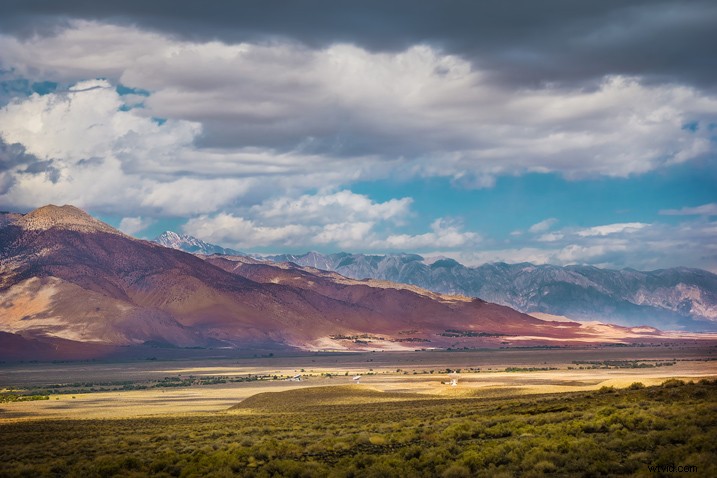
Covered by the clouds, the sun diffused the light and made it less dynamic. I could see right away that I did not need HDR processing to capture and preserve the entire light range. However, I took three bracketed shots anyway just to make sure I collected as much information from the scene as possible.
When I started editing the photo in Lightroom, I only used a single RAW image (middle bracket). The challenge was to overcome the mild haze in the air, so I had to apply pretty aggressive edits in Lightroom (contrast, clarity and vibrance) to bring back the contrast and colors of the scene.
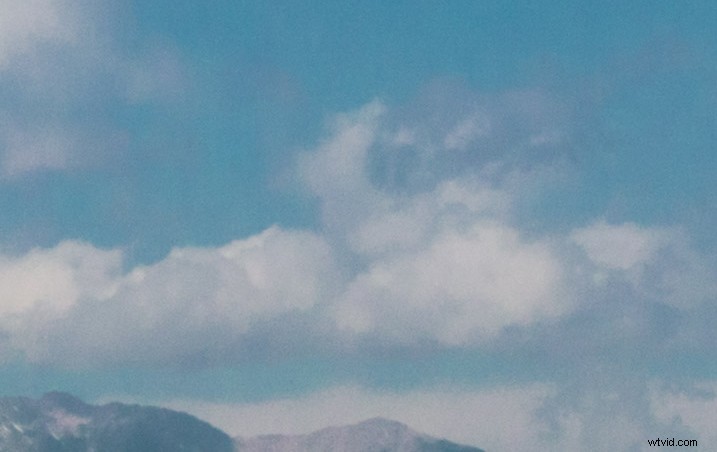
Once I was happy with the result, I evaluated the image by zooming in to 100% (1:1 in Lightroom), in order to see what noise reduction setting to use. When I did this, I realized that the image started to break up because of my aggressive editing. The deterioration in the image was beyond digital noise and was almost impossible to fix even using the dedicated noise reduction tool.
This is when HDR came to the rescue. I selected three bracketed shots and merged them to HDR using the HDR Merge module of Lightroom.
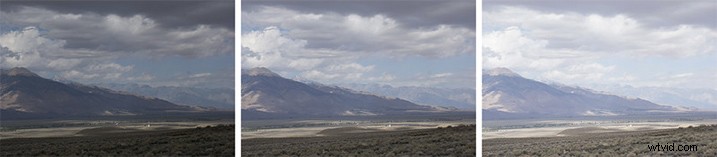
After Lightroom produced a brand new HDR image in DNG format, I used the Sync functionality of the program to apply the editing setting of the original RAW file, to the new HDR image.
The effect of the edits were identical to the original RAW file, but the image was much cleaner without any traces of deterioration. The newly created HDR file had much more information and details, which allowed me to push it much harder without producing negative artifacts.
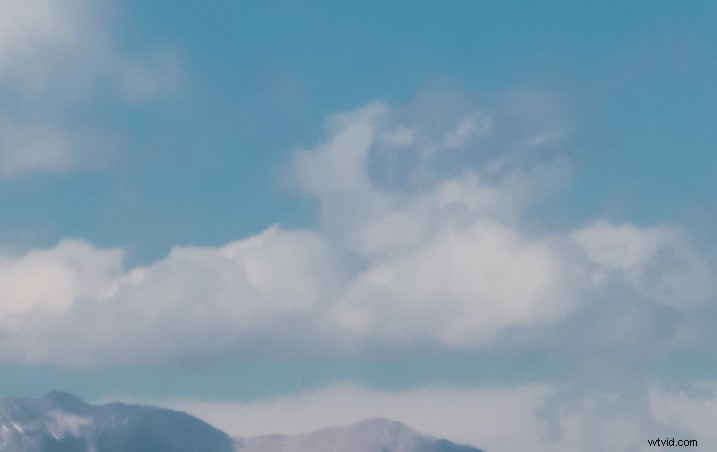
The image is cropped 100% without any noise reduction added.
The digital noise of the image was mild and was completely eliminated using the noise reduction plugin.
Conclusion
By merging multiple images to HDR, it not only helps us overcome the dynamic range limitations of modern photo equipment, but can also to produce images that have more digital information and details, compared to individual out-of-camera RAW files.