
Have you ever seen text scrolling at the bottom of a film that you can’t turn off, or encountered a theater listing marked “Open Caption” and wondered what it signifies?
Open captions—text permanently burned into the video—are increasingly common across movie theaters, streaming services, and social media platforms. Understanding them is essential for a broad audience: from hard‑of‑hearing viewers and language learners to anyone who prefers to watch content on mute.
In this guide we’ll define open captions, explore their applications in various media environments, and contrast them with closed captions.
What does open caption mean?
Open captions display text directly on a video or movie screen and cannot be toggled off. The term “open” indicates that the captions are always visible to everyone watching, as they are embedded—or burned—into the video itself.
If you’ve ever watched a foreign film with subtitles that appear directly on the screen, you’ve seen open captions. Unlike closed captions, viewers cannot turn them on or off through TV settings or a streaming platform; they are part of the video file.
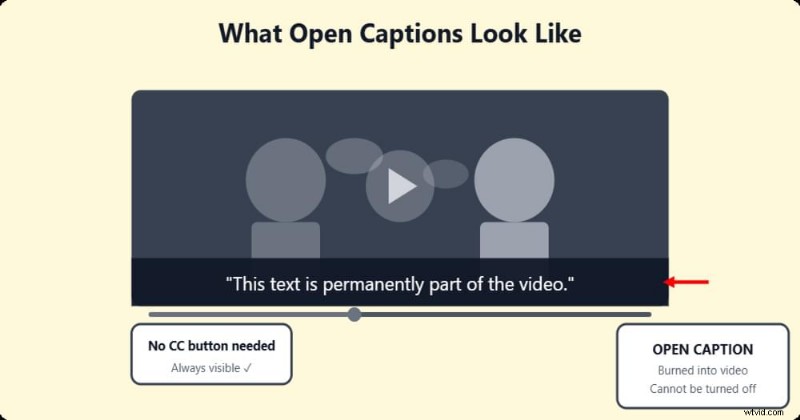
Open captions are invaluable in scenarios where caption settings cannot be controlled, such as autoplay videos on social media or content viewed in a public space where sound is muted.
Related article: Understanding the difference between subtitles and captions
Open Captions in Movies
Open captions serve multiple purposes in film, most notably translating foreign-language dialogue. For example, if an English‑language movie features a character speaking Spanish, the translated text will appear on screen as a burned‑in caption.
Beyond translation, filmmakers often use open captions creatively to display timestamps, character thoughts, and location names, adding an extra layer of storytelling.
Open Captions in Movie Theaters
While most theatrical releases do not include open captions, some cinemas now offer them to broaden accessibility, especially for viewers with hearing impairments.
These theatrical versions feature dialogue, sound effects, and other relevant audio information as on‑screen subtitles.
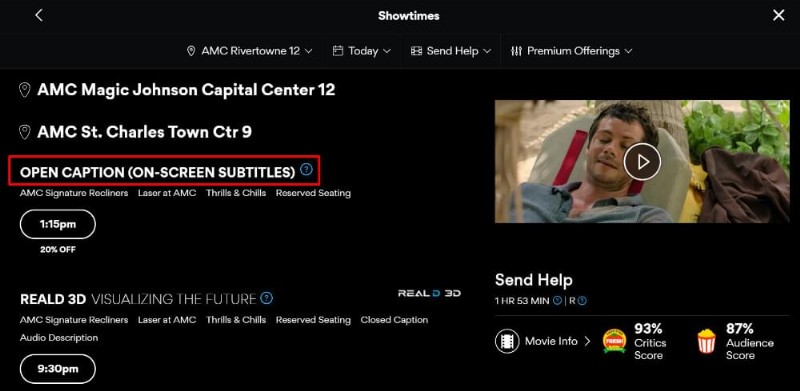
Major chains such as AMC provide dedicated showtimes for films with open captions. Look for the “Open Caption (On‑Screen Subtitles)” label on the theater’s website or app, and a screening labeled “presented in open caption” will display subtitles throughout the film.
Also read: 6 benefits of watching videos with subtitles
Uses of Open Captions
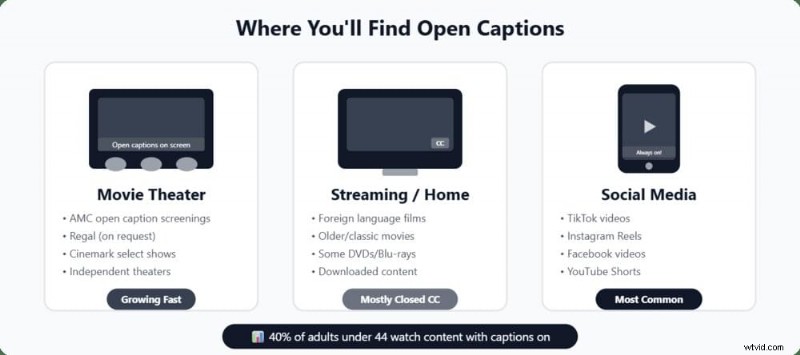
Open captions extend far beyond movie theaters. You’ll encounter them across a wide array of content types.
Social Media Content
On platforms like TikTok, Instagram Reels, YouTube Shorts, and Facebook, open captions are the default. With 85% of mobile videos watched on mute, hard‑coded captions capture attention and boost engagement.
Creators benefit from higher visibility as platform algorithms prioritize captioned content for accessibility and engagement.
Corporate Training and Presentations
Organizations often embed open captions in internal communications, onboarding modules, and training videos to ensure all employees—regardless of hearing ability or language proficiency—can follow along.
Simultaneous audio and text help employees absorb complex information and improve retention.
Public Displays and Digital Signage
Airports, hospitals, gyms, retail stores, and transit hubs use open captions because ambient noise makes audio unreliable. Burned‑in text delivers clear messaging in noisy environments.
Education and e‑Learning
In education, open captions enhance comprehension for all students, especially second‑language learners, and provide a valuable resource for reviewing recorded lectures or accessing content in audio‑restricted settings.
Related article: Top 10 benefits of subtitles and captions
Why Open Captions Matter for Engagement
Statistical evidence underscores the engagement benefits of open captions:
- Higher completion rates: Verizon and Publicis Media report that up to 80% of viewers finish a video with subtitles.
- Improved engagement: Captioned videos retain viewers longer than those without subtitles.
- Greater reach: Open captions make content accessible to hard‑of‑hearing audiences and non‑native speakers.
- Better comprehension: Even viewers with normal hearing prefer captions to clarify unclear dialogue, strong accents, or noisy environments.
Open Captions vs. Closed Captions
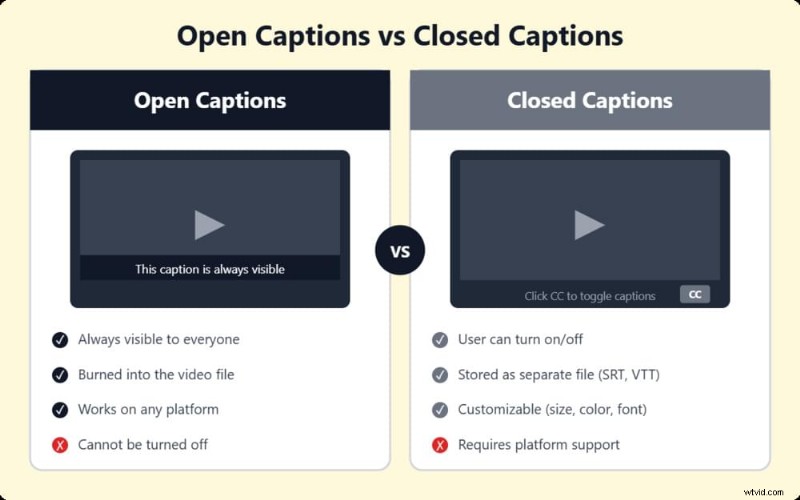
Below is a quick comparison of key differences:
| Feature | Open Captions | Closed Captions |
|---|---|---|
| Visibility | Always on, cannot be turned off | Can be toggled on or off |
| Location | Burned into the video file | Stored in a separate file (e.g., SRT) |
| Customization | Fixed appearance (hardcoded subtitles) | Often adjustable (size, color, font) |
| Platform requirements | Works everywhere | Require platform support |
In practice:
- Use open captions for: social media content, public displays, platforms lacking closed caption support, and when you want guaranteed subtitle visibility.
- Use closed captions for: long‑form streaming, content where viewer preference varies, multilingual options, and SEO‑friendly material.
Related article: What are SDH Subtitles? Difference in SDH and Closed Captions
Conclusion
Open captions are a versatile tool that ensures your message reaches every viewer—whether on mute, in a noisy setting, or with hearing challenges.
Creating them is straightforward with AI‑powered subtitle generators like SubtitleBee. Simply upload your video, and the AI produces accurate, burned‑in captions with up to 99% precision. Try SubtitleBee for free and elevate your content’s accessibility today.
FAQs About Open Captions
What is the difference between open captions and subtitles?
Open captions are permanently embedded into the video, making them unchangeable by viewers. Subtitles, by contrast, typically translate dialogue for viewers who can hear but do not understand the language spoken. Open captions also include descriptions of sounds, music, and speaker identification, offering a more comprehensive accessibility solution.
Can you turn off open captions?
No. Because they are baked into the video file, open captions cannot be disabled. If they distract you, seek a version that offers closed captions instead.
Why do some movies have open captions?
Films include open captions for several reasons: translating foreign dialogue, displaying on‑screen text integral to the story, and ensuring accessibility for hard‑of‑hearing audiences. New regulations in states like Maryland and Washington now require theaters to offer open caption screenings for broader accessibility.
Are open captions the same as subtitles?
While both display text, open captions go beyond simple translation. They provide a full audio description, making them ideal for deaf and hard‑of‑hearing viewers. Subtitles focus solely on spoken words.
How do I find open caption movie showtimes?
Check local theater websites or apps for showtimes labeled “Open Caption,” “On‑Screen Subtitles,” or “OC.” Major chains such as AMC, Cinemark, and select Regal locations offer dedicated open caption screenings.