
Take a fresh look at man's best friend, get creative with your flash and other photo remedies.
| Published Dec 17, 2008 7:17 AM EST
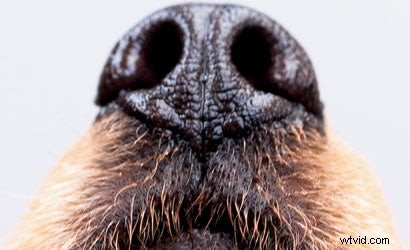
Why It Works
•Fundamentals: Wacky angle, extreme close-up.
• Angle: At first, we thought this was a very hairy extraterrestrial. The view from below is initially startling, then hilarious. We’ve seen in-your-muzzle pet pictures before, but this one is truly that elusive “different take.”
• Close focus: What also makes the picture is the fine detail in the fur and the nose — it makes you feel cold and wet and warm and fuzzy all at the same time. The focus and depth of field indicate that this was no grab shot.
• Lighting: Impeccable. Every whisker stands out.
• Framing: Filling the whole frame adds to the effect, as does the absolutely plain background.
• Fun factor: We all take photography too seriously at times. Shots like this show us that goofing around and making worthwhile images are not mutually exclusive.
For more great pet pictures by photographer Andrew Morrell, go to www.andrewmorrell.com.
5 Ways to Lighten Up With Flash
Too many people use their camera’s built-in flash only for indoor pictures, but you can pump up your photos with flash more creatively. Just about every camera made today has an automatic fill-flash setting that will augment, but not overwhelm, the main light source. Most DSLRs also allow you to adjust the fill-flash output (“flash exposure compensation”), as do many compacts.
1 Pictures taken in direct sunlight tend to be overly contrasty, with inky black shadows. A judicious dose of flash adds enough light to the shadows to reveal their detail without lightening the picture overall.
2 For portraits of people or animals, flash, even at a very low power, adds catchlights, those twinkly highlights that bring eyes to life. (Try -1.7 or -2.0 EV, if you have adjustable flash output.)
3 In the same vein, a low-power flash will add sparkle to reflective, textured surfaces, such as a lamé dress, without otherwise altering the image.
4 Taping over the flash with colored plastic film — such as cellophane, acetate, or photo gels — lets you mix flash of one color with ambient illumination of another for creative lighting effects. A colored flash used for fill makes another interesting effect: Shadows are a different color than the midtones and highlights.
5 Outdoors at dusk, foreground objects often appear as featureless silhouettes. To add visual interest to twilight photos, pop that flash to reveal the foreground. This is how I got detail in the Joshua tree in the lower photo at right. — Timothy Edberg
| Without Flash | With Flash |
| Timothy Edberg |