
Explore the difference between homage and plagiarism, and learn to incorporate another artist’s ideas while maintaining artistic integrity.
They say imitation is the sincerest form of flattery, but it doesn’t make for original ideas. There’s a fine line to walk when creating your own projects that may borrow from creators of the past, as well as current artistic greats. Let’s chat about the difference between homage (borrowing) and straight-up plagiarism, and how you can effectively incorporate a previous artist’s ideas into your own work, while maintaining your artistic integrity.
What Is Homage?
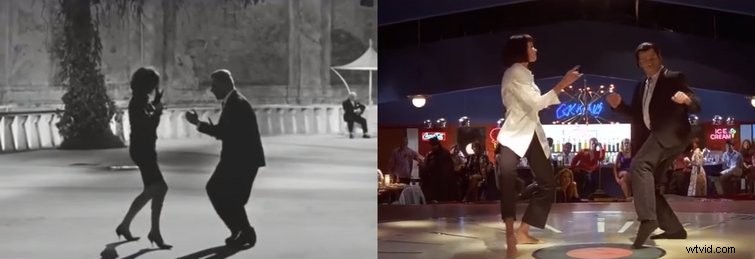
In the most generic sense, “homage” is to show respect or pay tribute to something or someone. Homage can be found in any medium, from music to painting, or even basketball and car designs. In most cases, the homage is a reference to a great piece of work, a famous person in the craft, or a defining feature of a genre.
We all have artists, musicians, and (of course) filmmakers who we love. Wanting to imitate those we look up to is human nature and often how up-coming filmmakers find their own voice. When we’re all starting out, we look to do the same things our favorite directors are doing as a way to be creative ourselves. I’ll be honest and say that I may have written a Quentin Tarantino-esque short film my freshman year of college—filled with profanities, over-the-top violence, and what I thought was witty dialogue. I don’t think I’m alone in making that mistake, but it did help me grow as a filmmaker.
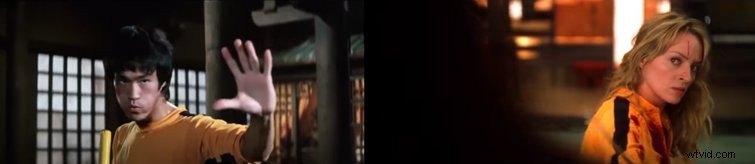
My poor attempt at replicating Tarantino‘s style is clearly stealing. Homage is more of a subtle touch (or reference) to an important work or artist, rather than a heavy-handed approach.
Ironically, one could argue that Tarantino is the king of homage. He was heavily influenced by the films and TV shows of his childhood, and borrows a lot of references and stylings of that era. Rather than blatantly stealing from his influences, he incorporates minor touches into his films and crafts them with his own creativity. The greats of the past have laid some groundwork as to what works in storytelling, and what works visually on film. It’s entirely appropriate to build off of their work to create shortcuts that overall improve your own work.
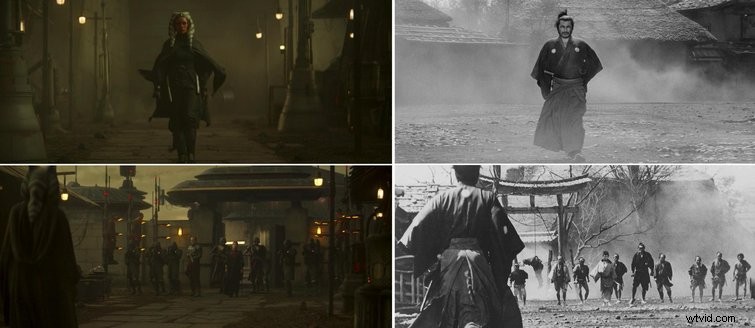
When homage is used correctly, not only does it pay tribute to influential work and build off ideas already established, but it can be a creative shorthand that’s greater than the sum of its parts. For instance, in the most recent season of The Mandalorian, “Episode 13: The Jedi” borrows massively from the works of Akira Kurosawa and his samurai classics. With the heavy use of reference and homage, we can gather more from the story than solely what’s presented on screen. If the viewer is familiar with the references, they’ll understand more from the story and what the filmmakers are trying to tell. Homage is a clever literary and storytelling device that can provide even more depth to our stories than what’s seen on the surface.
Using Homage in Your Own Work
The line between homage and plagiarism can be a little blurry, especially when it’s not explicitly obvious you’re making a reference to someone else’s work. Recently, even some famous directors walk a fine line and have been accused of copying other directors’ work.
In 2018, Guillermo Del Toro was accused of stealing the iconic tap dance scene in The Shape of Water. Personally, I disagree with this sentiment. Guillermo del Toro has a history of classic references in his work and several nods to other works in The Shape of Water alone. So, here are a few guidelines on how you can effectively include homage into your own work and avoid accusations of stealing!
Have a Purpose
There’s nothing worse than referencing a film for the sake of reference. Yeah, yeah, we get it, you’ve seen A Clockwork Orange and it’s your favorite film. However, that’s not a reason to make your main character only consume tall glasses of milk. Make your references make sense in the story you’re trying to tell. Work homage organically into your script and story ideas—insert them naturally and with purpose.
Instead of trying to shoehorn in your references, work toward them. Rather than starting with an homage and shaping the storytelling around it, think about how a reference or homage could help strengthen the story you’re trying to tell. Does the homage really help the scene or does it feel out of place?
Change It up a Little
A perfect way to use homage, or techniques of the past, is by changing the application to fit your own purpose or unique scenario. This can be a little challenging depending on the work you’re referencing. But, if the genre, tone, or characters are quite different from the original application, the homage will come off as more authentic and impactful.
Below is an example of how Pixar has used references to classic cinema in their own films. You can see a stark contrast in the tone between the light-hearted, family-friendly films of Pixar and many films that fall into the horror, fantasy, or action genres, including Alien, Vertigo, Star Wars, and Goldfinger. The references made by Pixar are still effective in their own films and give off a different feeling, but use the groundwork and techniques of other classic films.
As an example, imagine we’re trying to tell a comedic story of a character who’s trying to evade Character B at a house party. Just as our protagonist thinks they’ve gotten away, Character B shows up right behind them, over their shoulder. This would make a great time to use the classic Jaws, “We’re going to need a bigger boat,” framing within this scene. We’ve made use of an homage by not directly copying the application, setting, and genre of the original film, but are still able to correctly make a reference to Jaws and use it effectively.

Dissect and Reimagine
When looking at classic or influential films, it’s a good habit to think about why and how certain techniques work. What makes the framing so special? Why is the character’s positioning important? What does the dialogue say about the characters? Basically, you’re finding the defining factor within a given shot, scene, and/or line. When looking to use homage in your own work, it’ll be beneficial to think about how the original reference worked so well and why it’s memorable.
Breaking down why the homage should be referenced to begin with will help you find the correct time and place to use it. This could be similar to my above suggestion of “Finding a Purpose,” but it’s a little more than that. Finding the defining factor of the original work will also help you read and understand films better from a viewer’s perspective. As you become aware of the techniques that are effective in other stories, you’ll find places to include similar techniques or homages in your own works.

Finding the defining factor of a reference you plan to use will help you find the correct location to use the reference. You may figure out the homage you were going for doesn’t work at all within your given context, and that’s okay. The goal is to make the best end-product possible, not to fit in as many references as humanly possible.
Homage has a long tradition in the filmmaking world and can be a creative storytelling technique. It feels good to be able to reference films that have influenced us or cinema classics. Finding the right time and place for a proper homage can sometimes be difficult and a challenge to pull off correctly. These few tips will get you on the path to incorporating homage into your own work and maybe one day getting referenced yourself.