
We’ve compiled a list of pertinent stock footage terminology for you here. Read it, learn it, use it. And impress that next client.
Are you trying to figure out what “codec” means? How about “compositing,” “4K,” or “B-roll,” for that matter? Your answers lie here in our Shutterstock video glossary. Scroll on for a list of common terminology and explanations of concepts relevant to the stock-footage industry.
Please note that most terms link with a full-page blog that further expands on tips and tricks around that specific term.
Stock Video Glossary
16:9
The most commonly used aspect ratio of high-definition footage—a wide, rectangular-shaped image with a width of sixteen units and height of nine units.
24p
Footage recorded at 24fps (frames per second) progressive. In a single second, each movie clip is comprised of twenty-four individual frames.
2D Animation
Each object in a frame is created from a single perspective. Motion is simulated by each image leading to the next in a gradual progression of steps.
3D Animation
Animation is a character or object drawn or digitally created in all three dimensions (width, length, and depth).
4K
Displays and videos that offer a horizontal resolution close to 4000 pixels and a vertical resolution close to 2000 pixels (HD, by comparison, is 1920 x 1080).
For TV broadcast, 4K is commonly referred to as 4K Ultra HD. The resolution of this format is twice that of HD, which equates to the pixels being exactly doubled horizontally (3840) and vertically (2160).
For 4K digital cinema projection, standard horizontal width of 4096 pixels (2160 vertically) was established by the Digital Cinema Initiatives group, a joint venture of the major motion-picture studios.
4:3
Square aspect ratio of standard-definition footage. The image height is 4 units wide by 3 units tall. Historically used in the early days of cinema, but has since seen a revival with modern indie films.
ADR (Automated Dialogue Recording)
This is where you record dialogue in post-production to replace production audio—also referred to as looping. This may be required as the set or location was too noisy at the time of filming.
Aerials
Shots filmed from a helicopter, airplane, or drone provide a sweeping overview of a setting (flying over a park, building, or field).
Alpha Channel
The alpha channel defines the areas of transparency in a clip or still image. A grayscale channel contains white and black levels, which determine the different levels of transparency applied to color channels during compositing.
ARRI
Manufacturers of the ARRI ALEXA and ARRIFLEX cameras.
Aspect Ratio
The width of an image divided by its height.
ASA
American Standers Association measurement used to classify the speed of negative film stock or the sensitivity of a digital image sensor, often used side-by-side with ISO.
B Roll
A catchall term for additional footage that provides supporting details and greater flexibility when editing video.
Common examples include the footage used to cut away from an interview or news report to help tell the story. Professionally, the B-roll would be captured by the B-unit.
Backgrounds
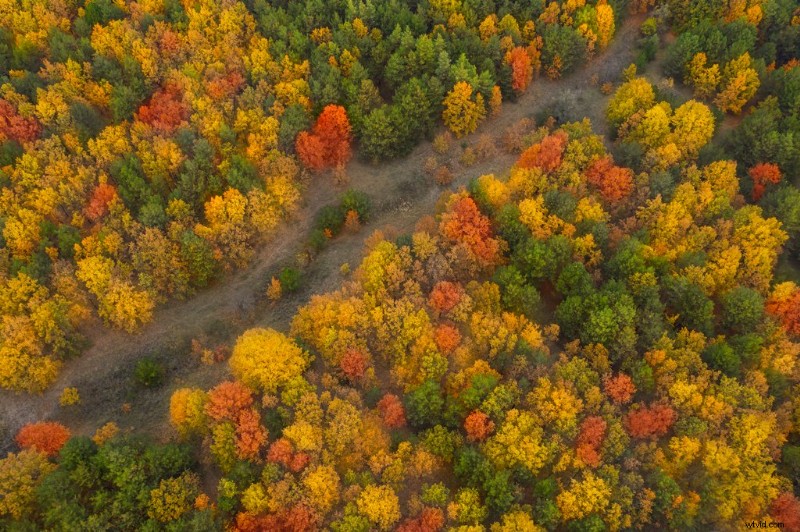
Either what’s literally behind a subject or object, or placed into a green-screen backdrop.
Blackmagic
An Australian camera company that offers cameras with impressive dynamic range for a comparatively low price.
Bitrate
The amount of digital data being processed during a given time period.
Block
To determine the choreography for the actors and desired angles for a scene.
Breathing
Often titled lens breathing, this is the visible wobbling on the edges of the frame. This will happen as the lens focus is changed, and you’ll typically see this on still lenses.
Cinema lenses are designed to negate lens breathing, which is also why they cost significantly more.
CGI (Computer Generated Imagery)
Anything rendered via computer part of a scene. The movie Avatar, directed by James Cameron in 2009, is an example of a film that contains primarily computer-generated imagery.

Chroma
The color portion of a video signal.
Chroma Key
*See green screen.
Close-Up
A shot in which the frame is filled almost entirely with the subject’s face.
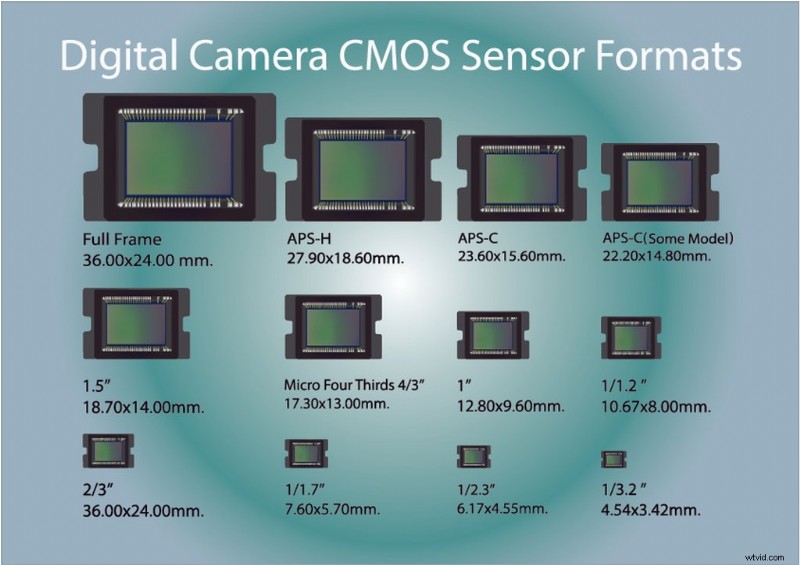
CMOS
Complementary metal-oxide-semiconductor chip.
Codec
A device or computer program capable of encoding or decoding a digital data stream or signal
Color Space
A method of mathematically representing color for use with a specific display or medium.
Color Temperature
The term that describes the color characteristics of a light source. The color temperature is measured in kelvin, and light will usually be described as either a warm or cool light source.
Composite Shot
Combining video clips from several sources into one video.
Crane (a.k.a. Jib)
A large piece of equipment for capturing footage from a high vantage point.
Daytime (DX)
Generally used to refer to a shot needed to match another image. For example, a daytime interior shot at night.
To match exterior lights, such as from a window, a customer might be looking for a daytime exterior shot to composite into a frame.
*See also Nighttime (NX).
DSLR (Digital Single Lens Reflex)
A camera that shoots photos and videos with a viewfinder showing the actual light going through the lens.
Driving Plate / Processing Plate
A shot with no actors, generally used for the background of a scene that will be composited with the actors to create a final scene.
A driving plate is usually the POV out of a car or vehicle. Think of the front window of your vehicle as being a screen. Your POV would be the street ahead of you, with buildings getting closer, while the back window would show the same road, but with the car moving away from those same buildings.
Establishing Shot
A shot that sets the scene. Is it in the city, the countryside, space, or underwater? Often, these are landscape and aerial shots.
EVF (Electronic Viewfinder)
Mirrorless cameras (that have EVFs) require the camera to have power in order to look through the viewfinder and lens.
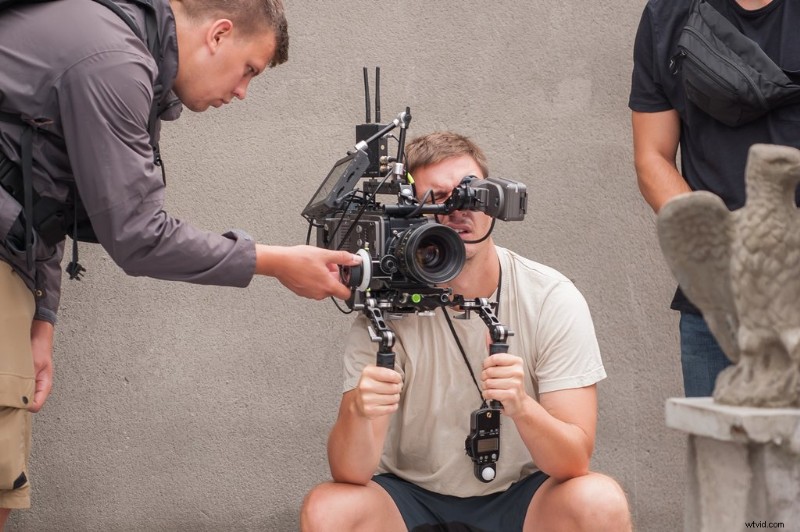
Focus-Puller
A crew member who manually adjusts lens focus during a shot.
FPS (Frames Per Second)
Cinema and motion pictures are 24fps. TV shows, especially news and soap operas, are shot at 30fps.
Higher frame rates are used in sports video (60fps) and for slow-motion effects (shot at 120fps or higher and played back at 24fps).
GoPro
A camera and media company famous for making tiny, rugged cameras attached to almost anything and giving great POV shots.
Grade
Color correct an image.
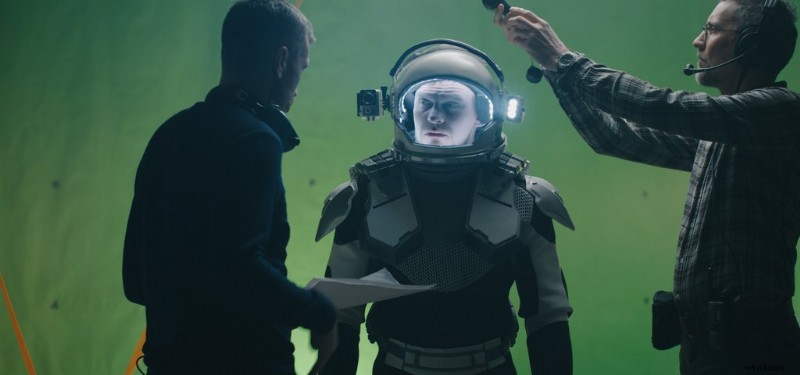
Green Screen (a.k.a. Chroma-Key Compositing)
A technique for which actors or objects are placed in front of a bright green (sometimes blue) background and is replaced with different footage.
Handheld
Shooting footage with no stabilizing equipment (which can often lead to shaky footage).
Histogram
An analysis graph of image exposure. The histogram graph is split into thirds and reads the shadows, midtones, and highlights from left to right.
We recommend to try and expose your image where the bulk of the graph data is within the midtones range.
Insert Shots (a.k.a. Cut-in Shots)
Shots showing objects or props that a character is manipulating, such as a phone getting dialed or a cup being picked up.
Jib
*See Crane.
Landscape
A shot that helps set up or ground a setting by showing where the action takes place (such as an NYC skyline, the Grand Canyon, or a ship at sea).
Locked Down
When the camera has been secured to a tripod or other support device in a fixed, stable position to eliminate any camera shake.
Linear
A method of expressing values of color and brightness equally across an entire range of altitude.
LOG (Logarithmic)
A method of expressing brightness and color values on a curve.
Luma
The brightness of an image, independent of color.
LUT (Look Up Table)
A set of instructions used to profile color and gamma to simulate their appearance on a given medium, such as an HD display or a specific film stock.
Medium Shots
Shots that show the subject from about the hips or waist up. These are useful for when a subject conveys information, allowing you to still see them interacting with their environment.

Metadata
Information that’s stored and attributed to each media file. This can range from the aperture used on the lens to the director’s name.
Mirrorless
The technological successor to the DSLR. Unlike DSLR cameras, which have a reflex mirror inside them to which the light bounces up into the optical viewfinder, the mirrorless camera has the light go directly into the image sensor.
With this, the images you see through the viewfinder and LCD screen are often a 1:1 preview of the image you’ll capture.
Nightime (NX)
Generally used to refer to a shot needed to match a shot, like a nighttime interior that was shot during the day.
*See also Daytime (DX).
NLE (Nonlinear Editor)
Such as DaVinci Resolve, Adobe Premiere Pro, and Final Cut Pro.
NTSC (National Television System Committee)
A method for encoding broadcast television used primarily in North America and some areas of South America. Alternative methods used in other countries include PAL and SECAM.
Panning
Moving the camera left or right on a fixed vertical axis.
PAL (Phase Altering Line)
A method for encoding broadcast television used in many parts of Europe, Asia, Africa, Australia, and South America. Alternative methods used in other countries include NTSC and SECAM.
Pixel
A single square or bit of an image. Most images comprise many millions of pixels.
POV (Point of View)
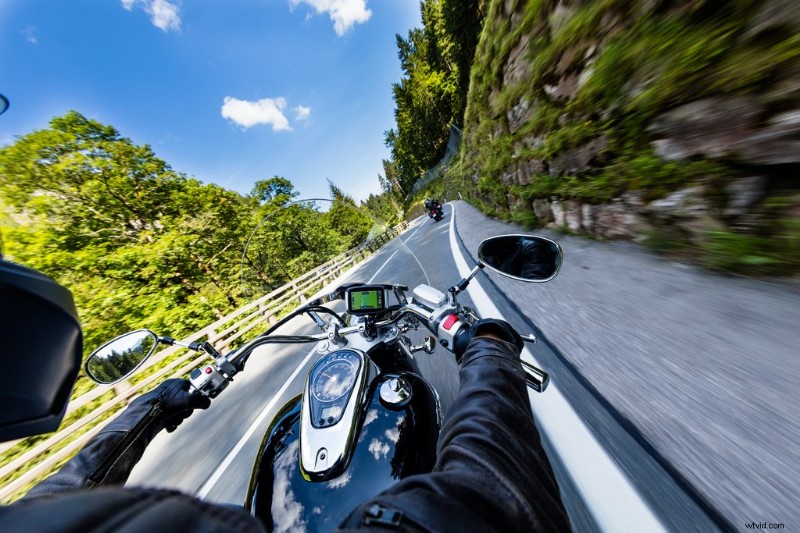
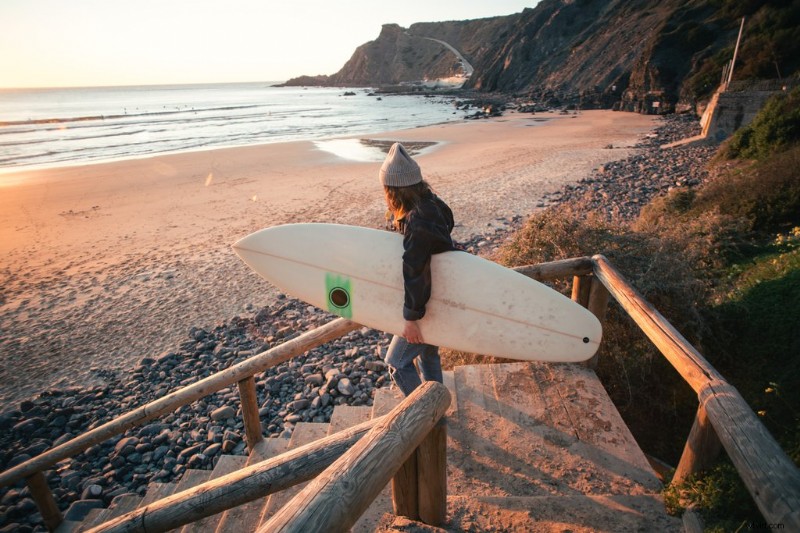
A shooting technique that shows the perspective of a scene literally from a character or object’s position in the setting, such as a GoPro helmet camera’s view of a bike ride or the perspective from the tip of a surfboard.
RGB
Color data is separated into Red, Green, and Blue channels for viewing on display.
RED
A camera brand renowned for providing high-tech cameras at relatively low prices ($8K-$50K).
RED is highly regarded for its EPIC and Scarlet cameras, which have excellent color detail and high resolution (5K and higher).
Resolution
A measure of the number of pixels an image contains. More pixels = more detail = higher image quality. 640 (horizontal) x 480 (vertical) was the most common resolution for TV (in the past).
In the past fifteen years, however, high-definition resolutions have become more widespread, starting with 1280 x 720, and then 1920 x 1080.
Recently, 4K has emerged as a new resolution standard, with 3840 x 2160 pixels for 4K television. The resolution is a bit wider for digital cinema projection (at movie theaters) at 4096 x 2160.
S35
Image sensor comparable in size to a Super 35mm film frame.
Sensor
The electronic light-sensing mechanism in a camera.
SECAM (Sequential Couleur à Mémoire)
A method for encoding broadcast television developed in France and used in parts of Asia and Africa. Alternative methods used in other countries include NTSC and PAL.
Slider
A device used to move a camera along a track smoothly.
Stabilization
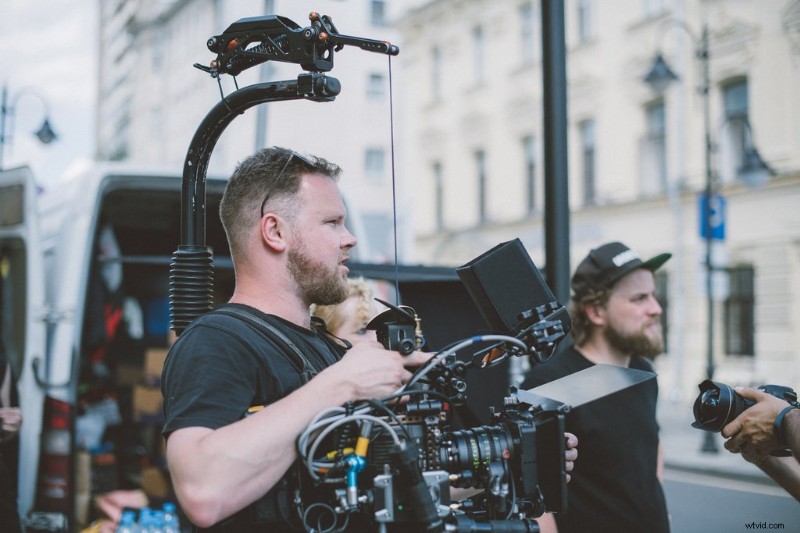
Practical methods used on location to stabilize a camera, like employing a tripod, monopod, shoulder rig, or more involved equipment, such as a Steadicam, glidecam, or Movi.
This can also refer to stabilizing footage after it’s shot using software in post-production.
Tilting
Moving the camera up and down on a fixed horizontal axis, like tilting your head up or down.
Time-lapse
Taking multiple photographs over an extended period and then playing them back at 24 frames per second to show the passage of time.
Transcode
Convert video or audio data from one codec, resolution, and/or format to another.
Wide Shot (a.k.a. Long or Full Shot)
A shot that shows an entire subject and how it relates to the environment at large.
VFX
Visual effects.
Video Village
Location where a DP sets up production monitors for viewing by the director and crew.
XLR
A connector often used for audio peripherals—three-pin for audio, four-pin for power.
Zebra
A customizable striped pattern appearing in the EVF or monitor indicating areas of an image falling outside of a defined exposure range.
Cover image via Gorodenkoff.