
In Time Out of Mind, Richard Gere plays George, a homeless man living on the streets of New York. Using up all his options for housing, he ends up at Bellevue Hospital, Manhattan’s largest intake center for the homeless. While trying to survive in the homeless shelter system, he also tries to re-establish a relationship with his daughter (Jenna Malone). The film was written and directed by Oren Moverman and shot by cinematographer Bobby Bukowski, which marks their third collaboration together, including features Rampart and The Messenger.
Time Out of Mind is one of the most unique-looking movies in years. Part observational and part experimental, the images are often hard to look at, yet you can’t look away from them. Moverman and Bukowski employed unusual techniques to capture what Bukowski describes as “riotous” images. “Oren is quite insistent on the idea that the film have a long prep time and process,” reveals Bukowski. “We went through the script quite copiously — beat-for-beat, scene-for-scene, and talking about the subjectivity of the film. We approach the visuals by putting ourselves in the position of an audience — the sensory experience one has sitting, watching, and experiencing a film.”
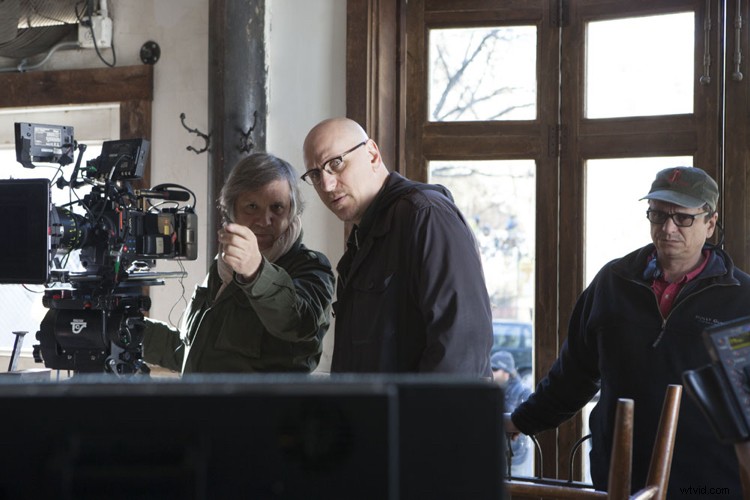
With a long prep time, Bukowski, Moverman, and Gere visited numerous homeless shelters in New York City, as well as Bellevue Hospital. The first unique aspect of the production was that Moverman and Bukowski wanted to hide the film crew while shooting on public streets. “The original conceit of this film was this idea of long lenses and putting Richard on the street just behaving,” says Bukowski. “He wasn’t boomed for sound and instead had mics on his body. If you looked at our set, you would notice zero impact or presence of a film crew.”
Having one of the most famous faces on the planet, Gere was skeptical at first that people would not recognize him on crowded New York City streets. As an experiment, Moverman and Bukowski sat the camera inside a Starbucks and began filming Gere on the street begging for change. “As he stood there longer and longer and nobody was recognizing him, we knew we would be able to proceed with the way we designed the film,” explains Bukowski. “For Richard, it was quite revealing to him as an actor because for the first time in his life as a celebrity, he was rendered invisible on the streets. It was a very profound realization for him to discover that these people really are invisible.”
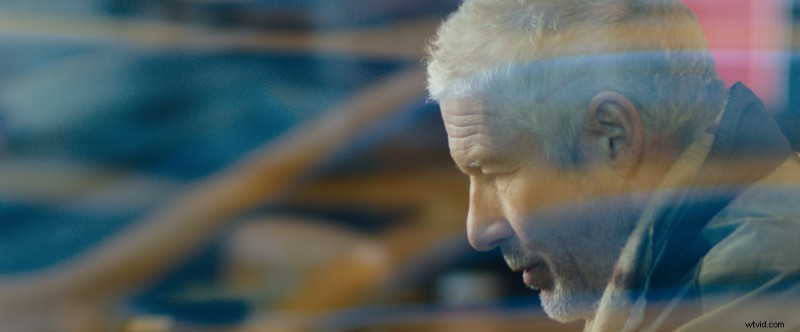
For the look of the film, Moverman and Bukowski looked at still photographs of New York City; they were most inspired by a single photograph by Saul Leiter, a photographer and painter who shot images of New York in the 1950s and ’60s. “Oren usually presents me with one image that he feels applies to the film,” reveals Bukowski. “For Time Out of Mind, he showed me a photograph taken by Leiter that depicted a man sitting in a restaurant behind glass with many reflections of New York City superimposed on the glass. This was the first visual key to unlock the process of how we would shoot this movie.”
Bukowski shot the film with one ARRI Alexa Plus 4:3 camera, which contains a 4:3 Super 35 sensor. For lenses, he employed two Hawk anamorphic zooms. The workhorse lens was a V-Series 300-900mm T4.0 and they also used a V-Plus Series 80-180mm T2.8.
Since they were underexposing most of the time, Bukowski captured in ARRIRAW (2880×2160 resolution) in order to keep the signal to noise ratio lower for post. “The ALEXA has such a broad range of latitude and the way I expose this camera is to look where all the values are falling,” he reveals. “I’m looking at IRE values and if they’re not peaking, you know that in post you’ll be able to retrieve detail in the highlights.”
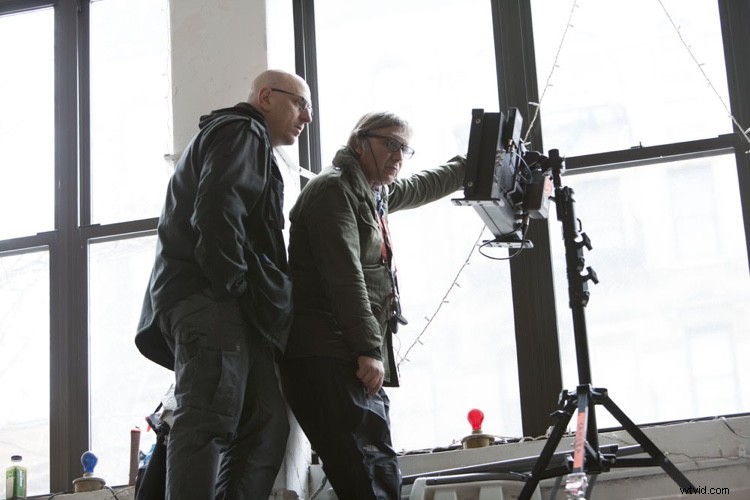
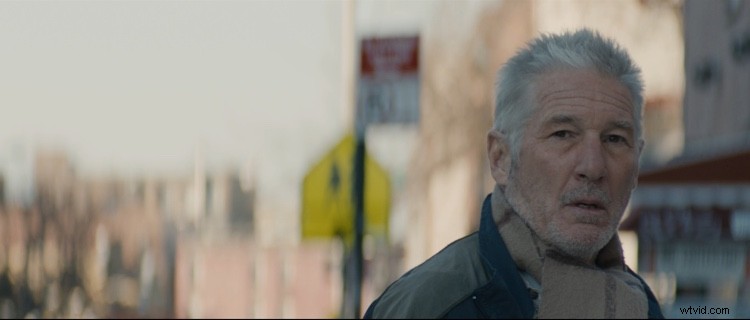
One of the reasons Bukowski shot with long lenses was to be able to shoot Gere from a far distance. As a simple rule, whenever Gere was outside, Bukowski tried as often as he could to place his camera in an interior shooting out a window. When Gere was inside, he would place the camera outside, creating a barrier between the character and the camera. “It wasn’t always the case, but it was something we were striving for in terms of subjectively portraying this character in a way that he’s always removed,” explains Bukowski. “A character living on the street is usually removed from people. People ignore him, people pass him, people don’t engage him.”
The only way to let Gere become engulfed by the city was to hide the camera, but by law you’re required to inform people that they’re being filmed. The sound mixer mic’d the actors and also hid mics all around the set, including on bushes and trees. “The minute people see a crew and a camera standing out there, they behave differently instead of passing through the frame,” explains Bukowski. “We posted signs indicating that if you entered the filming area you were going to being filmed. I thought that was a really unique thing to have the city move in the natural way that it moved. The people were not extras, they were all people in the street.”
If they didn’t have a window to shoot Gere through, Bukowski created an in-camera superimposition with his own set of glass in front of the camera, which sometimes gave the image an appearance of a moving painting. “They were 4×4 pieces of plexi that had different textures and even graphics written on them,” explains Bukowski. “When we didn’t have a location that provided us with a window, we would put our camera inside a construction tent and I would try to position the glass at a reflective angle to capture people walking on the street, traffic, or blinking signs — anything that could create movement as a superimposition over the main action.”
In terms of lighting, Bukowski lit most of the film with practicals and natural light, although on occasion he would employ Kino Flo Celebs for fill or to bring out detail. “I think it’s a style Oren and I have embraced since we started using the ALEXA together,” he reveals. “We literally use zero movie lights for Time Out of Mind. For me, the relationship with the production designer becomes quite instrumental because I am asking her to provide practicals that provide the quality of light that I need.”
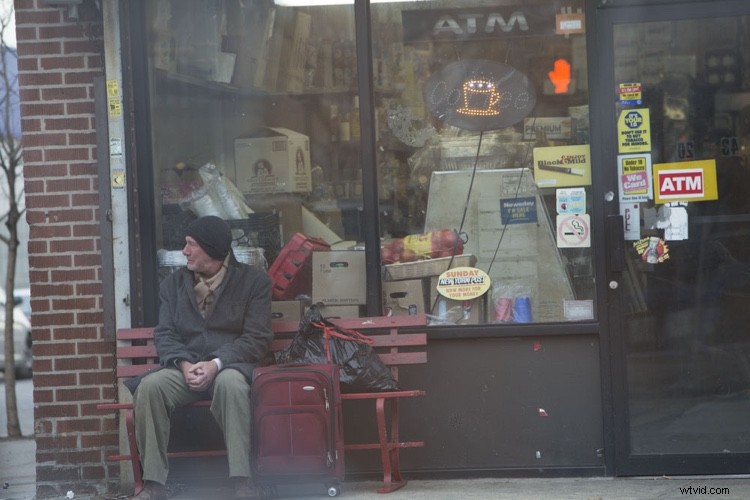
“Because we were trying to embrace natural lighting, location scouting became instrumental,” continues Bukowski. “When you’re exposing to the north sky throughout the day, that might mean a cooler north soft light. Do we want hard light for this scene? If so, let’s go to the south side of the building and work with the hard light that’s already there.”
Time Out of Mind was posted at Harbor in New York and graded by colorist Joe Gawler. Often times, Gawler and Bukowski would bring up highlights, or a specific color in the frame such as a yellow taxi or a blinking red light, in order to “assault the character with riotous color. In terms of lighting with the ALEXA, so much goes hand-in-hand of what I do on set and what I do in post. I’m lighting knowing that in post, the second step of lighting will occur.”
Bukowski proves that thinking outside the box is the best process in creating and capturing stunning visuals. Time Out of Mind is released by IFC Films.