

We’ve partnered with our friends at HDVideoPro to bring you some features and reviews on the best HD Video tools available. This is the second installment in this new series. Check out the previous post here.
At a small press gathering a few months back, Sony executives introduced their latest CineAlta camera system. For the past few years, Sony has been killing it in the digital video camera space by releasing an army of HD cameras in multiple categories, including the consumer VX900, the first full-frame-sensor camcorder. And with the F65 and 4K cameras from RED (EPIC and SCARLET), Canon (EOS C500 and EOS 1D C) and even GoPro (HERO3 Black Edition) all now available, it was inevitable that Sony would go long with 4K. After all, it’s already the leader in 4K digital cinema with its SXRD 4K projectors, and its XBR 4K Ultra HDTVs will see to it that even your living room will soon be 4K-ready.
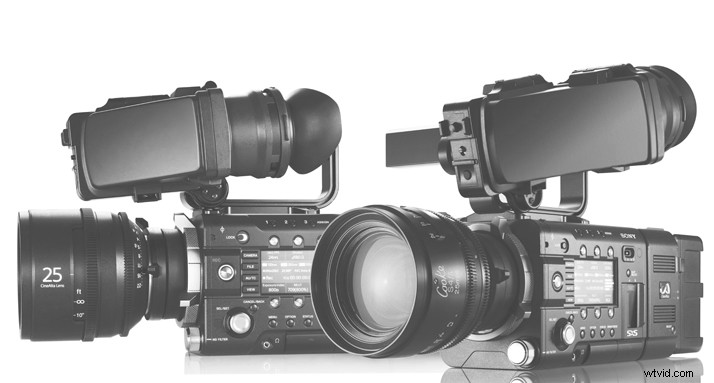
The F5 and F55: Filling a Niche
Instead of one, Sony introduced two new 4K systems: the PMW-F5 and PMW-F55. Both cameras can capture 4096×2160 resolution on a single Super 35mm, 3-perf-format-sized CMOS sensor, and can also capture 4K and 2K RAW footage using Sony’s new AXS-R5 recorder. In terms of dynamic range, both cameras contain a minimum 14 stops of latitude with very high sensitivity and very low noise. According to Sony Marketing Manager Peter Crithary, “Sony spent a considerable amount of time gathering feedback from the market, and dedicated over 500 engineers to this effort, resulting in a truly next-generation technology platform suitable for any production application.”
Cosmetically, the F5 and F55 look like twins, with the one exception being that the F5 has a black FZ lens mount and the F55 has a silver one. For a high-end professional system, both cameras are lightweight at only 4 pounds, 14 ounces; and when compared to the F65, the body style is much smaller and lighter than even the ARRI ALEXA, with a thin rectangular shape to which you add accessories, like the recorder and battery pack, at the rear. The cameras also contain three internal optical filters to give you up to six stops of neutral density.
The F5 and F55 both give shooters plenty of options in resolution and formats, capturing HD, 2K, QFHD (3840×2160) and true 4K (4096×2160). They’re also the first cameras to employ Sony’s new XAVC format, a cost-effective and file-size-efficient H.264/MPEG-4 Level 5.2 AVC codec that’s scalable and can support smaller 4K data files up to 60 fps, plus 8-bit, 10-bit and 12-bit color depth. Sony recently released an SDK to developers, and so far, a number of companies have signed on as licensees for native editing, including Apple and Adobe. If you don’t want to employ a new format just yet, you also can still capture HDCAM SR (MPEG4 SStP) in both 4:2:2 and RGB, as well as XDCAM 50 Mb/s 4:2:2 codecs.
Going All In With RAW
Sony brings the new AXSM Access Memory System for 2K/4K RAW recording with a new memory card platform, AXSM (512 GB capacity), that’s even faster than SRMemory capture and can mount to your computer without a driver. For high-speed capture, you can record 4K RAW at up to 60 fps and 2K RAW at up to 240 fps, with a 300 MB/s sustained transfer speed, and without cropping and/or windowing the picture.
The AXSM memory cards work with the AXS-R5 RAW recorder, which docks directly to the F5 and F55. The AXS-R5 RAW is also the 4K RAW recorder for the FS700U via the new interface adapter HXR-IFR5. And there’s a new USB 3.0 card reader, the AXS-CR1, that lets you transfer footage at up to 2 GB/s to your computer.
New SxS Pro+ Cards
For onboard capture, you can use Sony’s new SxS PRO+ memory cards (F55—4K 60p, 422, 10-bit XAVC and HD 422, 10-bit XAVC high frame rate, F5—HD XAVC and HD high frame rate). The cards are available in 128 GB and 64 GB capacities, and deliver speeds of up to 1.6 GB/s.
The Differences
Although the two camera systems may look similar, there are quite a few internal differences. Perhaps the biggest is color depth, with the F55 having the same color filter array as the F65, and the F5 containing the same as the F3. Since the F65’s color gamut exceeds that of 35mm motion-picture film, this is a pretty big deal. Unlike the F55, the F5 doesn’t have a 3G-SDIx4 out for 4K output. Another big difference is that the F55 has more options for high-frame-rate shooting, letting you crank up to 240 fps at 2K RAW 16-bit linear, compared to 120 fps with the F5 when using the onboard AXS-R5 recorder.
With your 3G-SDIx4 out, you can connect your F55 to Sony’s new 4K 30-inch LCD production monitor (PVM-X300), which uses 4 3G-SDI interfaces for live 4K monitoring up to 60p, and you can also connect to the 84-inch BRAVIA XBR 4K Ultra for large-screen monitoring of 4K 60p images.
The F55 also contains a global shutter on the imager to help eliminate rolling-shutter skew and flash banding. According to Sony, rolling-shutter distortions and flash banding are completely eliminated, a first for 4K CMOS imager technology.
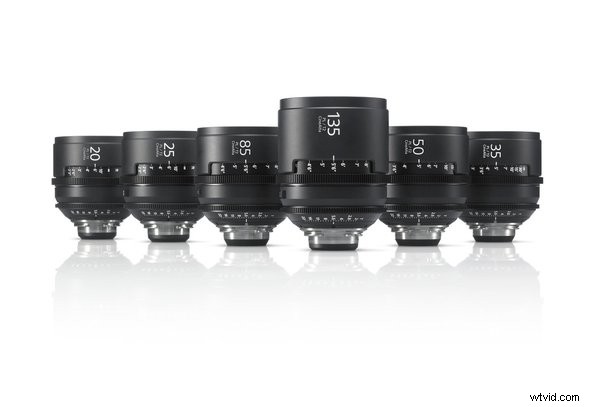
Second-Gen PL Lens System
Since both the F5 and F55 come with a PL-mount adapter, Sony is also releasing the second generation of its priced-to-own PL-mount prime lenses, which are able to resolve 4K and designed to minimize geometric distortion, vignetting, and breathing. The lenses contain a nine-blade iris, which will deliver a cinematic bokeh with focus rings that can rotate 240 degrees. Each lens has a T2.0 aperture, the same external diameter, matte box diameter, and gear locations for follow focus and aperture (with the exception of the height of the 135mm lens).
Like the F3, you also can shoot with still lenses by removing the supplied PL-mount adapter and use third-party (Canon, Nikon, Leica, etc.) adapters on the native FZ mount. Although, with a 19mm flange depth, this permits the use of any third-party lenses via an adapter without image penalty.
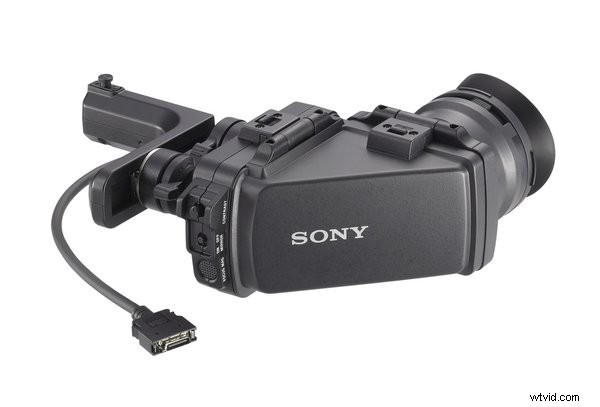
New Viewfinders
The F5 and F55 are compatible with a new series of OLED and LCD viewfinders. The 7-inch DVF-EL100 has 1280×720 resolution, and since it contains OLED technology, you’ll get better brightness, contrast response, and image clarity. The 3.5-inch DVF-L350 LCD viewfinder has 10 times the contrast of previous Sony LCD viewfinders, with a flip-up eyepiece for direct monitoring. The 7-inch DVF-L700 LCD viewfinder has a pixel-to-pixel 1920×1080 resolution.
More New Features
Sony’s new BP-FL75 battery pack uses Olivine—Lithium Iron Phosphate—instead of Lithium Ion cathodes, which should increase your charge-discharge cycles with the F5 and F55. Because of the compact size of the cameras, Sony is also releasing a special shoulder rig that offers more stability and comfort for shoulder-mount use.
Pricing was provided not long after the announcement, and Sony aggressively priced the F5 at $19,400 and the F55 at $34,900. Since professional camera systems seem to be released every one to two years, it’s very difficult to get a good ROI (return on investment) with an expensive camera system, so Sony was smart to price both cameras closer to the F3 than the F65. (RED smartly dropped prices on its own cameras across the board shortly after the F5 and F55 were announced.)
You can find more information about the Sony F5 and F55 at www.sony.com/35mm.
– Neil Matsumoto for HDVideoPro
Check out more articles and reviews at HDVideoPro.com.