
Key Takeaways
- SaaS marketers confront a unique content bottleneck: abstract products, rapid release cycles, and the difficulty of visualizing software that rarely lends itself to traditional photography.
- AI‑generated video excels in product demos, explainers, onboarding flows, and testimonial alternatives—formats that SaaS teams produce most frequently.
- Choosing the right approach—full AI, hybrid, or traditional—is essential for polished results and cost‑effective production.
- AI video offers a clean solution for testimonial‑style content, especially when NDAs or legal review limit direct customer footage.
- A partner who understands both AI tools and SaaS go‑to‑market strategy delivers video that feels like a true brand asset, not a generic experiment.
SaaS marketing teams must juggle constant feature releases, fresh sales demos, and onboarding content—all while the product itself is abstract and rarely photogenic. Traditional production struggles to keep pace with these demands, but AI video can close that gap.
AI video isn’t a cure‑all, but it fits exceptionally well with the content types SaaS teams need most. This guide explains where AI video shines, which formats deliver the best ROI, and how to brief projects so the output reads like a polished brand asset.
Why SaaS Is a Natural Fit for AI Video
Software brands face structural constraints that align perfectly with AI video production: abstract products, rapid release cycles, and a multi‑persona, multi‑vertical go‑to‑market strategy. Traditional production can keep up with one or two variables, but it often buckles under the full load.
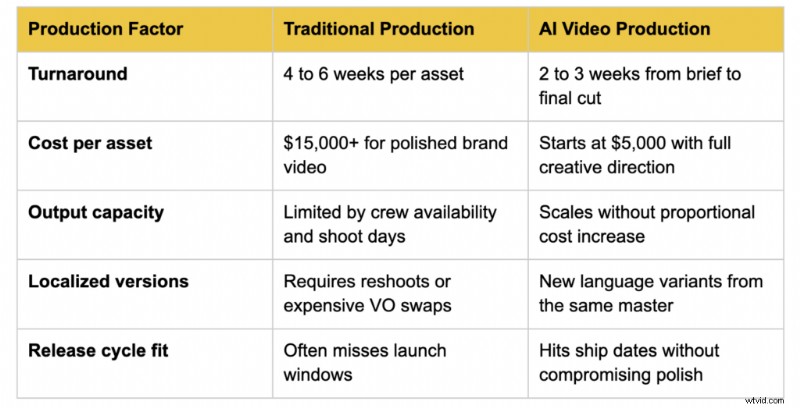
Consider a mid‑market SaaS company launching four new features per quarter. Each launch requires a hero demo and three social cuts, an onboarding library for eight core features, localized versions for three markets, and sales enablement videos for five verticals—over 100 video assets annually, not counting paid creative or customer stories. AI video compresses production timelines from 4‑6 weeks to about 2 weeks, slashes per‑asset costs, and enables variants and localizations without the budget multiplier that typically kills SaaS plans. For a deeper look, our AI video production cost breakdown explains exactly what each tier delivers.
AI also matches the creative style of SaaS marketing. Demos are concept‑led—showing workflows, dashboards, or outcomes—rather than talent‑led. This visual territory is where AI generation produces its strongest work.
Traditional vs. AI production for SaaS teams:
Video Formats Where AI Delivers
Not every format benefits equally from AI. The table below highlights four categories that consistently deliver results, explains why, and shows typical deployment scenarios.
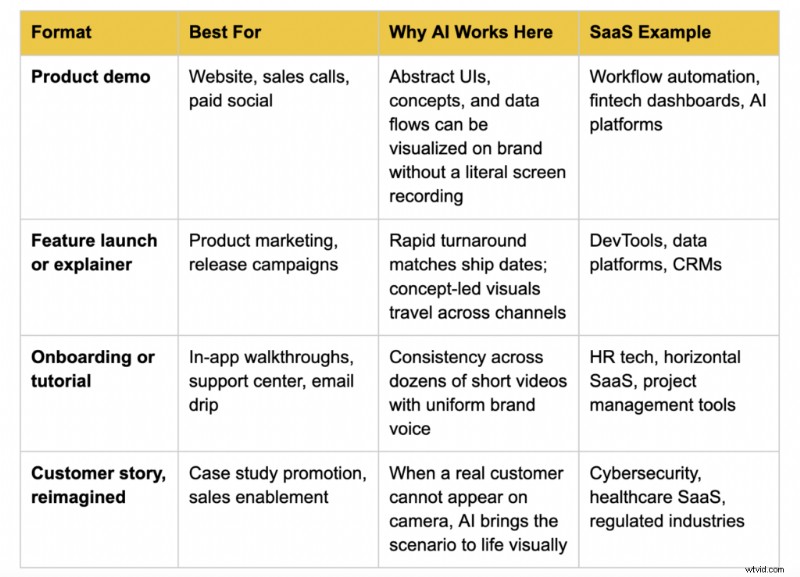
Product demos are the safest entry point for teams new to AI—briefs can be concrete, visual requirements are tied to user outcomes, and success is easily measured. Feature launch content thrives on the timeline compression AI offers; missing a launch window because production ran long can cost real revenue. Onboarding and tutorial videos benefit most from AI’s volume advantage: a 30‑feature platform can create a library of short videos and updates without prohibitive costs. Customer story content, while nuanced, is covered in depth below.
The Testimonial Alternative Problem, and How AI Solves It
Testimonial video is often touted as the easiest win for SaaS marketing, but in practice it’s one of the hardest to produce. NDAs, legal reviews, customer turnover, time‑zone scheduling, and compliance constraints (cybersecurity, healthcare, fintech) make on‑camera content risky.
AI video opens a middle ground: the represented user story. Instead of a single customer, AI creates a scenario‑based narrative that visualizes a use case—problem, workflow, outcome—while anonymizing the customer. The footage is tailored to the story, not pieced together from generic stock.
Best suited for:
- Common use cases shared across multiple customers.
- Compliance‑heavy industries where on‑camera content triggers long legal cycles.
- International markets where the actual customer doesn’t speak the target language.
- Mid‑funnel content that supports a claim without being the primary proof point.
When a customer is willing to appear on camera and can speak to a category‑defining outcome, live‑action still wins. Otherwise, represented stories unlock volume that SaaS brands have historically left untapped.
Free Download
Every Tool. Every Decision. One Playbook.
- AI vs. traditional decision tree
- AI video briefing template
- Tool recommendations by use case
- Budget worksheet
- Partner evaluation checklist
Where should we send it?
Every Tool. Every Decision. One Playbook. — lands in your inbox instantly.
HubSpot form renders here once deployed to your blog
What SaaS Marketers Get Wrong When Briefing AI Video
The most common mistakes are strategic, not technical. They show up in the brief before any frame is generated.
Listing features instead of framing the problem. Product teams think in capabilities, but marketing video must focus on outcomes. A brief that starts with “here’s what our product does” often yields generic output. Starting with “here’s what our customer’s day looks like before and after” produces video that actually converts.
Trying to replace the screen recording when the goal is to elevate it. A raw screen recording shows the product; a well‑produced AI video explains why it matters. The best demos use AI to add narrative layers around the product, not to replace the core footage. A hybrid approach—real UI paired with AI‑generated environments—often outperforms both full AI and straight screen capture.
Ignoring sales input on what prospects actually ask. Sales teams know the top three questions raised in discovery calls. A 30‑minute chat with the AE team before drafting a demo or explainer uncovers the script’s heart.
Planning one video when the asset should be a system. A single hero demo limits reach. The same creative concept can fuel a 60‑second website video, six 15‑second paid social cuts, a sales deck embed, an onboarding sequence, and localized versions for three markets. Planning the system upfront multiplies the return on a single production cycle.
Is Your Next SaaS Video a Good AI Candidate?
Use the chart below as a quick gut check to decide whether AI is the right move for a specific SaaS project. It’s not a rigid checklist, but the signals on the left are reliable indicators that AI will deliver. For a deeper walk‑through, our decision framework breaks down the five variables that matter most.
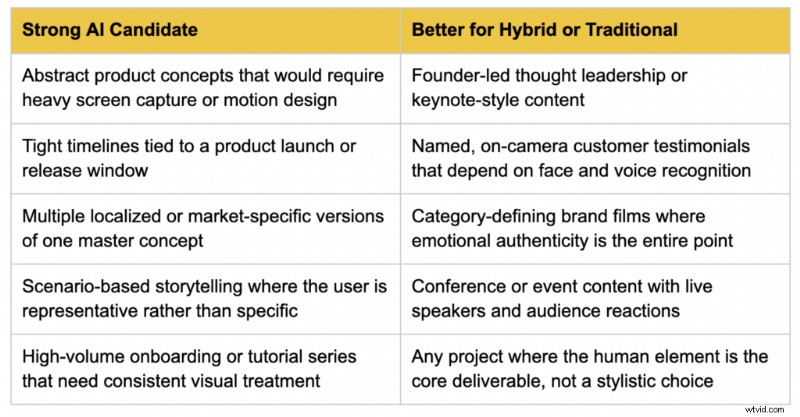
Most SaaS calendars mix both columns. The question is rarely whether to use AI, but which projects belong in each. Teams that plan 3‑6 months ahead, map each project to the appropriate column, and build a cadence that matches the right approach see the best results.
Ready to See What AI Video Can Do for Your SaaS Brand?
If you’re a SaaS marketing leader considering AI video for an upcoming launch, onboarding refresh, or sales enablement push, we’re ready to walk you through the possibilities. Explore Lemonlight’s AI Video Production services, review our portfolio, or book a consultation below.
Frequently Asked Questions
How much does AI video cost for SaaS brands?
Lemonlight’s AI video production starts at $5,000 per asset. The price includes a full production team—creative direction, scripting, AI generation, revision rounds, and delivery across all required formats. Volume agreements can reduce per‑asset costs. Compared to traditional demos that typically cost $12,000–$20,000, the savings are meaningful.
Can AI video actually replace a screen recording for product demos?
Sometimes yes, often no, and frequently the answer is hybrid. Pure screen recordings remain best when you need to show a specific workflow exactly as it runs. AI video excels when you need to communicate conceptual value, especially for abstract products like infrastructure tools, AI platforms, or data services. The strongest demos blend real UI footage for precision moments with AI‑generated visuals for narrative impact.
How long does an AI‑produced SaaS video take to create?
Most AI projects at Lemonlight run on a 2‑ to 3‑week timeline from approved brief to final delivery, including creative development, style frame approval, generation, revisions, and format cuts. That’s significantly faster than the 4‑to‑6 weeks typical for traditional production—often the difference between shipping on time and missing a launch window.
Will AI video feel on‑brand for a SaaS audience that values craft?
It depends on the production partner. DIY tools rarely meet the brand standards of SaaS buyers who evaluate software craftsmanship. Expert‑led AI production—with strong creative direction, locked‑in style frames, and human oversight on every scene—delivers output that matches, and often surpasses, traditional brand video.