
Strategy
Explore how social media algorithms shape content visibility and learn to navigate each platform’s ranking signals to maximize reach.
- Also available in
- Español
- Français
- Deutsch
- Italiano
Key Takeaways
- Ranking signals differ across platforms. Algorithms weigh engagement, watch time, relevance, and more, but each network assigns a unique priority to these factors.
- Platform‑specific focus in 2026. Instagram rewards watch time and likes, LinkedIn prioritizes content quality and early engagement, TikTok champions discovery beyond a user’s follow list, and Reddit relies on community voting.
- Effective optimization hinges on quality, authenticity, and format alignment. Consistently delivering high‑value content and engaging genuinely with your audience drives algorithmic amplification.
- AI’s expanding influence. Machine learning models now sift, rank, and personalize feeds, making first‑party engagement data the most critical metric for marketers.
Social media algorithms are sophisticated systems that combine rule‑based logic, ranking signals, and machine learning to determine which posts appear first in a user’s feed. They continuously evolve to deliver a personalized experience for the 141 minutes that the average user spends on social media daily.
In the early 2000s, feeds were purely chronological. As platforms grew, they began curating content based on user behavior and interests. By 2026, every major network—except Bluesky, which defaults to chronological order—uses a distinct algorithmic approach. Platforms such as X, Facebook, and Instagram still offer a chronological view as an option.
#1 Analytics Tool for Growth
Beautiful reports. Clear data. Actionable insights to help you grow faster.
Start your free trial
How a Social Media Algorithm Works in Practice
For example, when you watch three cooking Reels to completion on Instagram, the platform records your watch time, checks prior engagement with similar content, and surfaces more cooking videos in your feed and Explore page. A friend who skips cooking content and likes travel photos will see a completely different recommendation set—illustrating the power of personalization.
Key Social Media Algorithm Terms
Ranking signal: A metric that algorithms use to assess a post’s relevance and quality, influencing its placement in feeds or search results.
Machine learning: AI that learns from patterns in data to make predictions without explicit human instructions.
Artificial intelligence (AI): Technology that enables computers to simulate human reasoning and automate complex tasks.
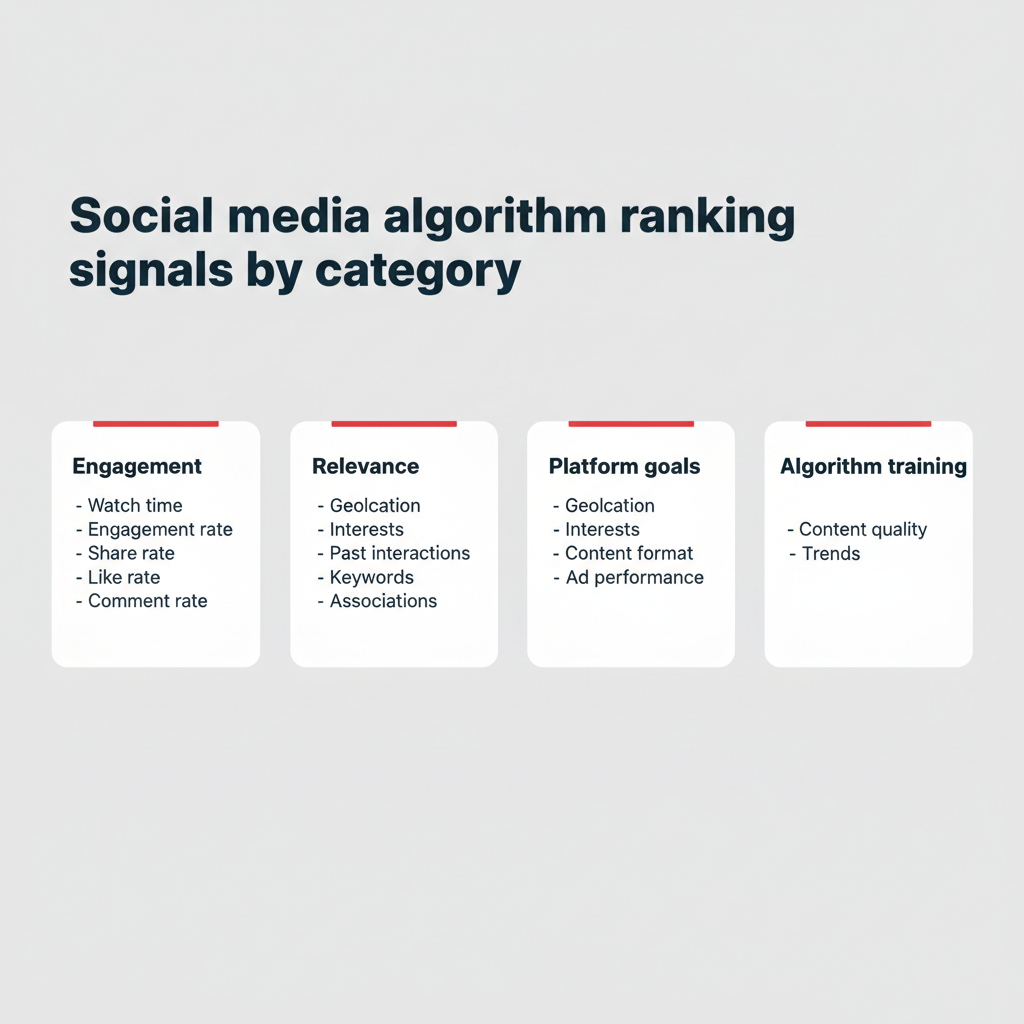
Algorithms rely on engagement metrics, relevance signals, and platform‑specific priorities to rank content. While the exact mix varies, most networks draw from a common set of signal categories.
Engagement‑Based Ranking Signals
- Watch time: Critical for video posts and increasingly influential for photos and text.
- Engagement rate: The ratio of likes, comments, and shares to total views.
- Share rate: Shares per total views.
- Like rate: Likes per total views.
- Comment rate: Higher comment volume boosts engagement, with platforms like LinkedIn also weighing sentiment and discussion quality.
Relevance and Personalization Signals
- Geolocation: Enhances local discovery and can be influenced by account settings.
- Interests: Topics a user follows and predicted interests based on recent activity.
- Previous interactions and behavior: Recent likes, comments, shares, and followed accounts inform future recommendations.
- Keywords and hashtags: Help categorize content and match user interests.
- Associative relationships: Likelihood of interest based on similar followed accounts.
Platform Goals
- Content format: Platforms often prioritize newly launched formats, adjusting priorities quickly to stay trend‑ahead.
- Ad performance: Advertisements are a primary revenue stream, so algorithms favor content that drives strong ad engagement.
Algorithm Training Signals
- Content quality: While subjective, algorithms assess size, policy compliance, and overall production value.
- Trends: Algorithms detect and amplify emerging topics.
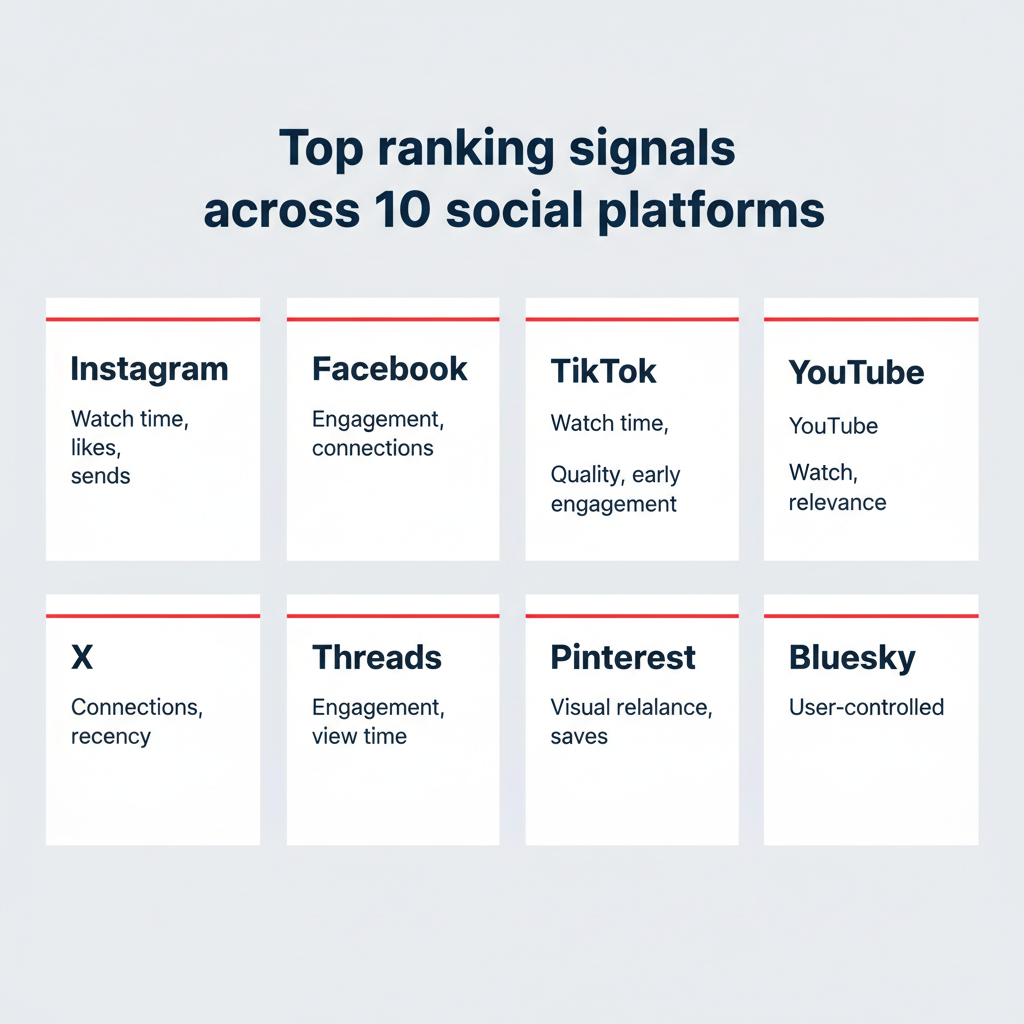
Below is a comparative snapshot of how the top platforms rank content in 2026.
| Platform | Top Ranking Signals | Preferred Format | Chronological Option? |
|---|---|---|---|
| Watch time, likes, sends | Reels, carousels | Yes | |
| Predicted engagement, connections | Video, photos | Yes | |
| TikTok | Watch time, user activity | Short‑form video | No |
| Content quality, early engagement | Text, documents | No | |
| YouTube | Watch time, relevance | Long and short video | No |
| X | Connections, recency | Text, images | Yes (Following tab) |
| Threads | Predicted engagement, view time | Text | Yes (Following tab) |
| Visual relevance, saves | Images, Pins | No | |
| Bluesky | User‑controlled, community | Text | Yes (default) |
| Upvotes/downvotes, comment quality | Text, images | Yes (New sort) |
According to Adam Mosseri, Instagram’s top three signals in 2026 are watch time, likes, and sends.
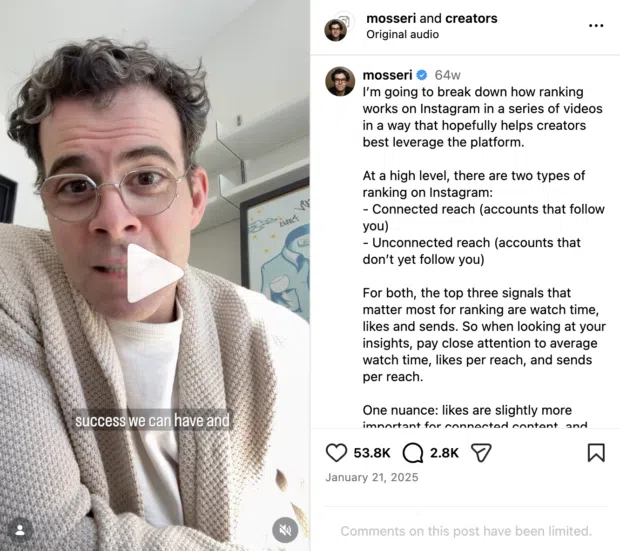
Source: @mosseri
Instagram distinguishes between connected reach (followers) and unconnected reach (non‑followers). For connected reach, likes carry more weight; for unconnected reach, sends (direct messages, shares) are more influential.
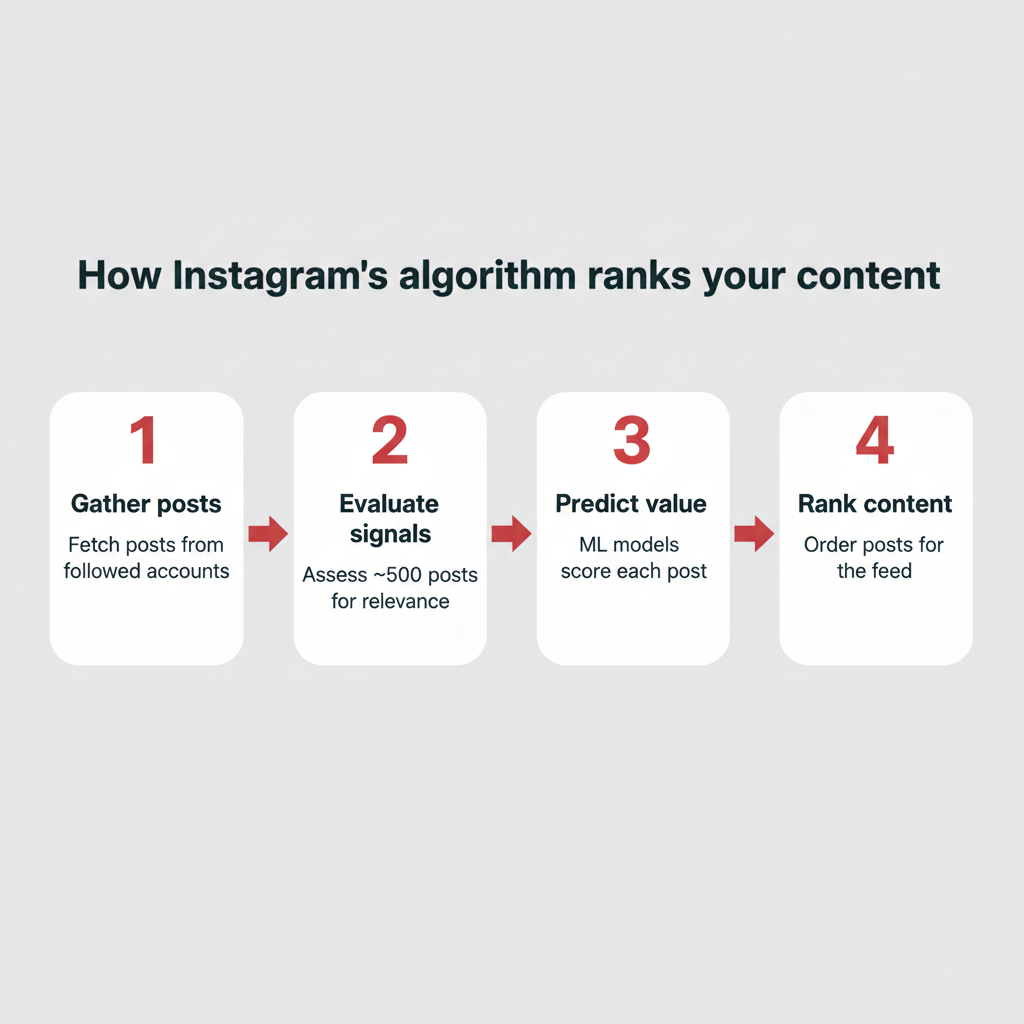
The algorithm processes posts in four stages:
- Gather: Collects all posts from followed accounts, filtering out violations.
- Evaluate: Scores roughly 500 posts for relevance to the user.
- Predict: Machine‑learning models estimate which posts will add value.
- Rank: Posts are scored and ordered for display.
Feed Algorithm Signals
- Likelihood of commenting, based on past behavior.
- Projected time scrolling Reels after opening one.
- Projected scrolling depth in the main feed after the first post.
- Likelihood of moving to the next post.
- Likelihood of spending >10 seconds on the first post.
Stories Algorithm Signals
- Likelihood of tapping a Story in the top feed slot.
- Predicted engagement with a Story.
- Friendship proximity to the Story author.
- Projected swipe‑to‑next or exit behavior.
Reels Algorithm Signals
- Probability of re‑using the Reel’s audio.
- Probability of watching >95 % of the Reel.
- Probability of leaving within 3 seconds.
- Probability of commenting or sharing.
Explore Algorithm Signals
- Likelihood of following an account from Explore.
- Probability of watching >95 % of a video or spending >5 seconds on a post.
- Engagement probability (comments, likes, shares, saves).
Meta highlights these primary signals: connections, content format, predicted engagement, and relevance.
- Content largely sourced from friends, joined groups, and liked pages.
- Format preference: users who watch videos see more videos, and the same applies to photos.
- Predictive models estimate likelihood of like, comment, share, or extended view time.
- Relevance is a set of predictions about how well a post aligns with a user’s interests.
X (Twitter)
The For You tab blends content from followed accounts with algorithmic recommendations, driven by connections, past interactions, and topical relevance.
Key signals include content quality, spam filtering, early engagement, and relevance based on follows, groups, and hashtags.
#1 for LinkedIn marketing
Schedule posts, answer messages, and manage ads from one spot. Then, show off your results in beautiful reports. It’s so easy.
Start your free trial
TikTok
The For You Page is curated by user activity, video metadata, account settings, and trending topics, with a heavy emphasis on watch time.
YouTube
Ranking signals include recent activity, negative reinforcement for non‑clickable content, video performance, and SEO elements such as titles and thumbnails.
Pinterest rewards visual relevance, trend alignment, and recent saves.
Threads
Top signals are predicted engagement, profile visits, and average time spent per post.
Bluesky
Bluesky champions “algorithmic choice,” allowing users to create or follow custom feeds that match their interests.
Ranking is driven by upvotes/downvotes, comment quality, recency, and subreddit relevance.
How to Optimize Your Content for Social Media Algorithms in 2026
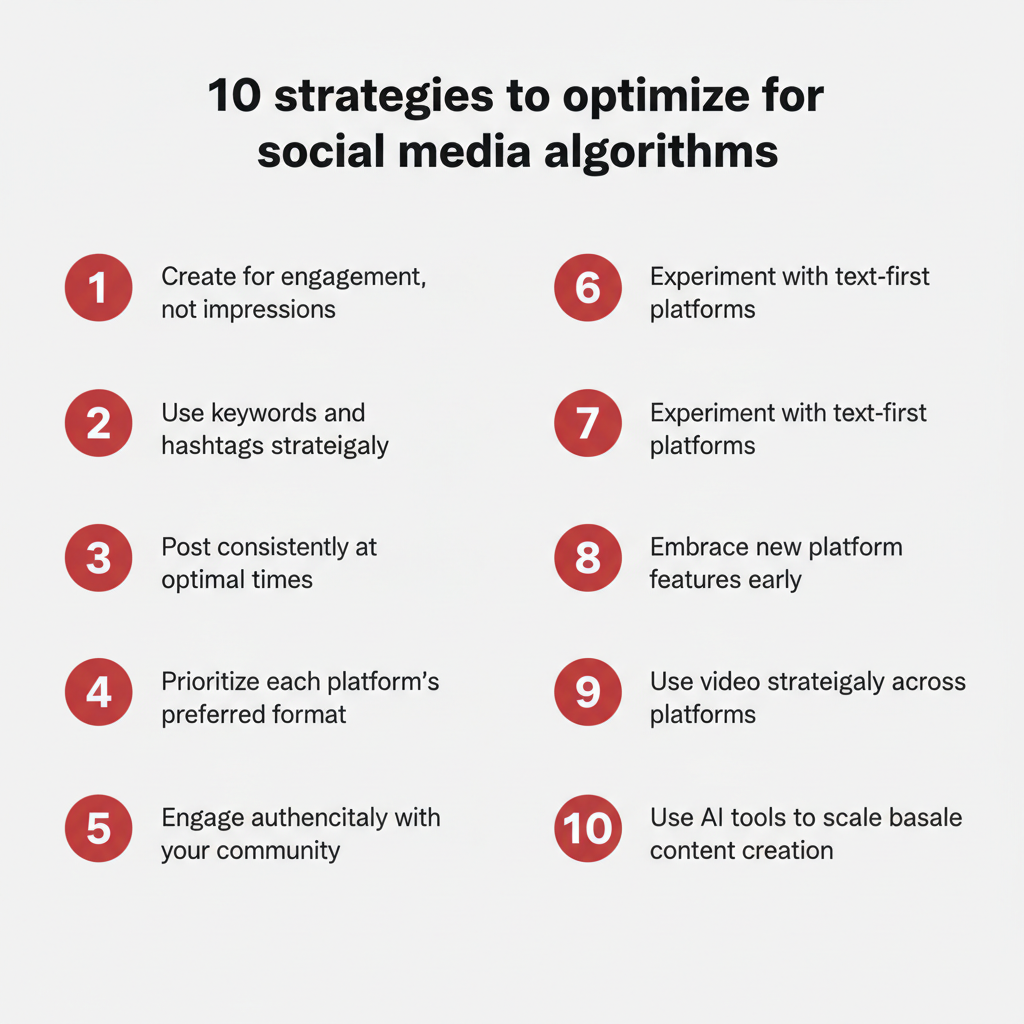
Understanding algorithms is just the first step. Below are ten proven tactics to expand reach across platforms.
- Create for engagement, not just impressions.
- Use keywords and hashtags strategically.
- Post consistently at optimal times.
- Prioritize each platform’s preferred format.
- Engage authentically with your community.
- Experiment with text‑first platforms.
- Embrace new platform features early.
- Use video strategically across platforms.
- Measure and iterate based on analytics.
- Leverage AI tools to scale content creation.
1. Create for Engagement, Not Just Impressions
Algorithms reward content that sparks interaction—comments, shares, saves—over simple views.
2. Use Keywords and Hashtags Strategically
With 46 % of Gen Z using social media as a primary search channel, relevant keywords in captions, alt text, and bios boost discoverability.
3. Post Consistently at Optimal Times
Regular posting signals activity to algorithms, increasing the likelihood that your content is surfaced.
4. Prioritize Each Platform’s Preferred Format
Reels and carousels dominate Instagram; short‑form video fuels TikTok; text posts thrive on LinkedIn and Threads.
5. Engage Authentically with Your Community
Active engagement—replying to comments, liking others’ posts—encourages algorithmic amplification.
6. Experiment with Text‑First Platforms
Threads, X, and Bluesky offer opportunities to refine writing and build discussion hubs.
7. Embrace New Platform Features Early
Platforms prioritize fresh features to drive adoption; early adopters often receive algorithmic priority.
8. Use Video Strategically Across Platforms
Video continues to dominate feeds: short‑form on TikTok/Instagram, long‑form on YouTube.
9. Measure and Iterate Based on Analytics
Track key metrics—reach, engagement, time on post—to identify high‑performing content and refine strategy.
10. Use AI Tools to Scale Content Creation
AI accelerates ideation and production, freeing time for strategic refinement that algorithms reward.
Artificial Intelligence: The Engine Behind 2026 Algorithms
- Hyper‑personalized ranking: Models analyze dozens of signals in real time, from scroll speed to hover duration.
- Content quality & moderation: AI flags low‑quality or misleading posts, protecting user experience.
- Adapting to AI‑generated content: Algorithms now prioritize authentic engagement over sheer volume.
- Predictive engagement modeling: Platforms forecast not only if a user will engage, but how.
What Do Algorithms Mean for Brands and Creators?
Impact on Organic Reach and Engagement
Organic reach is directly tied to how well content aligns with platform signals. Visibility drives all subsequent interactions.
Why Consistency and Quality Matter
Reliable, high‑quality posts demonstrate professionalism, earning algorithmic favor.
Why Engagement Is Paramount
Engagement signals that content is valuable; benchmarks vary by platform and industry.
While algorithms can seem opaque, they enable efficient discovery of like‑minded communities, fostering connection and positive dialogue.
Frequently Asked Questions
What are social media algorithms?
They are rule‑based systems that rank content using signals like engagement, watch time, and relevance.
How do they decide what to show?
By evaluating signals such as engagement history, watch time, relevance, and user behavior to predict valuable posts.
Can you influence algorithms?
Yes—optimizing for key signals on each platform shapes how your content is ranked.
What is the most important ranking signal?
Engagement—likes, comments, shares, watch time—remains consistently weighted across platforms.
How often do algorithms change?
Algorithms are updated daily for fine‑tuning and quarterly for major overhauls.
Do algorithms favor video content?
Yes, especially short‑form video, due to higher watch time and engagement.
How does AI affect algorithms?
AI drives the core of modern algorithms, using machine learning to analyze behavior, predict engagement, and personalize feeds in real time.
What is the 30/30/30 rule?
It suggests a content mix: 30 % brand promotion, 30 % shared content, 30 % engagement/entertainment, with 10 % experimental.
Are algorithms the same across platforms?
Each platform employs a unique algorithmic stack with distinct signals and priorities.
Save time managing your social media marketing strategy with Hootsuite. Publish and schedule posts, find relevant conversions, measure results, and more — all from one dashboard. Try it free today.

 The #1 social media tool
Create. Schedule. Publish. Engage. Measure. Win.
By Michelle Martin

As an ex‑agency strategist turned freelance fashion icon, Michelle brings a flair for turning complex technical topics into engaging copy that delivers results. She’s authored content for Fortune 500 brands and startups, with clients featured in Forbes, Strategy Magazine, and Entrepreneur.
Related Articles
The #1 social media tool
Create. Schedule. Publish. Engage. Measure. Win.