
We have all been there: you see an image online that gives you the best perspective of a location but you have no idea exactly where it is located. Sometimes the photographer lists the location on social media, but more often they leave you wondering where exactly they were standing. Last week I set out to film a time-lapse of one of the most photographed skylines in the world. However, finding the exact location I wanted required me to use multiple resources. Welcome to project "New York Harbor."
Fstoppers is currently producing a few projects based in New York, and with these projects we always need more and more B roll of the city. We could just license a lot of the footage from micro stock sites like ShutterStock, Fotolia, or Alamy, but it's often cheaper and more rewarding to film your own unique footage yourself. In between trips to Manhattan, I began wondering what the most iconic view of the city would be. I've shot all throughout New York including on top of Rockefeller Center, the Empire State Building, from the shores of Brooklyn, and from a helicopter high above the waterways and central park. Since I wanted to shoot some time-lapse footage, I knew I would need a stable location which ruled out shooting from a boat or a helicopter. I also only had a limited amount of time to schedule a sunset shooting session which meant I needed to be as flexible as possible with my time.
Scouting From Home
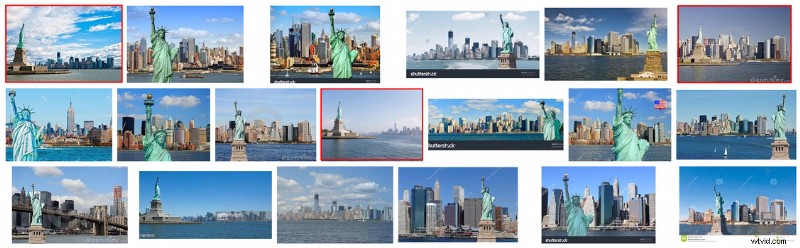
As I began to brainstorm a few ideas, the most obvious idea hit me. What if I could shoot the skyline of New York City with the Statue of Liberty in the foreground? That would clearly represent the Big Apple in the most iconic way possible. As I've learned working with many landscape photographer including Elia Locardi, the best resource to use in scouting these ideas is to use Google image. Unfortunately if you type in "Statue of Liberty New York Skyline" into Google, you get a lot of cheese composite images that would obviously not work for time-lapse video. A few of the images, as highlighted in red below, are shot from a boat which again would make video and time-lapse near impossible. I began to wonder if there was a reason no one had a great shot of the statue directly in front of Manhattan skyline; maybe there is simply not a great location that lines them both up in a single frame.
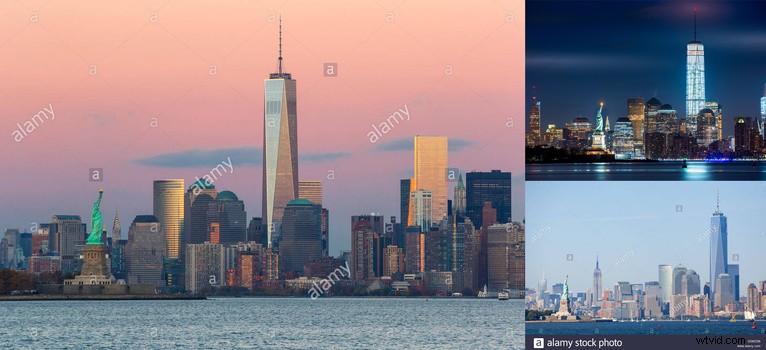
As I scrolled down Google images, I finally found a few specific photos that looked promising. I could tell from the stock images I found that the statue and the city were extremely far away but the perspective lined up perfectly. In one reoccurring image, the Statue of Liberty lined up next to the Empire State Building and from some of the others the statue was lined up more towards the Freedom Tower. Because these few images were framed up perfectly among different photographers I knew that there must be a solid location to capture the shot without involving a boat or ferry.
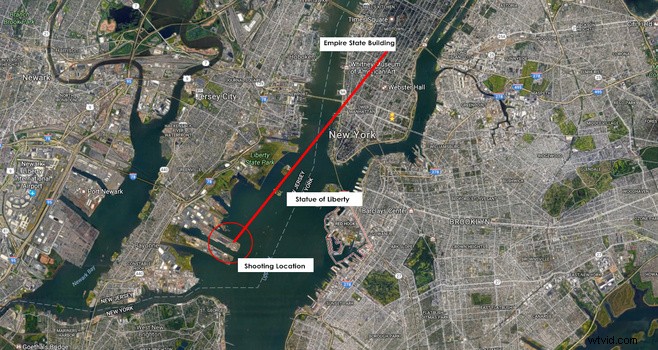
Once I found a few images that were close to the composition I desired, I figured the most accurate way to determine the location I need to setup my tripod was to use Google Maps. By zooming out and getting an aerial view of Manhattan peninsula area, I was able to draw a line that ran through the Empire State Building and the Statue of Liberty. I then extended this line of sight straight down into New Jersey and found that there were a few piers that should give me the perspective I wanted. The pier with the least obstruction was located at the very end of Port Jersey Blvd. As I zoomed into this road from Google maps, it appeared to be a public road but it definitely serviced a the private port located along the entirety of the pier. The second location was located on the pier just below the first one off of Port Terminal Blvd. The nice thing about this pier is that at the very end, near where I think the photograph needs to be taken, is a public 911 memorial called The Tear Drop Memorial. So while this location is probably the easier one to get access to, the best location at Port Jersey Blvd might actually block the view of the city if any buildings or cranes are located on that pier.
Since I was only going to have one shot at driving over to the Jersey side during my trip, I needed to find out more information about these two locations. As I scoured the internet even more for similar images, I was led to a few of the photographers' websites who had taken the stock images I found through Google. I emailed about four photographers directly and asked them about their experience with these two locations. A few of them responded back including Robert Engelbart and Raúl Cruz who were both very familiar with the locations. Each photographer had a difference of opinion on which location was better but both of them said I was on the right track and they were both easily accessible from the public roads. One photographer, Mihai Andritoiu, responded and warned me that the Port Jersey Blvd location was considered private property and he almost got fined by the police when he went. From research, it seemed that one of the locations would place the Statue of Liberty just to the left of the Empire State Building while the other one would place it between Empire and One World Trade. Personally I preferred having the Empire State Building in the shot more than the more modern Freedom tower but I was having trouble getting a clear answer on which location produced which shot.
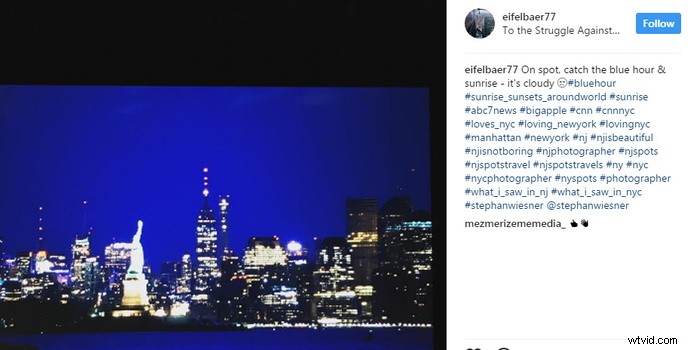
Days before I was to head back up to New York City, I was finally able to find out which location produced which specific framing. Through Instagram I was able to locate photographer Peter Praum who had the exact shot I was looking to capture on his feed. He had been to both locations and also warned me that he had trouble with the cops on Port Jersey Blvd but that the shot I really wanted was near the Tear Drop Memorial. That same night, Fstoppers reader Mahesh Ratnam Rajan told me he was actually standing at the end of Port Jersey Blvd shooting the city. He texted me an image that confirmed the information Peter had shared with me, yet Mahesh did not encounter any police while he was out there. It was great having someone on the ground reaffirming the photo was possible, and as it would turn out, Mahesh would meet up with me a few days later as we captured the sunset together.
The Day of The Shoot
The weather the entire week I was in New York was much like it was the previous week I was there: overcast with a heavy chance of rain. The best forecast for partial cloudy skies, the best time to shoot landscapes in my opinion, was only predicted for one day out of the six I was visiting. As the sun began to set during the late afternoon my shoot was scheduled, it became pretty obvious I was going to have to photograph a pretty dull and lifeless sky. It was such a bummer to have planned so extensively only to have the weather not cooperate, but it also meant the city should be super crisp and sharp because of the lack of weather.
Ultimately I decided to head to the Tear Drop Memorial location with the possibility of sending one of my friends to the Port Jersey Blvd location as a backup. The biggest issue with this location is simply getting to it from Manhattan. I wound up booking an Uber from Chinatown which took about 50 minutes start to finish with the late afternoon traffic. For the trip back home, Mahesh recommended I take the PATH train which connects from Exchange Place directly to World Trade Center. Ultimately this route can save you a lot of time compared to driving across the Holland Tunnel, but you will still have to get an Uber once you are on the Jersey side. Also, your Uber driver will probably question your final destination because the ports themselves are pretty far off the beaten path. All in all, be prepared to spend $50 - $100 total in cab fares and train tickets if you attempt this shot yourself and are staying in the city. If you've never used Uber before, download their app and use our code ADEWO to save $5 off your first four rides.
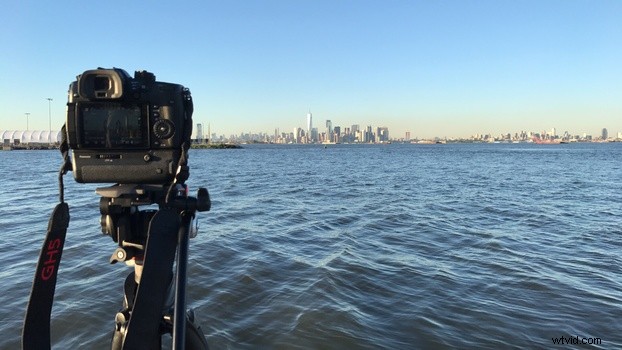
In terms of gear, you will definitely need a 200 - 300mm lens minimum if you want to frame up a similar shot. Fstoppers has switched over to the Panasonic GH5 system, and we highly recommend their 14 - 140mm lens which equates to about a 28 - 280mm lens in full frame. I was also shooting in 4k resolution which allowed me to crop in significantly more for a final 1080 resolution output. You can see a few different crops below with the equivalent focal lengths to get an idea of just how far away this shot is from the city itself.
I also highly recommend using a neutral density filter so that you can increase your shutter long enough to smooth out the water. The filter I wound up having in my bag was the K&F Variable Neutral Density 58mm Filter, and while it is a great, inexpensive filter for general use, for whatever reason it would not allow my lens to focus correctly when zoomed at the full 280mm. It's pretty easy to get silky smooth looking water with a general neutral density filter when shooting stills but I've still had trouble getting natural looking water movement with time-lapse no matter how long of a shutter I can squeeze out of my camera. You can definitely see the glittery water effect in the final time-lapses at the top of this article so I would recommend frame up more sky than water if you attempt something similar.
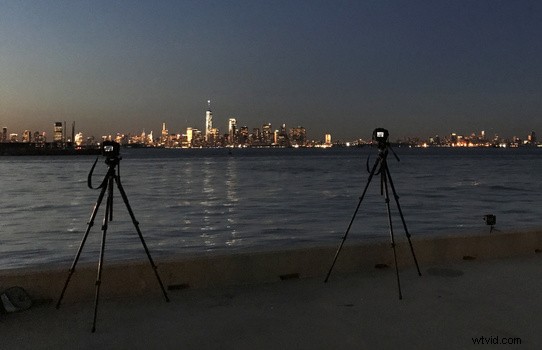
Finally, for tripods we are currently using our favorite portable fluid head, the Manfrotto MHXPRO-2W, and legs that are the equivalent of the Manfrotto 755XB (although we are soon replacing these all with our favorite tripod legs, the Benro TMA37AL). As you can see in the photo below, we also recently bought a few of the Manfrotto 709 Digi Table Top Tripod which works really well with the small GH5 Micro 4/3rds cameras. These tripods have been a lifesaver when you want to casually walk around a city but don't want to carry a big tripod.
Conclusion
Tracking down shooting locations these days is easier than ever before. With social media sites like Instagram and Facebook, mapping tools like Google Maps, and sun location apps like The Photographers Ephemeris, you should be able to accurately scout the best location for your photograph without even leaving your house. There are still those photographers who like to hide their locations but through this entire experience I was shocked at how helpful other photographers were to me in pin pointing exactly where the location was for the time-lapse I was trying to capture. Unfortunately for me, the only day that was not completely overcast in New York also turned out to be a day with absolutely zero clouds in the sky. I hope to go back to this location at some point and capture an even stronger time-lapse or even still photographs with a more interesting sky.
In a time when so many landscape photographers simply stand in the exact same location as the thousands of photographers who have come before them, I urge you to try to think outside the box and come up with a composition entirely your own. I can be honest with myself and say that I wasn't the first person to ever shoot from this location, but for me finding the exact location was preceded by the concept itself. Part of the fun of photography is coming up with an idea, solving the potential problems you might have, and then executing that vision as perfectly as possible. Hopefully this little exercise will inspire you to take whatever means necessary to capture the exact vision in your head regardless of how many uncertainties it might present. Finally, be kind to your fellow photographers, and if someone reaches out to you for help, point them in the right direction as opposed to keeping everything you have learned a secret.