
What’s a great way to create smooth transitions between scenes? By using audio to bridge them!
Watch the video to find out how or read the transcript below for a quick refresher on these editing techniques 👇👇👇
If you want to make smoother, more elegant transitions between scenes there is a specific type of pre-lap edit you can use, commonly referred to as a sound bridge.
A sound bridge occurs when the sound of the next scene begins while images of the last scene remain on-screen.
Sound bridges provide continuity in a film by avoiding awkwardness and abruptness while connecting two different scenes in succession. Here are three important sound bridge types you should always keep in mind when fine tuning your cut:
1. A Dialogue Bridge
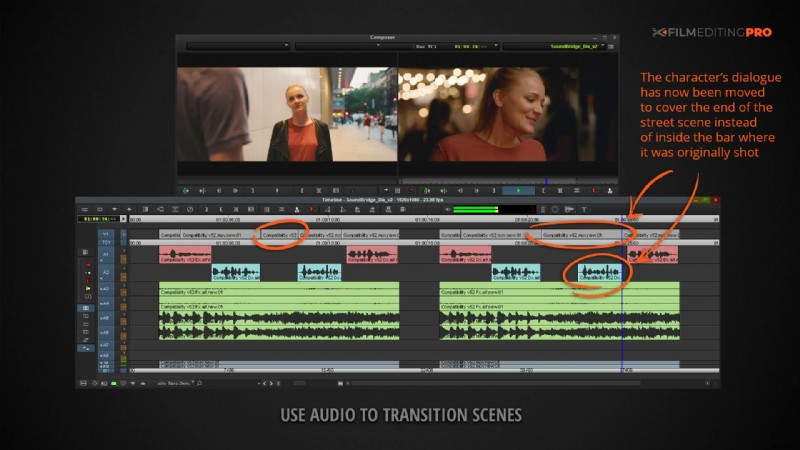
Let’s take a look at a scene of a man and a woman on a city street. At the end of this scene he asks her out, which then cuts to the two of them inside a bar. In the version on the left, the conversation ended and we cut to inside a bar where the man delivers his first line.
In our dialogue bridge version on the right, we hang on the city street shot while we hear the man’s line from the bar, pulling us forward into that next scene more smoothly than if picture and dialogue both cut at the same time.
2. A Sound Effect Bridge
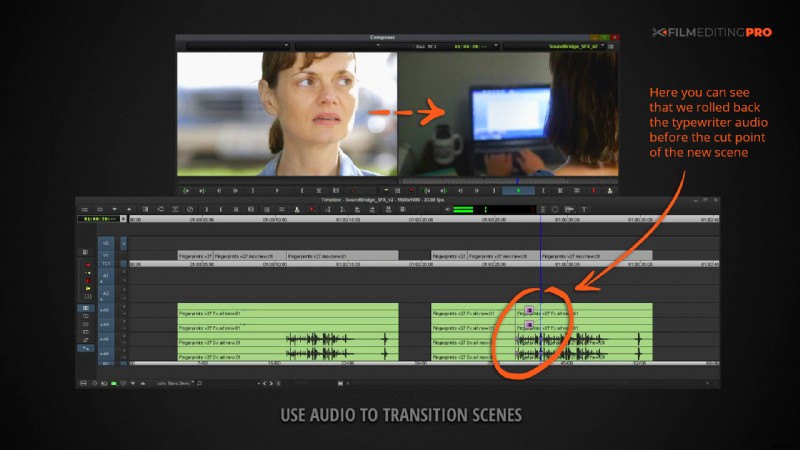
In this example, we have a scene with a woman contemplating something outdoors which then cuts to an indoor shot of her typing on the computer. In the edit on the left, we hear the sound of the typewriter begin exactly at the cut point for the corresponding visual.
Now, in the example on the right, you can see how we altered the scene so we hear the sound of the computer typing BEFORE we see it. Having that sound effect begin to play while the camera is still on her face adds a bit of mystery surrounding its source and draws us smoothly into the next scene, giving the viewer an idea of what to expect in the narrative.
3. A Music Bridge
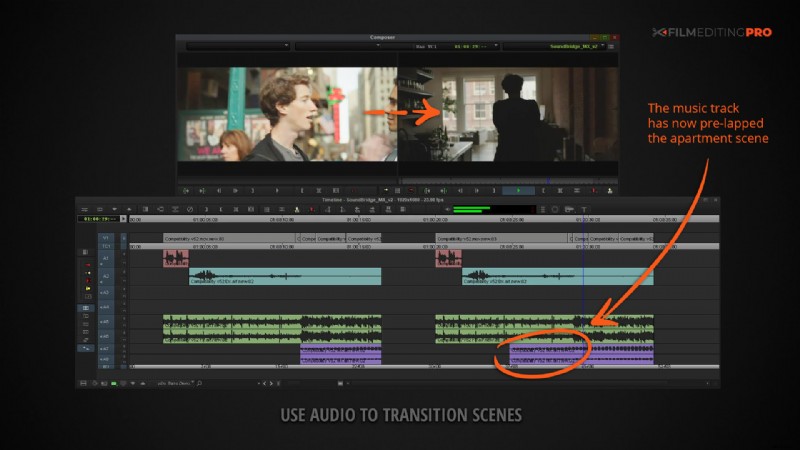
Now we have a scene with two guys talking on the street. In the film, our protagonist gets an important idea and we then cut to the interior of his apartment where he will begin to work on said idea. In the example on the left, the music starts exactly at the cut point where he walks in.
In the example on the right, we’ve moved the music cue so that it starts while we’re still on the street. By beginning the cue earlier, it embodies the thoughts going on in our hero’s head before we see the actions he’ll take. Propelled by the music, the mood of inspiration and discovery is connected seamlessly across scenes.
—
If you find our tutorials helpful, let us know! Or if you want to ask us a question leave a comment below, we read them all!