
We may earn revenue from the products available on this page and participate in affiliate programs. Learn more ›
A high‑quality lens lets you showcase interiors and exteriors in their best light, enticing buyers and renters. Today, online listings dominate the search process; many consumers decide to purchase solely from photos, never stepping inside the property. Exceptional listing images can spark interest, build confidence, and even prompt an immediate offer.
The goal is to create a virtual walkthrough, revealing the house’s layout and the relationship between key features. Ultra‑wide‑angle lenses are essential; they capture almost an entire room—including small bathrooms—and allow large spaces to be rendered in fewer images. Selecting the right lens elevates your photos, attracts more clients, and keeps them satisfied.
- Best for Nikon mirrorless: Nikon NIKKOR Z 14-24mm f/2.8 S Lens
- Best for Nikon DSLRs: AF-S NIKKOR 14–24mm f/2.8G ED
- Best for Canon mirrorless: Canon RF 15-35mm f/2.8 L IS USM Lens
- Best for Canon DSLRs: Canon EF 11-24mm f/4L USM
- Best for Sony: Sony FE 12-24mm f/2.8 GM Lens
- Best for Fuji cameras: Fujifilm XF10-24mm F4 R OIS WR
How we chose the best lenses for real estate photography
Our team at Popular Photography brings decades of experience across all photography disciplines. With over ten years in real estate imaging—and having designed a gear program for a leading vacation‑rental firm—we’ve tested countless lenses across major manufacturers.
We focused on focal length first—ultra‑wide is non‑negotiable. Full‑frame lenses were prioritized because most real estate professionals use full‑frame gear. Distortion is a critical factor; while some barrel or pincushion distortion is unavoidable, we only selected lenses whose distortion is linear and easily corrected in post‑processing. Finally, we evaluated overall optical performance: sharpness, chromatic aberration, and vignetting.
The best lenses for real estate photography: Reviews & recommendations
According to the National Association of Realtors, 95% of buyers searched for homes on the internet. First impressions matter and high‑quality photographs can make a significant difference. They are also crucial for vacation‑rental listings, driving traffic, securing bookings, and validating the prices of a listing. As photographers, we can make a big impact on a real estate or vacation‑rental listing with the right gear.
Every major camera company makes excellent ultra‑wide angle lenses that work well for real estate photography. If you already have a quality camera for real estate photography, your best bet is to stick with that system and invest in a lens that will work with it. Here are some of our favorite lenses for each camera manufacturer.
Best for Nikon mirrorless: Nikon NIKKOR Z 14-24mm f/2.8 S Lens
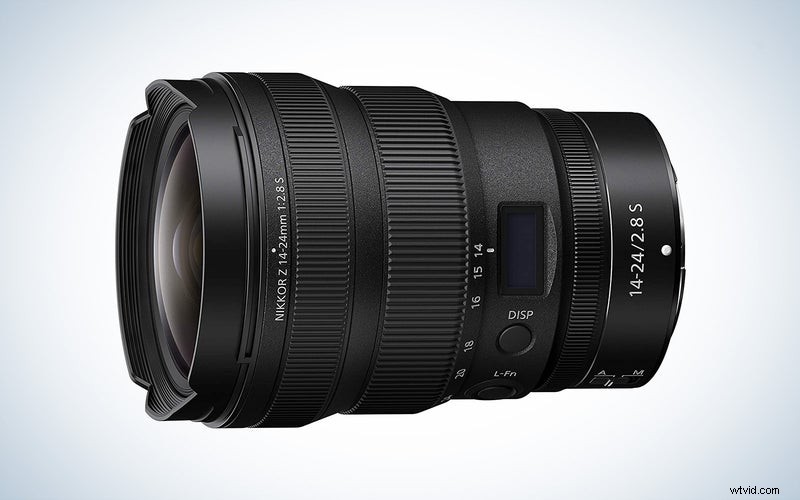
Why it made the cut: Nikon’s wide‑angle offering for the Z mount delivers exceptional sharpness and minimal distortion. Its f/2.8 maximum aperture also makes it versatile for other shooting styles.
Specs
- Weight: 1.4 pounds
- Filter size: 112mm
- Maximum aperture: f/2.8
- Lens mount: Nikon Z
Pros
- Relatively lightweight and compact
- Impressively sharp
- Modest distortion
- Fast autofocus
Cons
- Front filters are large and expensive
- Pricey
Nikon’s 14‑24mm for its DSLR was the benchmark ultra‑wide for years; the mirrorless version continues that legacy. It delivers top‑notch sharpness across the zoom range, with only minimal, easily correctable distortion and low aberration for superior image quality.
The Z‑mount 14‑24mm is lighter than its predecessor at 1.4 pounds, making it easier to carry. The autofocus is fast and accurate, allowing you to capture every angle without delay. A unique OLED information panel on the lens body lets you verify settings at a glance.
The main drawback is its price. If you need a more budget‑friendly option and won’t be shooting wide open, the NIKKOR Z 14‑30mm f/4 S Lens is a solid alternative.
Best for Nikon DSLRs: AF-S NIKKOR 14–24mm f/2.8G ED
Why it made the cut: The Nikkor 14‑24mm is the best real‑estate lens option for Nikon DSLRs, with little distortion, excellent sharpness, and fantastic colors and contrast.
Specs
- Weight: 2.2 pounds
- Filter size: N/A
- Maximum aperture: f/2.8
- Lens mount: Nikon F
Pros
- Exceptional sharpness
- Minimal lens distortion
- Fast autofocus
- Wide maximum aperture for good low‑light performance
Cons
- Not compatible with standard filters
Released in 2007, the Nikkor 14‑24mm remains one of the sharpest ultra‑wide‑angle lenses available. Its rectilinear design keeps distortion minimal and easy to correct in post. The lens features three aspherical elements and two extra‑low‑dispersion elements, plus a Nano Crystal Coat that reduces flare and ghosting—ideal when shooting toward windows or bright ceilings.
Its fixed f/2.8 aperture delivers excellent performance even when wide open, and its fast autofocus makes it a versatile choice for real‑estate work. The protruding front element limits filter use, but the built‑in hood mitigates impact.
Best for Canon mirrorless: Canon RF 15-35mm f/2.8 L IS USM Lens
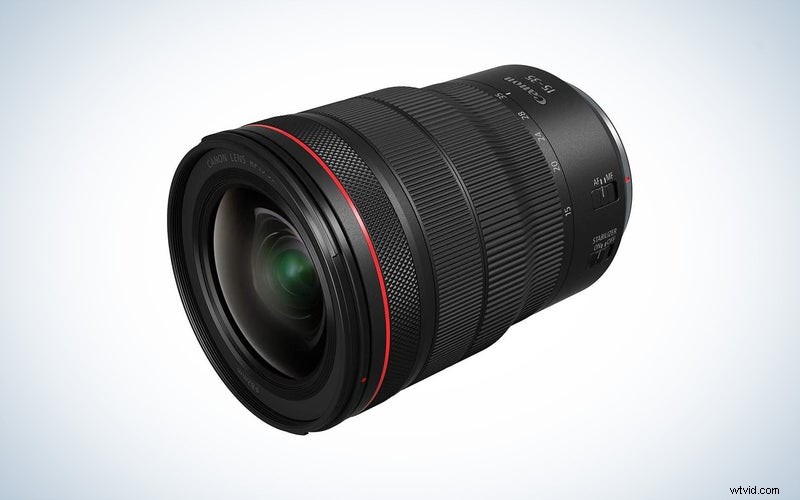
Why it made the cut: Canon’s RF mount ultrawide offers excellent sharpness, a weather‑sealed body, and five stops of shake reduction.
Specs
- Weight: 1.85 pounds
- Filter size: 82mm
- Maximum aperture: f/2.8
- Lens mount: Canon RF
Pros
- Extremely sharp
- Fast autofocus
- Rugged build quality
- Five stops of image stabilization
Cons
- Expensive
For RF‑mount users, the 15‑35mm f/2.8 is a standout choice. It delivers sharp, clear images with minimal distortion, aberration, and ghosting—all of which can be corrected automatically or in post.
The built‑in autofocus is fast and accurate, while the five‑stop IS is invaluable if you lack a tripod. The lens is also weather‑sealed, protecting you during outdoor shoots.
If you need a slightly wider focal length and are willing to trade a stop of light, the RF 14‑35mm f/4 L IS USM Lens is an excellent, more affordable alternative.
Best for Canon DSLRs: Canon EF 11-24mm f/4L USM
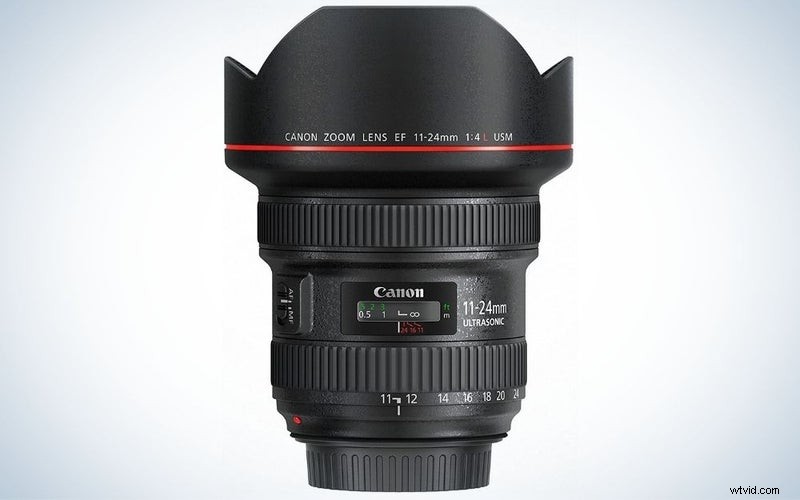
Why it made the cut: Canon’s 11‑24mm is the widest full‑frame lens on the market, and it also happens to be one of the sharpest ultra‑wide angles as well.
Specs
- Weight: 2.6 pounds
- Filter size: Rear insert‑type
- Maximum aperture: f/4
- Lens mount: Canon EF
Pros
- Exceptional sharpness
- Minimal distortion
- The widest focal length for full‑frame cameras
- Weather‑sealed
Cons
- Expensive
- Heavy
The EF 11‑24mm f/4L USM is designed for full‑frame DSLRs, but its extreme wide angle also works well on crop sensors. Its 16‑element optical design excels at reducing distortion and chromatic aberration, while delivering edge‑to‑edge sharpness that is rare at this focal length.
The lens is sealed against dust and moisture, making it reliable for outdoor shoots. Although 2.6 pounds is heavy, most real‑estate photographers use a tripod, so the weight is manageable. The bulbous front element accepts rear insert filters, offering some flexibility.
If you prefer a slightly narrower focal length, the Canon EF 16‑35mm f/4L IS USM Lens is a solid alternative.
Best for Sony: Sony FE 12-24mm f/2.8 GM Lens
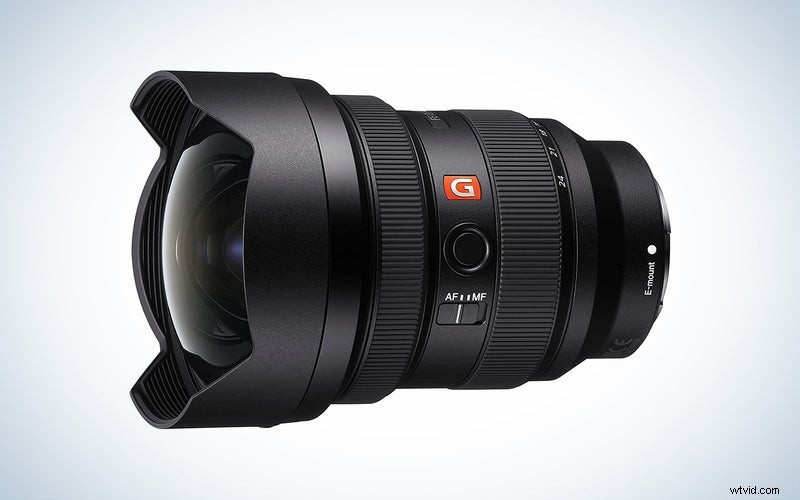
Why it made the cut: Sony’s 12‑24mm f/4 is the lightest, most compact option on the list—weighting in at only 1.24 pounds—ideal for photographers who travel frequently.
Specs
- Weight: 1.86 pounds
- Filter size: Rear gel filters
- Maximum aperture: f/2.8
- Lens mount: Sony E
Pros
- Lightweight and compact
- Fast, quiet focus
- Good edge‑to‑edge sharpness
- Weather‑sealed
Cons
- Not compatible with standard filters
- Very expensive
Sony’s ultra‑wide is a powerhouse. It is weather‑sealed and uses rubberized control rings for better handling in cold temperatures. The f/2.8 aperture and rounded nine‑blade diaphragm produce attractive bokeh, adding versatility beyond real‑estate work.
The lens offers 2mm more focal length at the wide end compared to Nikon and Canon, useful for tight interior spaces. Distortion is present but easily corrected with a lens profile in most editing software. Its overall sharpness remains excellent across the zoom.
As a G Master, the lens is pricey. If you can accept an f/4 aperture and a slight loss of sharpness, the Sony FE 12‑24mm f/4 G offers significant savings. Alternatively, the Sigma 14‑24mm F2.8 DG DN Art is a highly competitive, more affordable option.
Best for Fuji cameras: Fujifilm XF10-24mm F4 R OIS WR
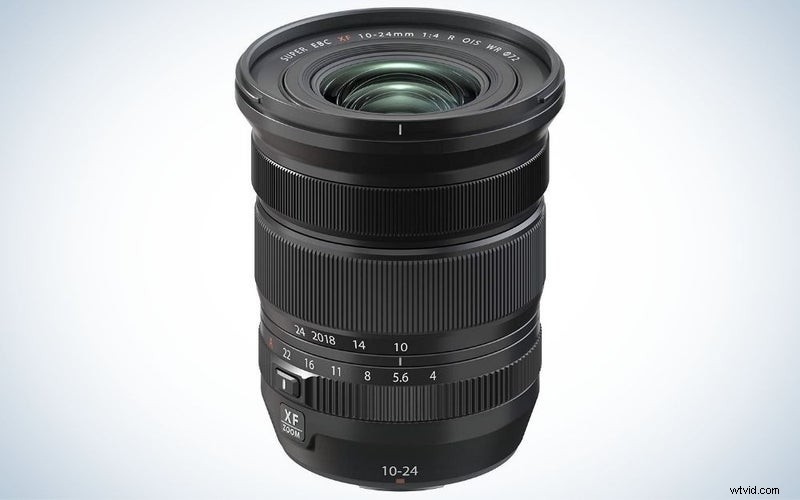
Why it made the cut: This compact lens packs a lot of imaging power into a relatively small package.
Specs
- Weight: 13.6 oz
- Filter size: 72mm
- Maximum aperture: f/4
- Lens mount: FUJIFILM X
Pros
- Lightweight
- Affordable
- Robust weather‑proofing
- Autofocus is excellent for both stills and video
Cons
- No hard stops on the focus ring
Fujifilm’s XF10‑24mm is one of two ultra‑wide‑angle zoom lenses available for X‑mount. The other option, the XF 8‑16mm f/2.8 R LM WR, offers a wider field and a stop more aperture but at twice the price. The 10‑24mm provides ample width for most real‑estate needs while remaining budget‑friendly.
The lens employs four extra‑low‑dispersion and four aspherical elements to curb chromatic aberration and distortion, boosting sharpness and color fidelity. The Super Electron Beam Coating (EBC) reduces flare and ghosting—critical for real‑estate imaging. Its filter thread facilitates filter use, and its 13.6‑oz weight makes it ideal for travel.
Things to consider before buying the best lenses for real estate photography
The most crucial feature of a lens for real estate photography is a wide‑angle focal length. Aim for a maximum focal length between 12 and 16mm to capture a room without excessive distortion. Avoid fisheye lenses; their distortion is hard to correct and misrepresents the space.
Real‑estate photography differs from architectural photography. For high‑end architectural work, a focal length around 24mm is preferable, as 12‑16mm distortion may be too pronounced.
Crop factor
Crop factor matters because it changes the effective field of view. On an APS‑C camera, a 16‑35mm lens becomes roughly 25.6‑56mm on a full‑frame camera—insufficiently wide for most real‑estate needs. Full‑frame users simply need to confirm that the lens is compatible.
Zoom or prime lenses for real estate photography
Primes offer one fixed focal length and are often cheaper and sharper. However, they lack the versatility of zooms. If sharpness is paramount and you’re comfortable carrying multiple lenses, a prime may suffice. For convenience and flexibility, a zoom is usually preferable.
Chromatic aberration and distortion
All wide‑angle lenses exhibit some barrel distortion and chromatic aberration, but quality lenses keep these effects linear and easily correctable. Cheaper lenses may display exaggerated, complex distortion—such as mustache distortion—which is difficult to fix. For professional real‑estate work, steer clear of extremely low‑priced lenses or obscure brands.
FAQs
Q: What type of lens is used for real estate photography?
Wide‑angle and ultra‑wide‑angle lenses are the tools of choice. They capture entire rooms in a single frame, giving potential buyers a clear sense of layout and space. Avoid fisheyes; their distortion misrepresents the property.
Q: How much does a lens for real estate photography cost?
Pricing varies by focal length and build quality. Expect to pay between $500 on the low end and up to $3,000 for top‑tier lenses.
Q: What filter do real estate photographers use?
A circular polarizer is a popular choice. It reduces glare and softens highlights on shiny surfaces, revealing details on floors, countertops, and windows.
Q: Can I shoot real estate with a 24mm lens?
A 24mm lens works for certain properties, especially high‑end architectural work where minimal distortion is desired. For small houses or basic listings, 24mm is too narrow and may produce choppy images that don’t showcase the space well.
Final thoughts on the best lenses for real estate photography
The optimal lens depends on your camera system. All major manufacturers offer high‑quality wide‑angle lenses that meet real‑estate needs. You don’t need to switch systems solely for a lens. The options above will serve you well for real‑estate work and any other wide‑angle applications.