With the Nikon Df, you can carry on the street‑photography tradition that dates back to the 1930s.
By Roger Hicks | Published May 28, 2014 10:41 PM EDT
We may earn revenue from the products available on this page and participate in affiliate programs. Learn more →
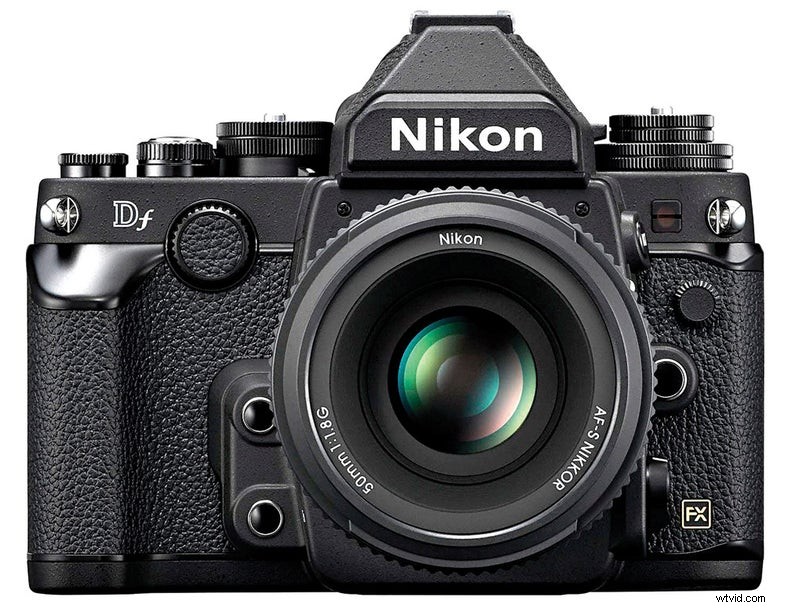
A multitude of dials, buttons, and wheels gives photographers more hard controls than they might need. The Nikon Df is as close as you can get to a simple, old‑fashioned film SLR with a full‑frame digital sensor—a dream long sought by enthusiasts.
Its body, built on a lightweight alloy chassis, feels like a true camera rather than a plastic mash‑up. The control layout is ergonomic, with engraved shutter and ISO dials that echo the tactile pleasure of classic Nikon SLRs. And, remarkably, it accepts manual focus lenses all the way back to 1959.
Despite its retro aesthetic, the Df is a modern autofocus DSLR. It offers all the features you expect from a contemporary camera—except for video and a built‑in flash, which many users simply overlook.
When I first unpacked the Df, I spent hours sifting through the dense manual, customizing settings, and making notes on the functions I’d actually use. The result? A camera that invites you to shoot relentlessly, finding new moments in everyday scenes.
Yes, it feels a bit bulkier than a classic film SLR, and its array of buttons and dials can seem overwhelming. But compared to a Nikon F with an F36 or F250 motor drive and an external intervalometer, the Df looks surprisingly streamlined—thanks to its built‑in equivalents.
Nikon’s approach of using single‑function buttons wherever possible means you can ignore most of the controls until you’re ready to use them. I rarely use the info or Fn buttons, and I’ve reassigned the rear dial to set aperture on autofocus lenses. The result is a camera that feels intuitive and low‑risk—no accidental double‑presses that send you into a confusing mode.
Not everyone will love the retro styling or the lack of video and built‑in flash. Others may balk at the price. With 16 MP (roughly 35 mm equivalent in non‑ideal conditions) it sits in the same price bracket as the 36 MP D800. The Df is a niche product, and if it ever goes out of production it could become a cult classic, fetching higher resale values.
I was already committed to a new DSLR, so I chose the Df over the D800 to avoid the high‑resolution data flood. I purchased it from Gray’s of Westminster in London.
After nearly 40 years of shooting with Nikon, I own lenses ranging from 14 mm to 600 mm, including fisheye, macro, soft‑focus, high‑speed, and perspective‑correcting units. The Df’s bundled “Special Edition” AF‑S NIKKOR 50 mm f/1.8G lens was an unexpected but welcome addition—its performance is impressive and unobtrusive.
Unobtrusiveness matters. A compact body and lens make the Df less conspicuous than a large zoom, letting you blend into street scenes just as you would with a Leica rangefinder. I can use it in the London Underground or on busy sidewalks with the same confidence as my Leica.
Low‑light performance is another strength. Thanks to the modest pixel count on a full‑frame sensor, the Df handles ISO 12 800 exceptionally well, and even the expanded range (H1‑H4) delivers usable monochrome results. The high‑ISO capability opens the door to handheld pinhole photography—a niche yet thrilling pursuit.
Noteworthy Specs:
SENSOR: 16.2 MP effective CMOS full‑frame
FILE FORMATS: JPEG, NEF Raw, Raw + JPEG, TIFF
SENSITIVITY: ISO 50–204,800 (expanded) in 1/3‑EV steps
AUTOFOCUS: TTL phase‑detection, 39 points (9 cross‑type), single‑shot & continuous, 3D predictive tracking, -1 to 19 EV at ISO 100
SHUTTER: 1/4000 – 4 s (1‑EV steps), up to 30 s (1/3‑EV), bulb; rated for 150,000 cycles
VIEWFINDER: Fixed eye‑level pentaprism, 100 % coverage, 0.70× magnification
LCD: Fixed 3.2‑inch, 921,000‑dot resolution
MEMORY CARDS: SD, SDHC, SDXC
DIMENSIONS: 5.6 × 4.3 × 2.6 in. (143.5 × 110 × 66.5 mm)
WEIGHT: 1.7 lb (765 g) with battery and card
PRICE: $2,750 body only, $3,000 with Special Edition 50 mm f/1.8G lens; nikonusa.com