
Canon has developed a new 3.2-megapixel single photon avalanche diode (SPAD) image sensor that can take color photographs in the dark, according to Nikkei Asia. It’s due to go into production next year, but don’t expect to see it in consumer cameras any time soon— it’s mostly for industrial and security applications.
What is SPAD?
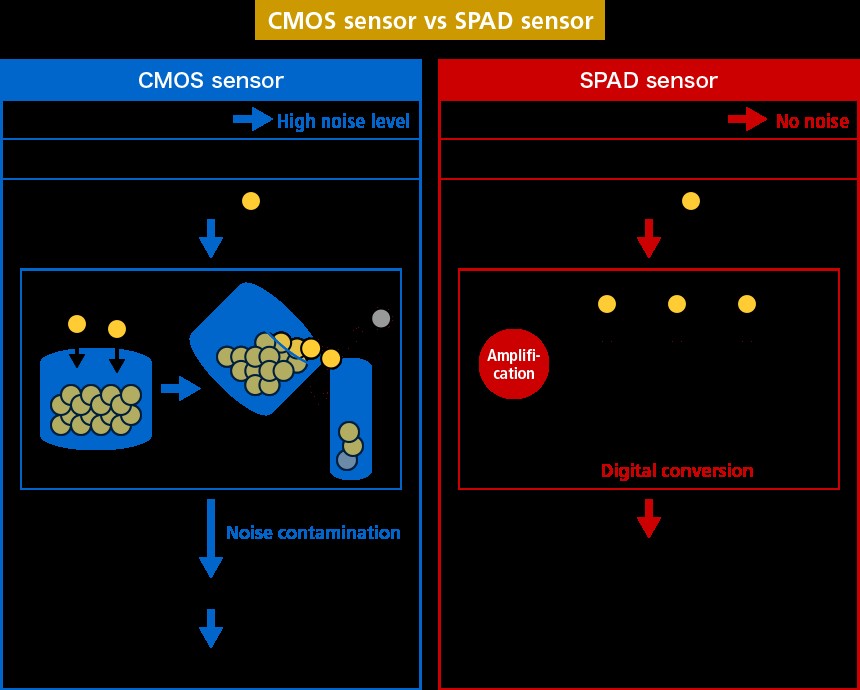
Although most sensors rely on the fact that light is made up of particles, single-photon avalanche diode or SPAD sensors work differently from conventional CMOS sensors used in most digital cameras. A CMOS sensor measures the amount of light that reaches it in a given period of time and then converts that into an electrical signal, while a SPAD sensor converts each photon into an electrical signal immediately.
Because CMOS sensors rely on the volume of light, their signal can be corrupted by interference (or noise) from the sensor itself, which is amplified along with the signal when you shoot at a high ISO. SPAD sensors, on the other hand, count and amplify the signal from individual photons which means they are much less vulnerable to noise. This is why they can be used in extreme low-light situations.
Pixel-density problems
Despite first being developed in the 1970s, there’s a reason SPAD sensors haven’t been widely used: historically, their image resolution is too low. The problem is that each sensing site on a SPAD sensor is small and shrinking them further to squeeze more in means less light will reach each one, which makes it harder for the sensor to detect the resulting electronic signals.
Last year, however, Canon broke through what they called “the pixel count ceiling” with a one-megapixel SPAD sensor. Now, they’ve announced a 3.2-megapixel sensor that they’re ready to put into commercial production.
What will Canon’s SPAD sensor be used for?
There are a lot of scientific and security uses for an ultra-low-light image sensor that doesn’t rely on infrared. For one, it means security cameras can capture color images which make it easier to identify people, cars, and similar objects.
But SPAD sensors can do a whole lot more. Canon’s one-megapixel SPAD sensor from last year had a global shutter that could capture video footage at 24,000 FPS. That’s fast enough to show a pulse of light moving through smoke. While the video capabilities of the 3.2-megapixel sensor haven’t been announced, they’re likely to be similar.
SPAD sensors can also use Time of Flight (ToF) to measure distances and create a map of three-dimensional space, similar to LIDAR. This means they could conceivably be used in robots and autonomous vehicles, as well as augmented reality (AR) and virtual reality (VR) devices.
When will we see the SPAD sensor in the wild?
According to Nikkei Asia, Canon will start production on the sensor in 2022 and launch it in security cameras in 2023. Canon can apparently still use a lot of their existing CMOS-manufacturing equipment to make the news sensor, which means they won’t have to build any massive new factories to get it into production.