
The team behind RGB shares insights into how they built their all-female leadership team — and breaking into the documentary-editing industry.
In 1993, Ruth Bader Ginsburg became the second female justice to be appointed to the Supreme Court of the United States (the first being Sandra Day O’Connor), a seat she still holds today. At the Sundance Film Festival this year, RGB premiered — a documentary film that explores Justice Ginsburg’s life and career — directed, produced, shot, and edited by an all-female leadership team.
In a conversation with Adobe’s blog, filmmakers Julie Cohen and Betsy West, cinematographer Claudia Raschke, film editor Carla Gutierrez, associate producer Nadine Natour, and associate editor Grace Mendenhal sat down to chat about how they put their team together, and they shared some tips on collaborating and editing a project inspired by Justice Ginsburg herself.
Bringing the Team Together
Cohen and West met while working on a digital archive about the modern women’s movement that interviewed Justice Ginsburg. From there, they realized that many of her millennial fans didn’t know the full story of how Justice Ginsburg rose to her position, so Cohen and West put together a treatment and pitched it to CNN Films, who agreed to take on the project and let them assemble their team — their way.
Empower Voices and Collaboration
When filmmakers like West were breaking into the industry and starting their careers anytime between the ’70s and the ’90s, there were few women involved, and it could often feel like there wasn’t an even playing field. On their all-female RGB team, however, as Raschke describes it, they “listen to each other because we all are filled with mutual respect because we already know that you know what you’re talking about.” The focus is on appreciating the best you can do, then enabling each other to do the same.
Working with Your Subject
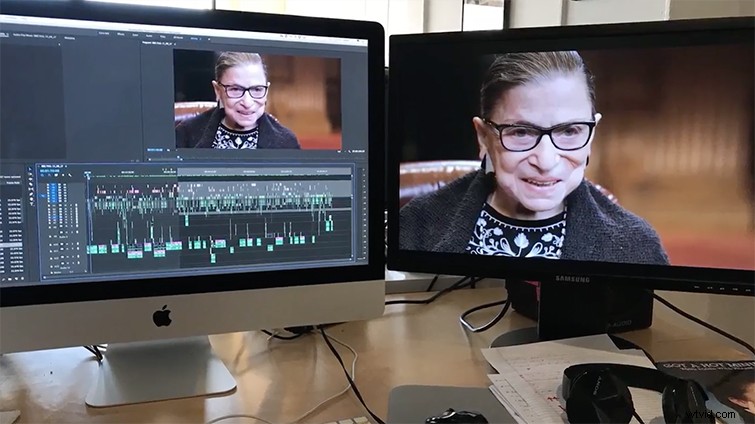
Justice Ginsburg has been a true patriot of civil rights throughout her lifetime — not just during her time on the Supreme Court. Raschke describes Justice Ginsburg as holding up the flag of equality, which the filmmakers took as an example when working with her (and each other): “these amazing women who have withstood so many challenges in their own careers, and here’s RBG, who’s a leader and hero to us all.”
Breaking into the Industry
While the filmmakers each followed their own paths into the industry, West stresses the importance of not getting discouraged or giving up. “Be like Justice Ginsburg,” she says. “Try to see your way around obstacles and see obstacles as potential opportunities.” While Gutierrez advices honing your chops on tools like Premiere Pro, she also encourages learning how to “be present in the room, ask questions, stay curious, and find mentors.”
Bonus: Learn Your Editing Programs
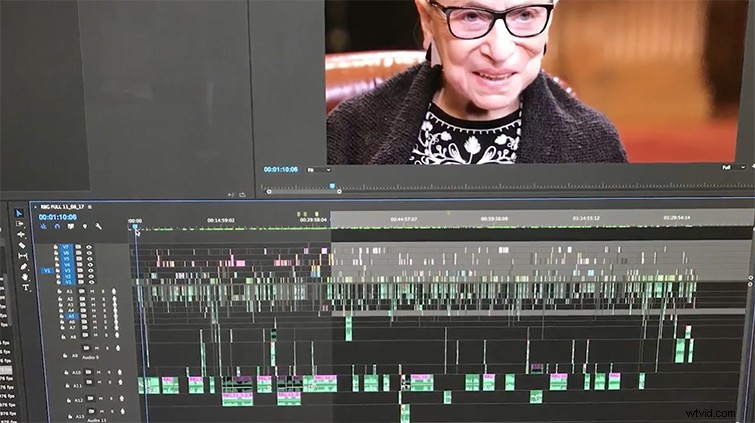
For those looking to launch a career in editing, learning to masterfully use Adobe After Effects is a way to get a leg up, as Mendenhal learned. (She handled much of the additional graphics work on the project.) For more resources on working with After Effects (as well as increasing your Premiere Pro knowledge), check out some of these links.
- Free AE Templates and Assets to Celebrate 25 Years of After Effects
- How to Create a Motion Graphics Template in Adobe After Effects
- Our Favorite After Effects Tutorials of 2018 (So Far)
- An In-Depth Look at the Adobe Premiere Pro Editing Tools
- Precision Editing with Adobe Premiere Pro’s Trim Mode