
PremiumBeat got all the gory details of how Clouser generates his inventive scores using synth, instruments, effects, and processing plugins.
Composer Charlie Clouser has been rocking a form of logic studio software since his days touring with the dark, industrial alt band, Nine Inch Nails. When Clouser ended his tenure with the band in the early 2000s, software like Apple’s MainStage hadn’t come onto the scene yet. Plus, software synths and plugins (in general) were in their infancy. However, he was no stranger to computer-generated sound, having studied old-school electronic music in college and spent a couple of years as the “computer guru” at the iconic Sam Ash Music store on 48th street in Manhattan, right when music technology was exploding with the arrival of MIDI. He soon was recruited by a customer to do synth and drum programming on television scores, which brought him out to L.A. There he did synth and drum programming on albums with bands like Prong and White Zombie, eventually getting brought into the NIN world around 1992, and didn’t leave for almost a decade.
After a whirlwind of work, building a studio with NINs in New Orleans, touring, making albums, and doing dozens of remixes for artists ranging from Killing Joke to David Bowie to Rammstein to Jamiroquai, Clouser made his way back to L.A. and back into the film industry. With the release of Spiral this month, his prodigious partnership with the Saw franchise is going on eighteen years and nine films.
Premium Beat got all the details on how Clouser generates his inventive scores featuring synth, instrument, effects, and processing plugins for the horror anthology.

Studio Hardware and Software
Clouser has always liked working in the studio with digital technology, whether it’s digital recorders and mixers or synths and processors. Although he’s made many records in all-analog studios, and still owns a decent collection of analog synths and outboard gear, it’s the level of precision and control that digital can provide that ignites his passion.
Clouser would still be using Studio Vision, as he found the software one of the most innovative and intuitive DAWs ever and mourns its passing. For you NIN melophiles, this software was used extensively on the album, The Downward Spiral. However, the company was purchased, and the program discontinued, which forced the move to Logic for the making of the NIN album The Fragile. He used second-generation Pro Tools/24 hardware as a playback engine, with Apogee AD-8000 converters for a little better signal quality on the way in.
However, Clouser was always a lover of smaller, more nimble setups, and pushed towards an in-the-box solution. The first track he completed entirely inside a computer was his remix of the NIN track “Starf*ckers Inc.” that appeared on the Things Falling Apart remix album, released in 2000. He explained the process:
After he left NIN in 2001 and transitioned back into scoring for film and TV, the plugin world was exploding as computers became powerful enough to run more than a few at a time. The Apple G4 and G5 machines brought incremental increases in power, and with it, the arrival of software like Ableton Live and Propellerheads Reason, both of which Clouser still uses today. After Apple made the switch to Intel processors, the wave of plugins coming to market became a flood, and he bought just about every iteration he could find.
Clouser has a long history of using hardware synths, and still maintains a vast collection of favorites—both old and new—from vintage hardware like the Sequential Prophet VS, Waldorf Microwave II XTK, Roland MKS-80, and Oberheim Xpander to recent reissues like the MiniMoog Model D, Korg’s Arp 2600 FS, and MS-20 Kit, and more modern like the Waldorf Quantum (the current king of the synth heap in his book). He tells us, when he wants to get strange, he has a large EuroRack modular system, and some “oddball instruments” made by Folktek. But, his current fascination is focused on manipulating sound from things such as homemade bowed-metal instruments, which are a big component of the SAW scores. He’s also into interesting guitar textures created with the Parker Adrian Belew, the Moog Guitar, and Moog Lap Steel, which are all equipped with divided pickups to drive guitar synthesizers like the Roland VG-99. He tends to use synths as an enhancement to his compositions rather than taking a leading role, leaving that up to instruments with a more organic sonic footprint. So, how does he put it all together?
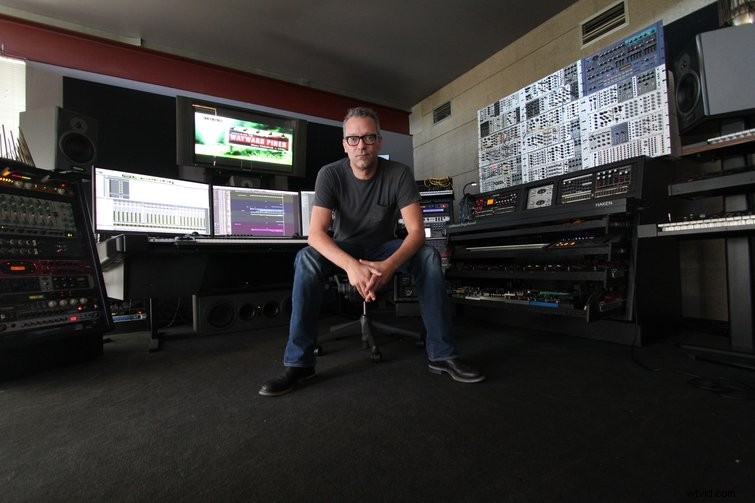
Although Clouser knows many film composers use Cubase, after 25+ years of using Logic, he doesn’t plan on jumping ship anytime soon. He has over 1,200 plugins running smoothly on his rig. And, while they don’t all get used every day, he finds there are often tasty surprises lurking where you’d least expect them. Cheap-n-cheerful plugins live right alongside the expensive stuff in his setup, and he’s ready to name some names.
Synth and Instrument Plugins
Besides Logic’s excellent included plugins and the obvious industry-standard stuff like Native Instruments, Arturia, Spectrasonics, and U-He synths, some of Clouser’s favorite instruments include:
- Quanta from Audio Damage (a nice granular sample synth)
- Diversion and Thorn from Dmitry Sches (an awesome, four-layer, hybrid wavetable synth and a powerful, three-oscillator, hybrid synth, respectively)
- Granulizer 2 by Inertia Sound Systems (a great-sounding, but simple, granular sample synth)
- Granite by New Sonic Arts (a powerful, yet simple, granular, sample synth)
- The Mangle by Sound Guru (a cool, granular, sample synth)
- TAL Sampler by TAL Software (a simple, but great-sounding, sampler that emulates the low-resolution hardware samplers of yesteryear)
- Imperfect by W.A. Production (an odd synth that has controls to simulate wobble and shake for that VHS-tape feel)
- VPS Avenger by Vengeance Sound (a EDM-oriented synth that can get downright nasty)
- Serum from Xfer Records (one of the best-sounding digital/hybrid/wavetable synths out there, by his old friend and fellow NIN alumnus Steve Duda)
Effects and Processing Plugins
It’s no surprise that most of the familiar heavy-hitters are on his rig, like the collections from Eventide, Fab Filter, Plugin Alliance, Soundtoys, Waves, and Universal Audio’s plugins for their UAD-dedicated DSP hardware. Again, here are his faves:
Waves plugins are on nearly every mix he does, like Scheps Omni Channel and L3 Limiter, but he finds some of the less widely-used ones helpful, as well. Their JJP and Kramer series can make individual drums stand at attention, and the CLA and Abbey Road series get a lot of use on his mix busses and stems. Some of his less-obvious favorites from Waves are Submarine (a sophisticated sub-bass enhancement and synthesis processor that will put serious boom on anything), Torque (a unique plugin for tuning the pitched component of drum sounds), and Vitamin (a multi-band exciter that can light a fire under just about any sound).
But, what about the cheap-n-cheerful, oddball, and less well-known plugins? Some of his favorites include:
- Jaws and Mikron Cascade by 112db (a great distortion and an amazing delay-cloud ambience creator, respectively)
- AIR FilterGate by AIR Music Technology (a tasty triggered-filter plugin that creates trance-gate and sequenced filter effects)
- All the plugins from AirWindows (simple emulations of consoles, preamps, and more)
- Nuxx from Audiaire (a sophisticated, step-sequenced filter and effects processor)
- All the plugins from Audio Damage (really great dub delays, filters, etc.)
- Audiority’s GrainSpace (a wild, pitch-shifting, granular effect)
- Harmonic Maximizer (a multi-band enhancer with a bonus-crushing compressor on the output)
- The collection from CableGuys (their fantastic ShaperBox plugins)
- Stream by Delta Sound Labs (a unique, real-time granular effect for audio tracks)
- Pitch Monster by Devious Machines (one of his favorite pitch shifters that can handle any signal you throw at it)
- The whole collection from Puremagnetik (cheap and simple plugins for extreme pitch and delay processing)
- Crowd Chamber from QuikQuak (a unique crowd-simulation processor, cool on voices and most anything else)
- Lowender by reFuse Software (a shoot-out champion in the sub-bass enhancement category)
- SaltyGrain by SampleSumo (another wild, real-time granulator)
- The complete collection of plugins by SoundHack (some of the original sonic destroyers)
- Wolfram by Subsonic Labs (starts with distortion and filter but goes so much further, a total destruction engine)
- Spectre by Wavesfactory (another nice, multi-band enhancer/exciter/saturator)
- RC-20 Retro Color by XLN Audio (a cool dirt and grime simulator for that VHS crust)
- Soundmagic Spectral collection by New Zealand composer and educator Michael Norris (these have a basic UI, but are absolutely bonkers plugins that can blur, drift, and stretch any sound into an ominous cloud or a terrifying hailstorm. Plus, they’re free!)
Where Do You Find It All?
Clouser is agnostic about whether a plugin comes from a company with twenty years of DSP engineering experience, or from a twenty-year-old kid who coded it on Mom’s laptop. As he says, “If it sounds good, it IS good. And, there are plenty of no-name, cheap (or free), and oddball plugins out there.”
Here’s his list of resources for forums, news, and info:
- https://www.kvraudio.com
- Gearspace.com
- vi-control.net
- https://sonicstate.com
- https://cdm.link
Inspiration and Reflection
Allow Charlie Clouser to now morph into beat poet. We found this last gem of his journey so inspiring, we’re happily giving him the last word.
Need a bit more inspiration? Here are some related articles to dive into:
- Helpful Tips Every Audio Engineer Wants You to Learn
- Genre Breakdown: The Different Types of Horror Films
- The RØDE VideoMic Go Audio is Terrible: Here’s How to Fix it
- The 5 Best Free Audio Editing Programs Available
- 10 Top Audio Editing Tutorials Every Video Editor Should Watch
Cover photo by Zoe Wiseman.