
As filmmakers increasingly turn to quality over quantity of features, the Fuji X-T3 is starting to attract some attention.
When Fuji announced the XT-3 in 2018, it was a surprising addition to an already-saturated camera market. Now, with so many viable cameras on the market, filmmakers seem to be gravitating toward a balance between how many features a camera offers and the quality of those features. The Fuji X-T3 might be the best of both worlds.
In this article, we’ll explore some of the reasons filmmakers are making the leap into the Fuji ecosystem.
Color Science
The color science behind the Fuji line of cameras and film stock is simply exceptional, and it has been for years. Filmmakers have been emulating Fuji’s film stock with a variety of film simulation plugins for digital capture. No matter the feature list of any camera, if the image doesn’t look great, then it’s irrelevant. However, this is not the case with the Fuji X-T3, now that we’re seeing the production of coveted and emulated color science with the digital filmmaker in mind.
Nestled inside the Fuji X-T3 is their very own log color profile, F-Log, which makes grading the footage to the look you want much easier. This feature makes the camera a viable option for cinema application. (If you choose not to film in F-Log, you can use one of the 16 built-in film simulations.)
Recording Rates
The X-T3 offers an impressive catalog of recording options. Most notably, the camera features 4K 60p at a 4:2:0 10-bit color space — internally. With the addition of an external recorder, the X-T3 is capable to 4K 60p at a 4:2:2 10-bit color space. This feature alone tops many cinema-grade cameras, like the Canon C300 Mark II.
A 400 mbps H.265 10-bit 4:2:2 color space at 23.98fps 4K feature is an impressive base codec. With the same data rates as the GH5, but with an APS-C sensor, the XT-3 features strong recording options.
Autofocus
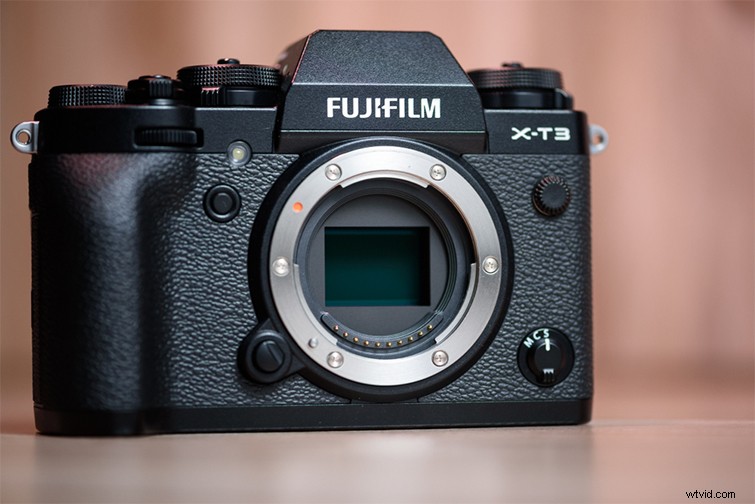
Fuji improved their autofocus feature with the X-T3. For filmmakers who consider autofocus a necessity, the XT-3 features a 2.16M pixel phase detection autofocus system. The improved face-detection makes vlogging or portraits a breeze.
Lenses
Fuji’s long history of lens manufacturing is not lost in the lenses compatible with the X-T3. Fuji lenses are known for being exceptionally sharp and well-built, and they provide superb image quality that rivals other top photographic lens manufacturers. With a large catalog of options, you won’t want for lens options. However, if you’re switching over from another system, changing your entire lens library may be a bit of a hassle, but the payoff may be worth the effort.
Overall, the Fuji XT-3 is a great option for many filmmakers. The feature-packed camera offers wonderful color science, strong codecs, and great lenses. For content creators looking for something different (and a great image), the X-T3 may just be what you’re after.