
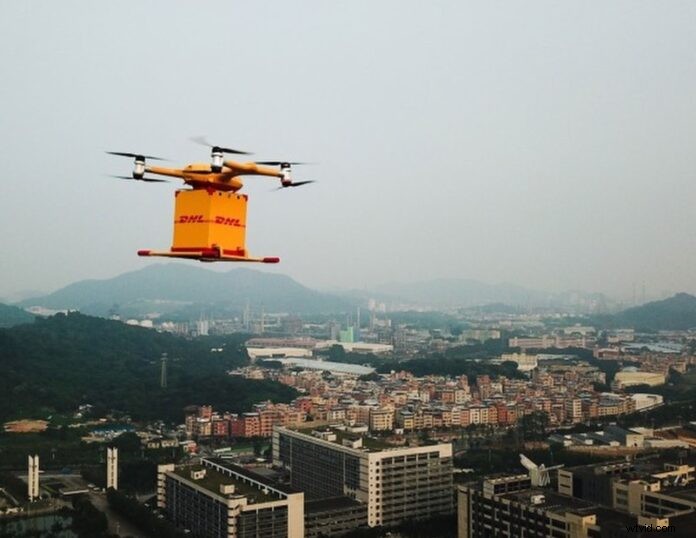
When the 2010s unfolded, headlines declared that autonomous drones would soon ferry everything from gourmet meals to life‑saving medicines in minutes. Forward‑thinking firms such as Amazon Prime Air and Google Wing promised that drone logistics would revolutionize the last‑mile delivery cycle and usher in an unprecedented era of convenience.
\nYet, more than ten years later, drone delivery has yet to realize the sweeping promise it once held. Despite cutting‑edge prototypes and multi‑million‑dollar investments, the skies remain largely unoccupied. This article examines the lofty expectations, harsh realities, and the intricate journey of drone delivery, and why the revolution remains, for now, on hold.
\nThe Early Promise: A Glimpse into a Sci‑Fi Future
\nThe concept of drone delivery captured global imagination when Jeff Bezos announced Amazon Prime Air in 2013, promising 30‑minute deliveries via autonomous aircraft. It represented more than speed; it suggested a wholesale rethinking of supply chains and consumer convenience.
\nTech giants and nimble startups entered the arena, each offering a distinct vision. Google Wing, Zipline, and others vied for dominance. Zipline’s early success in Rwanda—delivering blood and medical supplies to hard‑to‑reach communities—earned acclaim for its life‑saving impact. Concurrently, Wing conducted test runs in Australia and the United States, probing air‑traffic integration and inter‑drone communication.
\nThe hype was real. Investors followed. Media headlines heralded a new logistics frontier. Yet the skies stayed mostly clear.
\nWhat Grounded the Vision? The Reality Check
\n1. Technological Complexities and Limitations
\nBuilding a drone capable of carrying a small package is straightforward; creating a reliable, scalable system for mass delivery is another story. Drones must navigate dense urban and suburban environments, avoid collisions, communicate autonomously, and execute precise drops—all without human oversight.
\nOperational challenges—weather volatility, battery endurance, and the need for accurate, safe drop‑offs—quickly outpaced early optimism. Moreover, drones are best suited for light, compact items; the typical bulk orders that dominate e‑commerce proved less compatible.
\n2. Regulatory Turbulence
\nThe FAA and its international counterparts struggled to keep pace with rapid innovation. Crafting air‑space rules that safeguard safety, privacy, and accountability has proven arduous. Companies still require special waivers to fly beyond line of sight—a prerequisite for large‑scale operations.
\nProgress such as the FAA’s UAS Integration Pilot Program and mandatory remote‑ID mandates has eased mandates but not eliminated procedural bottlenecks.
\n3. Economic Viability and Cost Concerns
\nDrones are expensive to develop, maintain, and operate. Fleet management, software, safety systems, and regulatory compliance add to the cost burden. In sparsely populated or rural settings—where roads are unreliable—drones can offer clear value, as demonstrated in Rwanda. In dense urban markets, however, ground delivery remains far cheaper.
\nIntegrating drone logistics into existing networks adds layers of complexity. With customers already accustomed to same‑day or two‑day ground delivery, the return on investment for drone systems is hard to justify.
\nZipline: The Silent Success Story
\nDespite turbulence, not all drone ambitions faltered. Zipline, a comparatively low‑profile startup, has emerged as the most successful drone delivery firm to date. Its mission was not flashy consumer deliveries but solving a critical logistics gap—transporting medical supplies where roads are scarce.
\nFrom Rwanda to Ghana and Nigeria, Zipline has completed hundreds of thousands of deliveries, supporting rural hospitals and saving lives. Its fixed‑wing, catapult‑launched aircraft fly over 50 miles and deploy packages via parachute.
\nZipline identified a niche that many tech giants overlooked: drones excel where alternatives are inefficient or absent. By focusing on high‑value, time‑sensitive medical logistics instead of dense urban consumer markets, it carved a sustainable business model.
\nZipline continues to innovate. Its newest drone incorporates an autonomous “droid” that lowers packages gently with a tether, promising safe, precise drops even in populated areas—a breakthrough that could unlock urban deployment.
\nAmazon’s Drone Dream: An Expensive Detour?
\nAmazon’s journey has been uneven. Over a decade of promise has yet to translate into a scalable Prime Air network. Recent FAA approvals in select U.S. towns such as Lockeford, California, mark progress, but rollout remains sluggish.
\nInternal friction, over‑engineering, and shifting priorities have hampered momentum. Regulatory and safety obstacles compound delays. At one point, reports surfaced that Amazon’s drone unit was burning through capital without delivering tangible results.
\nThe company now pledges a new drone model and expanded service in select U.S. cities by year‑end 2024, but skepticism persists among industry insiders and the public.
\nThe Recalibration: From Hype to Practicality
\nAfter years of grand proclamations, drone delivery firms are adopting a more measured strategy. Rather than attempting to replace established carriers like UPS or FedEx, they are targeting niche applications:
\n- \n
- Medical and emergency supplies—drones excel when speed and accessibility are paramount, such as delivering defibrillators, blood, or vaccines. \n
- Remote and rural deliveries—areas lacking robust road infrastructure benefit dramatically from aerial logistics. \n
- Campus and suburban settings—universities, tech parks, and planned communities experiment with drone food and pharmacy deliveries within controlled environments. \n
By narrowing focus, companies such as Zipline, Flytrex, and DroneUp are gradually regaining credibility and demonstrating the tangible value of drone logistics.
\nLessons Learned: What the Drone Saga Teaches Us
\nThe drone delivery narrative serves as a case study in tech ambition versus realism. Key takeaways include:
\n- \n
- Not all technological dreams scale uniformly; what works in a pilot may not translate to mass‑market adoption. \n
- Regulation is critical; innovation without policy alignment stalls progress. \n
- Consumer expectations evolve slowly; concerns over noise, safety, and privacy temper enthusiasm. \n
- Incremental, mission‑driven wins—such as Zipline’s quiet progress—prove that success can emerge without fanfare. \n
Conclusion: The Sky’s Not the Limit — Yet
\nDrone delivery was poised to transform the world, but it hasn’t yet met the expectations set in its early days. Rather than a sudden revolution, the sector is experiencing a deliberate, strategic evolution.
\nAs regulations mature, technology improves, and the right niches are identified, drones will likely play a meaningful—though not dominant—role in future delivery ecosystems.
\nUntil then, keep an eye on the skies. The future may yet arrive—just not in 30 minutes or less.
\n\n