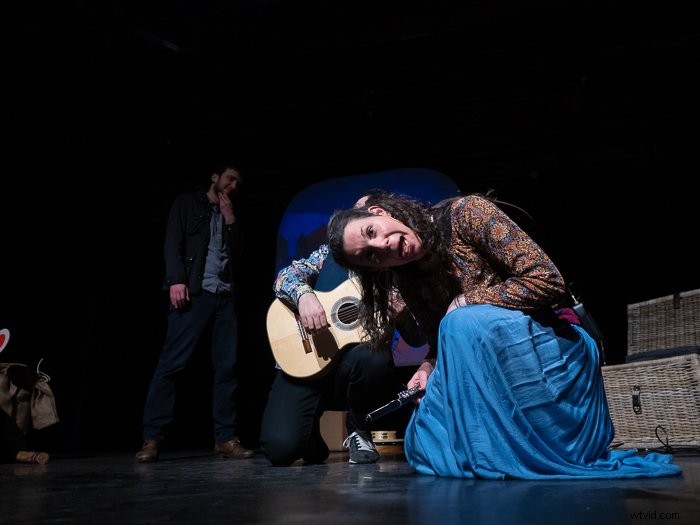
Theatre photography, concert photography, and dance photography are all examples of stage photography.
They’re all a lot of fun to photograph, but definitely have their challenges. This article is full of tips that will help you to improve your stage photography.
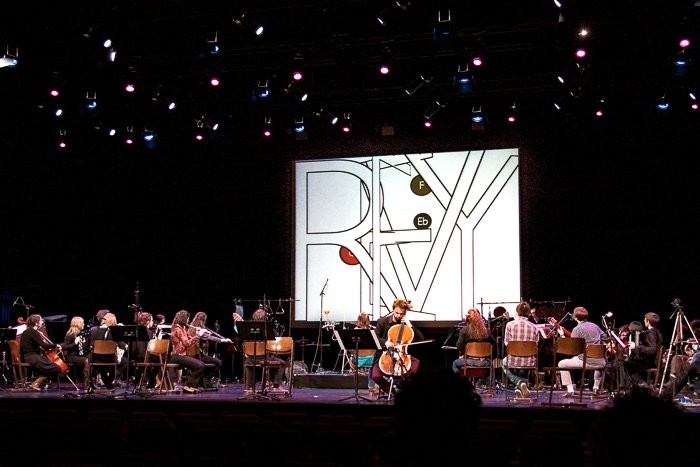
1. Stage Photography Etiquette Rules to Follow During Performances
When you are photographing a performance, and particularly a live one, there are some rules you need to follow. Otherwise, you’re likely to get kicked out of the venue.
Ask If You Can Take Photos
The first thing to know if is you are allowed to take photos. Every live event has its own policy. If you are not the photographer hired by the place or the performers, it is best to ask.
If they say no, the best tip I can give you is to enjoy the performance.
Respect Others
If you are at a live performance, remember that others have payed their ticket to enjoy the spectacle. Don’t move around too much (it’s distracting for both the audience and the performers) and don’t make noise.
If you want to move more freely, consider shooting from the back with a long telephoto lens. A restricted area with no public is also a good option, if you can access it.
Be Invisible During a Stage Performance
- Dress in dark clothes to blend with the darkness;
- Turn off the AF light to avoid distracting the performers;
- Do not use flash for any reason. If you are too far, it’s useless anyway, and if you are close, it’s a distraction that will have you tossed out pretty soon;
- Muzzle your DSLR camera to turn down shutter noise. If you have it, use a silent mode or, even better, the electronic shutter.
- If you are the official photographer and there is more than one spectacle, consider covering both, changing your place from one show to the other.
2. Get To Know The Spectacle
There are many restrictions in place when covering a live performance. This is why it’s best to research the show you plan on photographing.
This way you’ll be prepared to capture the most important parts from the best possible angle: a musician’s solo, a dance move, a particular act in a play, the entrance on the stage of your kid, etc.
Attend Rehearsals
If you can, ask to attend the rehearsals. You can observe how people move on stage, which side of the stage they are on most of the time, what they do and when.
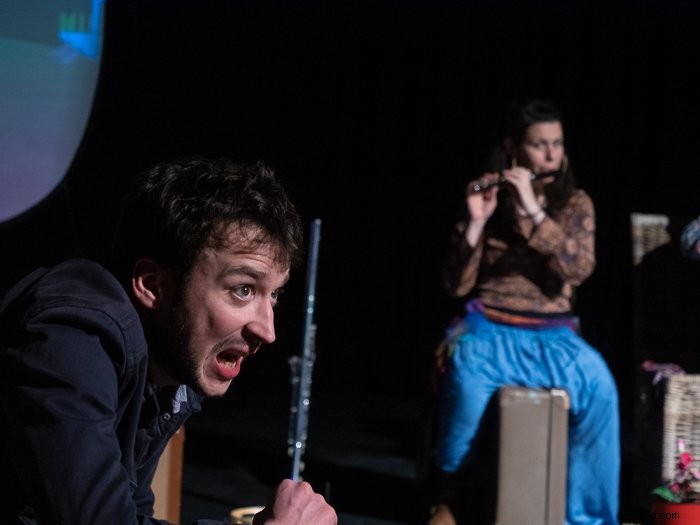
Take advantage of this time and opportunity to try different angles and also to take some backstage photos.
Dress rehearsals, sometimes called dry runs, give you the best photographic opportunities.
The actors are dressed as they will be in the live performance, there is no public, you can move more freely and you can experiment with camera settings and angles.
3. Best Gear for Stage Photography
Camera
Most of the time you can enter with a compact camera. Interchangeable Lens Cameras, such as DSLRs and mirrorless, are usually forbidden.
Some high-end compact and bridge cameras, like the Sony RX100 and RX10, and the Canon G7X series, can deliver very good results.
If you can bring your DSLR or mirrorless camera inside, you want one that performs well in low light conditions. ISO will be pushed up to 1600 or more.
Full frame cameras are the natural choice for the pro stage photographer. But you can get very nice results even with a camera sporting a sensor as small as a 1″-type sensor (crop factor 2.7x).
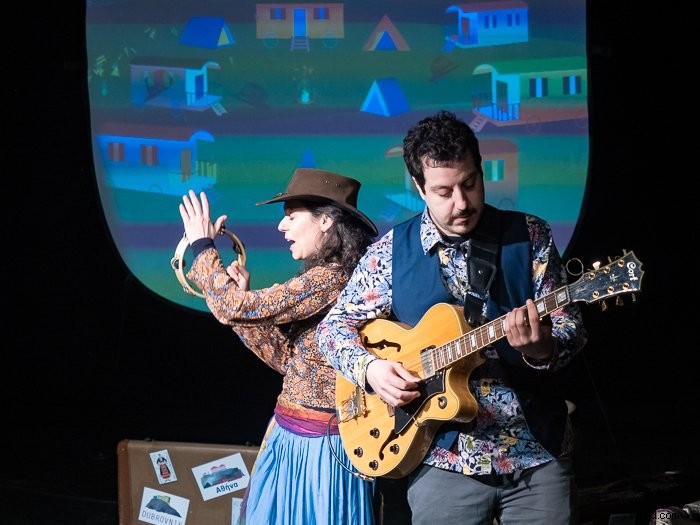
For a given lens and aperture, a smaller sensor will grant you a bit more depth of field than a full frame camera. This can help you reduce the number of photos with missed focus.
Take a Fast Zoom Lens
If you are the hired photographer or there are no restrictions, a fast, zoom lens is the ideal glass to mount on your DSLR or mirrorless camera.
In a small venue, I like the 24-200mm of my Sony RX-10. I can go from covering the entire scene with the wide end of the zoom, to zoom in and take headshots of the performers.
A very popular choice among DSLR user and pros is a 70-200mm zoom lens, typically f/2.8 constant.
4. Set Your Camera to Work Fast and Consistently
Here is how I like to set my camera:
- Image Quality RAW: better quality and I don’t have to worry about white balance;
- Lens Stabilisation ON: this will prevent me from introducing camera shake in my images;
- Back Focus Button for AF: by decoupling the AF function from the shutter, I can focus only when I need and save time when firing the shutter;
- C-AF: I sometimes use continuous auto focus with subject moving fast up and down the stage;
- Continuous Shooting: if there is a great deal of movement, I like to photograph using continuous shooting mode to maximise my chances to get a good image;
- ISO: I usually work with ISO in-between 1600 and 2000. Some people like to use auto ISO, but I like to have images that are consistently exposed for a given moment of the show.
- Metering: I like to use Spot or Centre Weighted metering, if I am not using a wide angle lens to get the entire scene in.
- Manual Mode: I like to shoot in manual mode, if the light is constant, e.g. at a classical concert. Otherwise, I like to shoot in S mode and keep the shutter speed at 1/100 at the very least, to freeze the action on the stage.
How to Compose for Stage Photography
This is the most difficult part of stage photography. You have set your camera, your settings and now you have to make images that convey the feeling of the performance.
You have to show the fun, the drama, the tension, the playing, etc.
A good composition is a must. This means you need to know the play, so that the decisive moment doesn’t come at a surprise, but you can wait for it to happen.
A safe and general composition rule is the rule of thirds. It will give enough space to the subject to look/move in.
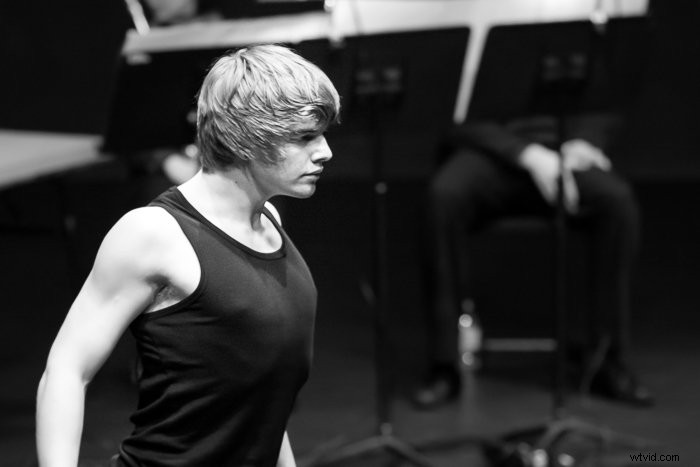
Close in on a Subject
We are generally working at a wide aperture with a zoom lens. Because of this, depth of field can be rather shallow. This can help to naturally isolate the subject from the other people or a busy scene on stage.
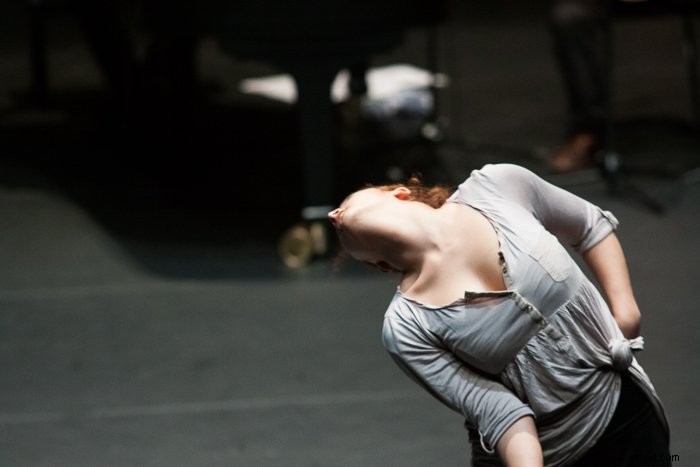
Headshots are great to capture facial expressions to transmit feelings.
Use moderate close-ups when you want to capture body language and movement.
5. Take Wide Angle Shots to Show the Entire Stage
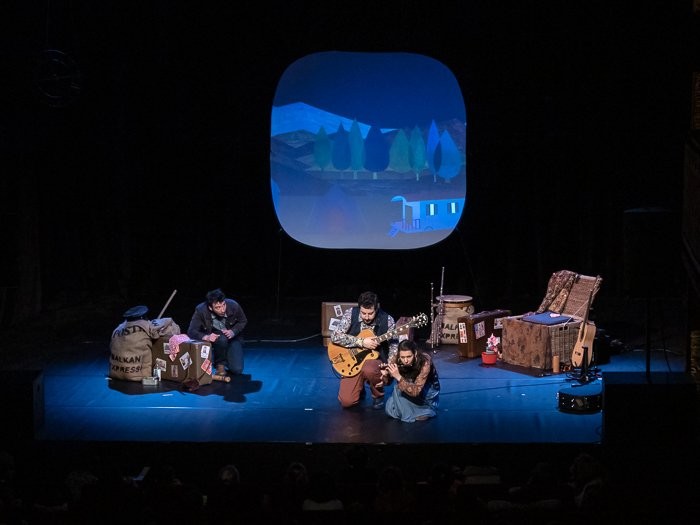
Particularly in small venue, wide angle shots are great to show the entire stage and even part of the public, if you are live.
The beauty of wide shots is their ability to capture the show as a whole. They show how scenography, lighting and artists all work together to create the atmosphere.
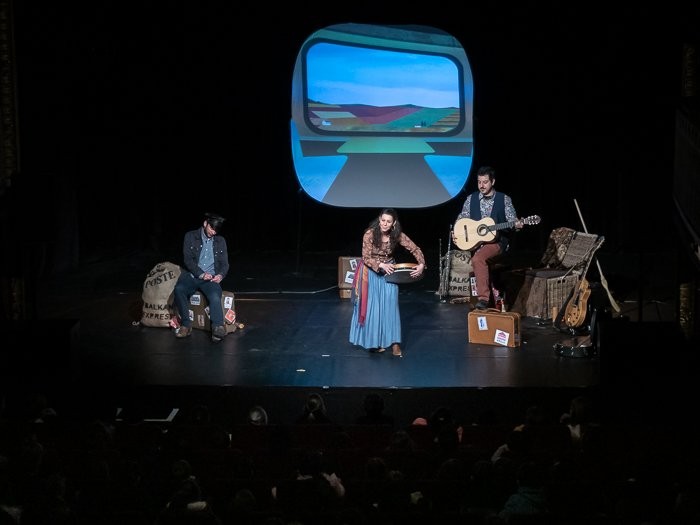
It is important to respect the lighting of the scene. Forget the white balance. If the scene is blue, for example, there is a reason for it.
It might be nighttime, as in the image below. Or it might be the particular mood the artists want to convey.
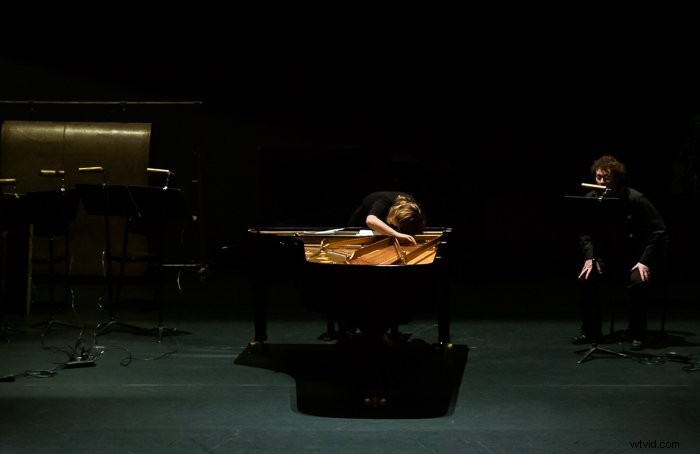
The way the lights appear in the scene is part of the show. In the image below the key light was on the pianist, to isolate her more from the rest of the scene that was kept darker.
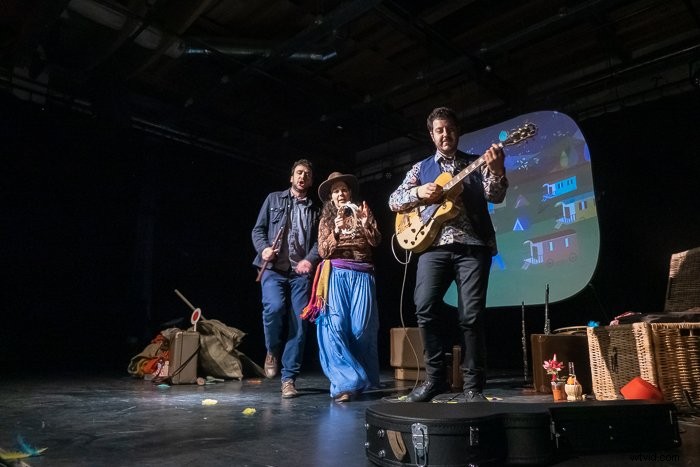
If you are next to the stage, you can use wide angle lenses in combination with a low angle to create a more dynamic and powerful image.
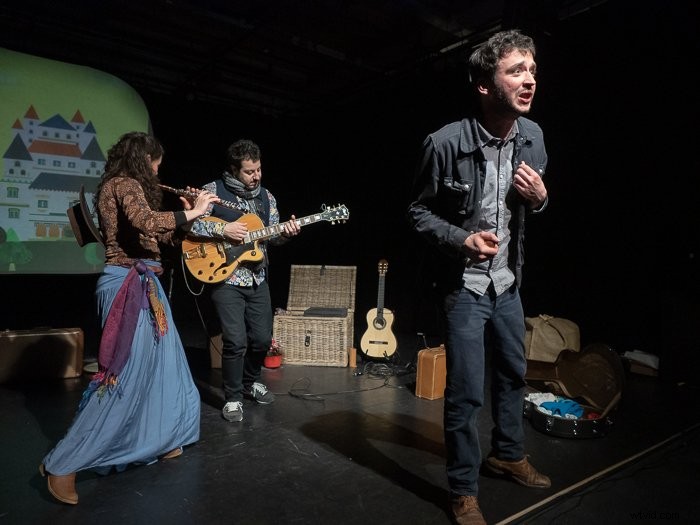
If you can go up close, like during a rehearsal, experiment with the way a wide angle creates distortions.
6. Capture the Movement
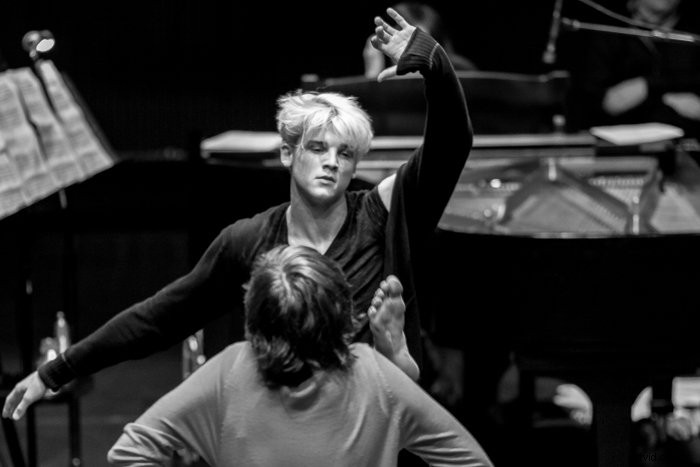
Capturing movement is important in theatre and stage photography. You can do so by photographing a particular moment where movement is obvious in the body language.
Like in the photo below.
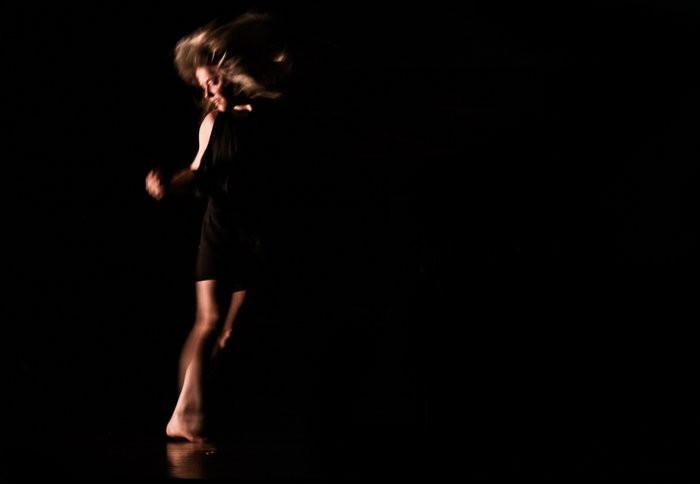
A relative slow shutter speed to allow some motion blur is a great way to convey movement.
With more people on stage, you need to create a balanced composition.
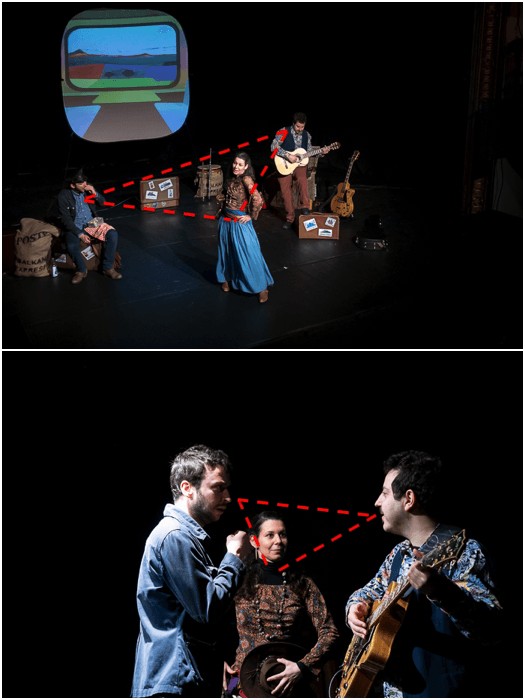
Use Triangles
If you have three people, you should photograph them when they are forming a triangle on the scene.
Split Them into Groups
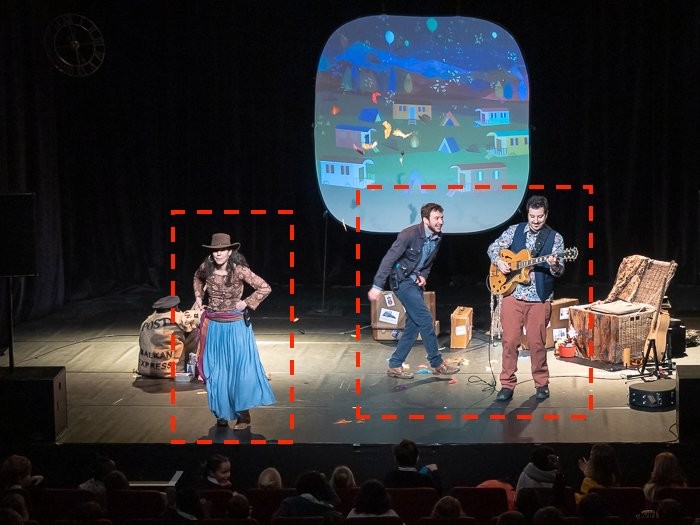
This works nicely with an odd number of people on stage, who are moving and interacting.
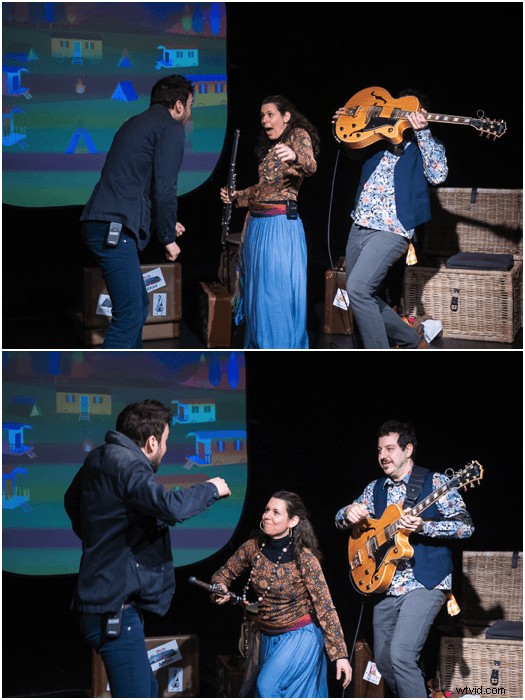
In the image below, I have waited for two of the three artists on stage to come closer and interact. Splitting the people in groups is a well-known rule in group photography.
Line Them Up
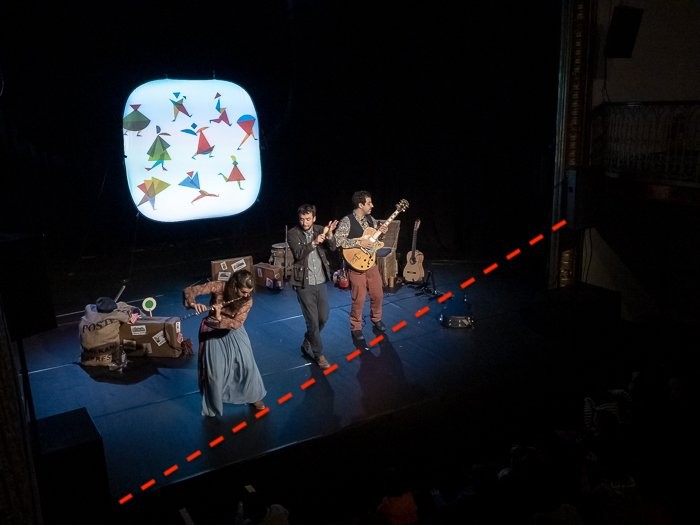
Having the artists on the same line works nicely if you are composing from the side of the stage. Keep the line somehow diagonal in the frame.
This will make your shot more dynamic.
Capture Interactions On Stage
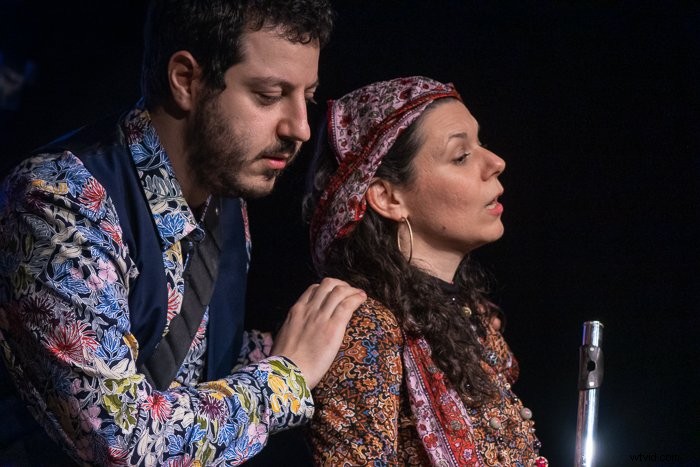
People on stage will interact and it is nice to portray those moments. It lets the viewer engage with them and share the emotions on stage.
The kind of interactions you should look forward to can be physical, like the two musicians singing together in the photo below. A close-up works really well for this kind of shot.
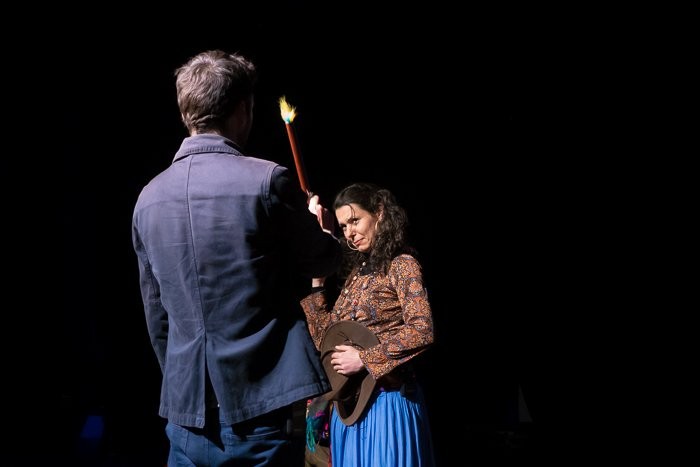
Another thing to look for is how actors look at and react to each other to transmit emotions.
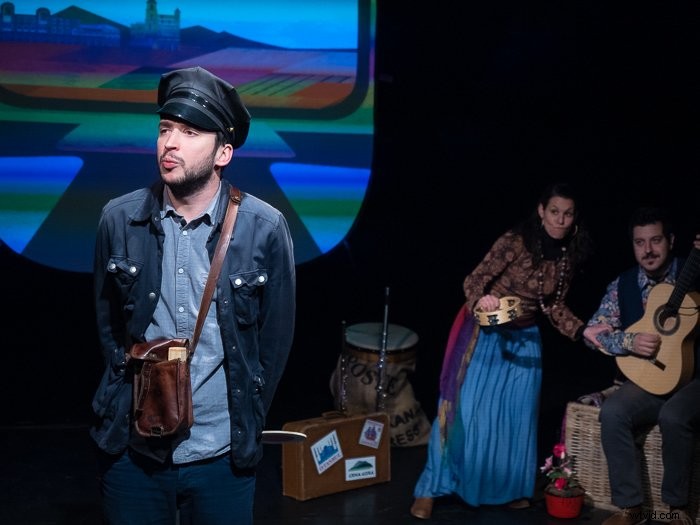
Finally, action can involve different planes. In the image below, it is clear that the people in the background are planning something for the guy in the foreground.
7. Backstage Photography Can Add to the Story
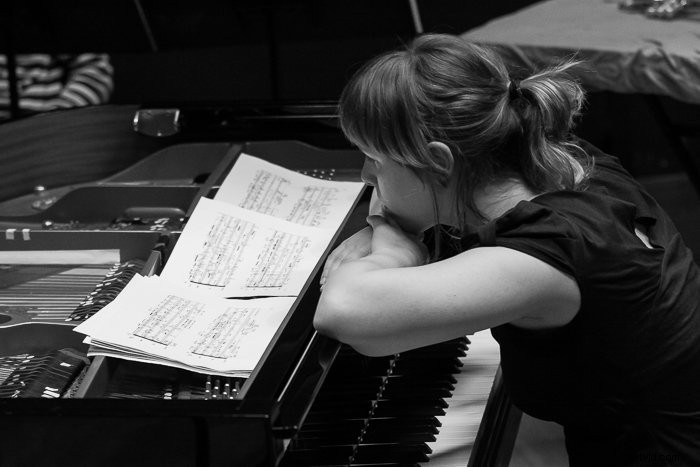
If you are the hired photographer and have access to rehearsal and can follow the preparations, this is the time to do some backstage photography.
A classic way to do backstage photography is to shoot black and white. Colours work just as well.
Try to cover different points of view, meetings, and relaxing moments.
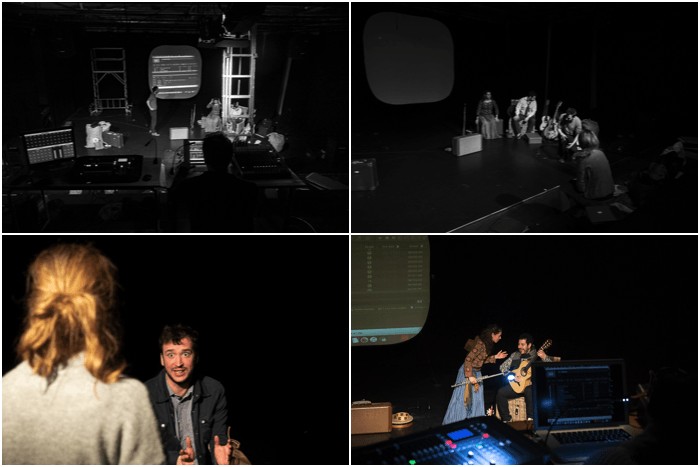
Conclusion
These tips will help you get better images next time you are up for a stage or theatre photography session.
Remember to have fun and enjoy the performance too!