
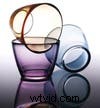
Subtractive Lighting
Fritsch “metered” his shot via the capture software in a tethered MacBook Pro. Tech data: 1/250 sec and f/16, ISO 40.As we’ve said before, if you can light glass, you can light anything. Tom Fritsch, a product and still-life specialist from Chicago, can light glass. He recently took on a personal project of lighting glassware in a way designed to enhance reflections in one part of the scene, while eliminating them in another. Not easy!
His ultimate goal? To emphasize the translucent, crystalline quality of his subjects by avoiding the bright white reflections so common in glass. For Fritsch, the problem with these reflections is that would have called attention to the surfaces of the glass, not to its transparency. The lighting strategy he ultimately chose was based, in part, on subtractive lighting. Just as glass reflects white light, producing a white reflection mirroring the shape of the source, it can also reflect black. When used as lighting tools, these black reflections are known as subtractive fill.
Fritsch created it with two large (relative to his subjects) 10×18-inch black cards on each side of the glasses. Positioned close and at a 45-degree angle to them, the cards did more than block light as gobos or flags typically do. By subtracting light from his setup the cards also:
-Created the dark accents along the sides of the glasses that defined their shapes.
-Helped darken the glass floor in the foreground so that the reflected images of the glasses would stand out. And, more traditionally…
-Controlled the bright light that reflected off the background and prevented it from blowing out the glassware and desaturating its color.
Subtractive fill wasn’t the only trick up Fritsch’s sleeve. Instead of aiming his two strobes to create a circular white hot-spot immediately behind his subjects—as many of us would have done—he aimed his lights much more deliberately.
The left-hand strobe was aimed near the horizon line behind the glasses, and its function was to blow out the seam where the tabletop glass met the white background paper (see diagram). The opposite light was aimed above his subjects and off-axis to the right, which caused its output to fall off into shadow more quickly, helping to create the darker foreground that made the reflections down in this area stand out.
The overall result? An unusually pure and subtle rendering of a typically thorny subject.
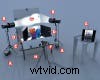
For maximum control of reflections in the glassware he was photographing, Tom Fritsch set up:
(A) Two Speedotron 2403CX packs and (B)102 Black Line strobe heads to reflect off the (C) white seamless background and backlight his set. He fired them with Quantum Radio Slaves. For precise light pattern placement, he added 10-degree grid spots to the heads. He controlled reflected light and added subtractive fill with (D) two black cards placed beside the glassware. (E) A sheet of glass under the subject created the tabletop reflection. Fritsch shot with a Hasselblad 553 ELX** (F)**, 54M Sinarback digital back, and Hasselblad 80mm f/2.8 Planar lens, all tethered to a 17-inch MacBook Pro (G). He supported the camera with a Gitzo Traveler tripod (H).