
Knowing when to reduce light on set is just as important as knowing how to set it up. Let’s take a look at smart ways to shape light.
Adding light to a scene is a powerful way to tell a story. However, sometimes it’s even more powerful to take light away. This can create a richer mood, a more cinematic image, and a more intriguing story than you first imagined. In this article, let’s take a look at how to strategically remove some light after you’ve set up your initial lighting rig.
Negative Fill
Negative fill can be a cinematographer’s best friend. We often talk about lights and tools to add more light to a scene. However, we often don’t talk about how to control that lighting — or even take it away, if necessary. Negative Fill is a powerful way to take away light and create more contrast to enhance the mood of your film.
We can achieve negative fill using a black solid flag. These flags come in all sort of sizes and varieties. They can range from an 18×24 all the way up to a 48×48 floppy, which converts to a 48×96. These solids allow you to shape light and create mood. Think of a solid as the exact opposite of a reflector. Instead of adding light into a scene, they can simply take it away and reshape your talent’s features or remove light from the background.
Nets
Nets are another powerful way to control light, but less intense than a black solid. Nets, are just that: nets. They’re netted fabric that comes in two different strengths: single and double. Much like scrims for lighting fixtures, these nets carry one of two labels: red for a double and green for a single. A double (red) takes away one stop of lighting, while a single (green) takes away half a stop. So if you’re looking to lose a stop of exposure on your background to make your talent stand out a bit more, then a double would be just what you need.
Diffusion
Diffusion is really more about shaping your light for a desired look than about taking it away. However, I like to think that when filming day exteriors, various diffusion materials act in different ways to reduce light in a scene. Taking away light from a day exterior scene is an important step to reducing contrast and making the image more pleasing to the eye.
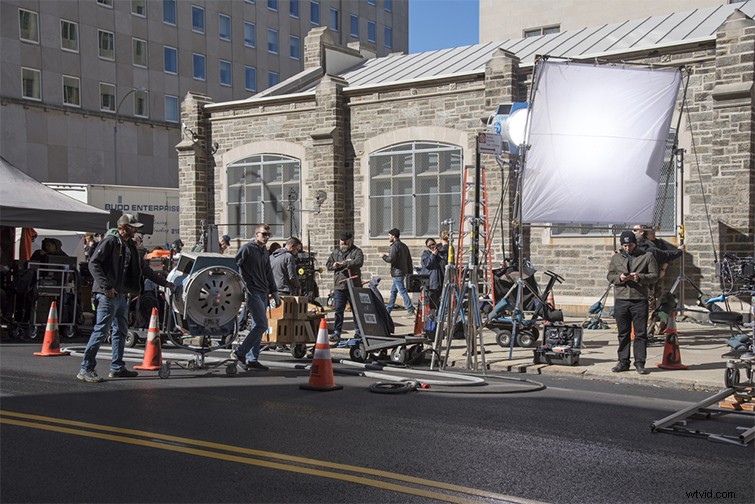
For example, if you were to set up an 8×8 solid and completely block the sun from your talent, this would create a much softer lighting. The reason why is that the ground and the surrounding environment have now becomes the sources of reflected lighting, not direct sunlight. If you were to set up two double nets to cut down the sun on your talent, they would still have the same harsh lighting as before. Knowing and understanding how each of your tools works is important because cutting down and taking away the harshness and intensity of the sun is key to creating a cinematic outdoor image.