
Color has long been one of the primary tools filmmakers use to communicate aspects of their characters and the worlds they live in.
Bernardo Bertolucci and Vittorio Storaro used a striking and effective color palette in The Last Emperor, with each period of the protagonist’s life painted in a specific color.
Rodrigo Prieto went even further in 2004’s Alexander, using color infrared film stock to capture the moment when Alexander is almost killed fighting in India. The trees turn a vivid red, the skin tones are desaturated, the sky is white, and blood turns a grotesque yellow.
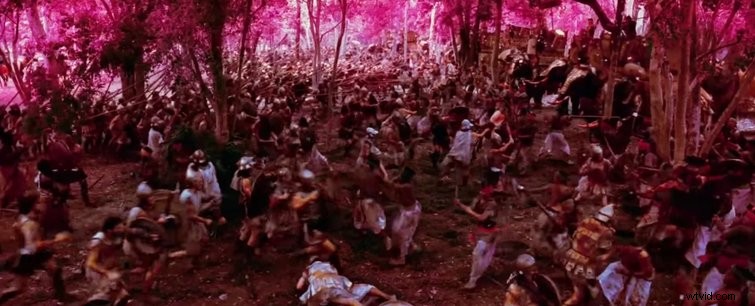

Since the release of these films, this color effect has been emulated many times. Star Trek Into Darkness recreated a similar palette with makeup and production design rather than infrared film stock — to envision a primitive alien planet. They probably did this to create a more consistent, predictable result. The color changing effects of color infrared film stock are only apparent once the film gets developed.

I got my hands on a color meter recently, and I wondered if I could do the same thing with RGB lighting. A color meter gives precise readings for colors, and by manipulating the lighting on my main character, I was going to attempt to shift the colors of the scene to create an otherworldly feel.
Most RGB lights have settings for hue, saturation, and intensity. What I needed to do was find the color value of the background (that I couldn’t change) and use that to calculate the color the subject should be.
I measured the color of the leaves by placing a leaf over the color meter sensor and got a hue reading of 75 (yellow/green). If I was going to have to shift this to zero (red), I would have to shift it down by 75. So, if I wanted to arrive at a skin tone value of around 25, after the shift of -75, I set out to light my subject at a value of 100 (blue/green).
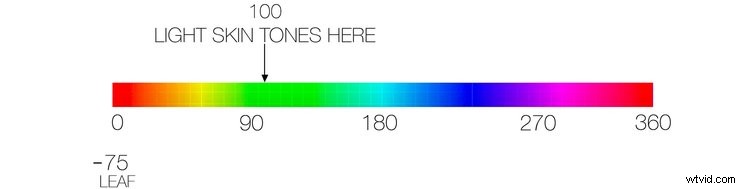
The first few experiments were contaminated by sunlight, so we built a tent from duvetyne and added more lights.

Finally, we were able to get the correct value. After taking the raw footage into Resolve, I decreased the hue value by 75 and got a shot very reminiscent of Prieto’s Alexander.

There are downsides to this technique — you need to be able to light your subject separately from the background, and RGB lights aren’t (yet) as bright as daylight or tungsten sources, but there is a great deal of possibility in this technique to manipulate your color palette, far beyond what was previously possible.
I have since exported this look as a LUT and loaded it into my monitor. I can now view this effect in real time and have more control on set.
A color meter can open up a new world in measuring and manipulating color on set. Combined with RGB LEDs and raw video capture, the only limit is your imagination.