
F-stop definition
Talking about F-stop in photography we just must say several words about aperture, as those two notions are closely connected and sometimes even interchangeable.
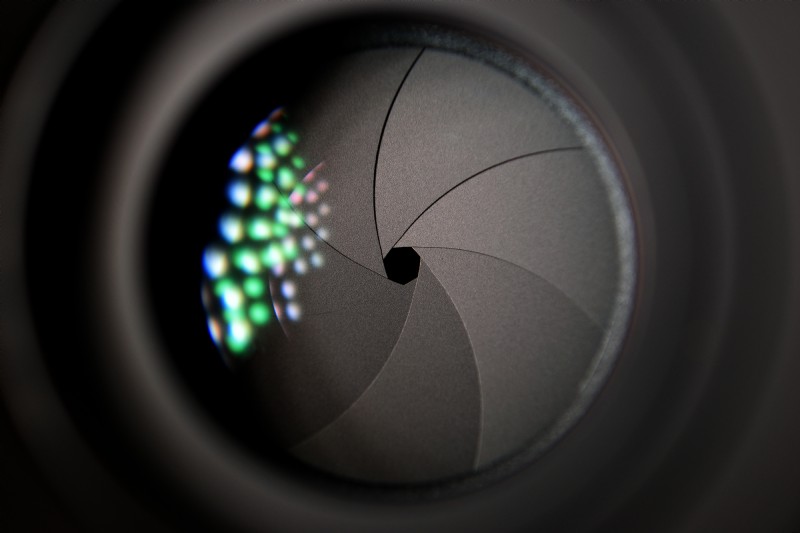
Aperture, in brief, is a hole through which the light enters the cam and imprints onto the sensor or the film. F-stop is the size of this pupil.
How it works
Every mechanical or digital camera has special blades which open at the exact width depending on the settings and the lens’s properties. The wider the hole (aperture) is – the more light is let in. It means that, for example, for a night shooting you’ll need the largest aperture possible (and the lowest shutter speed, but that’s another topic).
On the other hand, an aperture defines the depth of field, and here the correlation is in inverse proportion. Large apertures cause shallow photos with a blurred background, small ones give sharp and focused photos in which you can distinguish the finest details.
What does F stand for
That’s fine, but how does it correlate to F-number? Directly.
Officially “f” stands for focal length, but for us as amateur photographers it makes no sense. Let’s have a look at another definition which will help us understand the very notion of F-stop. F-number means a fraction, i.e. a proportion of the abovementioned blades opening.
Quite logically, the largest aperture is defined by the lowest F-number. The maximum pupil would be 1 (as 1:1 proportion means 100% wide open blades), but it doesn’t exist. The widest aperture possible is F/1.2, but, again, it also depends on the DSLR camera and its lenses.

Common F-numbers
- F/1.2 – the widest aperture apt for night shooting.
- F/1.4 – the “ring of blades” is two times wider as for the previous F-number.
- F/2 – again, blades stop two times further than at the previous step. This principle is true for all the following F-stops.
- F/2.8
- F/4
- F/5.6
- F/8
- F/11
- F/16
- F/22
- F/32 – extremely small aperture with extremely deep depth of field.
Of course, there are other F-numbers as well.
Points to consider
- Each lens has its own F-number range. This parameter is so important that the maximum aperture is usually included in the device’s description: something like 20 mm F/1.4. The minimum aperture may be found in manuals and documentations.
- While using a large aperture (small F-stops) mind your exposure and white balance. But even if your photo or video is overexposed, you may adjust its colour scheme, contrast, and other parameters.
- Try shooting the same object with different F-stops to grip the difference. If you are not experienced enough yet, set an aperture-mode priority so that the cam could adjust the shutter speed and other settings.