
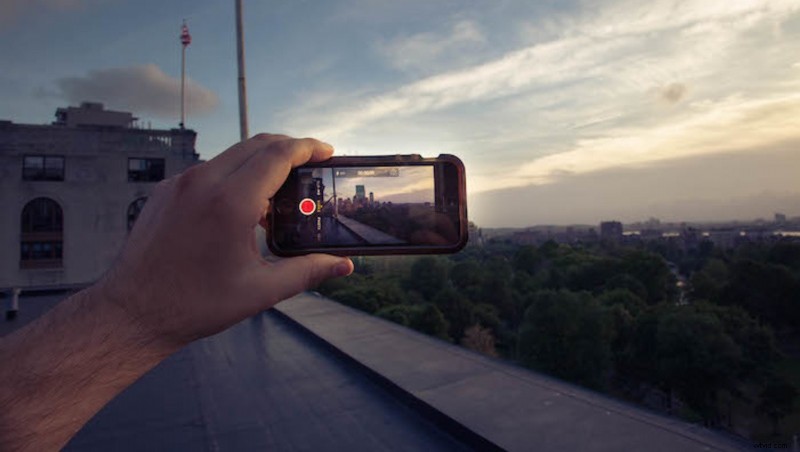
When audiences at the Sundance Film Festival were told that "Tangerine" was filmed entirely on an iPhone 5S, people were not sure if they believed it. It soon became clear that this was a fact, and that mobile videography had reached a new plateau in the film world.
A few months later, Mark Duplass stated in a keynote at South by Southwest, "We are at a place right now where technology is so cheap, there is no excuse for you not to be making movies on the weekends." Duplass understands the mobile revolution that is occurring not only in the film industry, but also within smaller markets. Given the emergence of GoPros and the praise Apple and Samsung mobile devices have been given for their cameras, it was only a matter of time before people started shooting feature-length films on their mobile devices. We also featured an article a few months back that talked in-depth about a entire video shot on an iPhone 6 Plus.
Recently I ran across a Vimeo Channel curated by Philip Bloom and Vincet Laforet dedicated to mobile cinema. It features videos from all over the world that were shot exclusively on mobile devices. Here's one such video:
https://vimeo.com/128497475
These videos have come a long way from what they used to be, which was the equivalent of later 80s and early 90s home movies show on VHS. Given the technology now in our pockets, filmmakers now have access to two key native features that were relatively out of reach three years ago.
Time-lapse
This feature is great and easy to use on most devices. The only downside to time-lapses is that you cannot set the intervals on most of mobile devices. For example, Apple uses what they call "dynamically selected intervals" which bases the interval time on how long the time-lapse was shot for. It does all of this in the post-processing internally on the device.
Slo-mo
Most devices will allow for video to be shot at up 240fps at 720p. The great thing is that if you choose to shoot at 240fps you can tweak the speed in a variety of ways. Given the compression that most videos go through when posted to YouTube and Vimeo, the loss of detail is not completely lost.
Granted theses are just two features that most pro cameras and DSLRs have. However, considering that when the Canon 5D Mark II was released you needed to buy an external intervalometer and it could not shoot 60fps unless you hacked it says a lot about how much technology has advanced. Given these advancements it's no wonder we are finally seeing people using their mobile devices as full-fledged video cameras.
I guess this begs the bigger question, are you shooting movies on the weekends?