
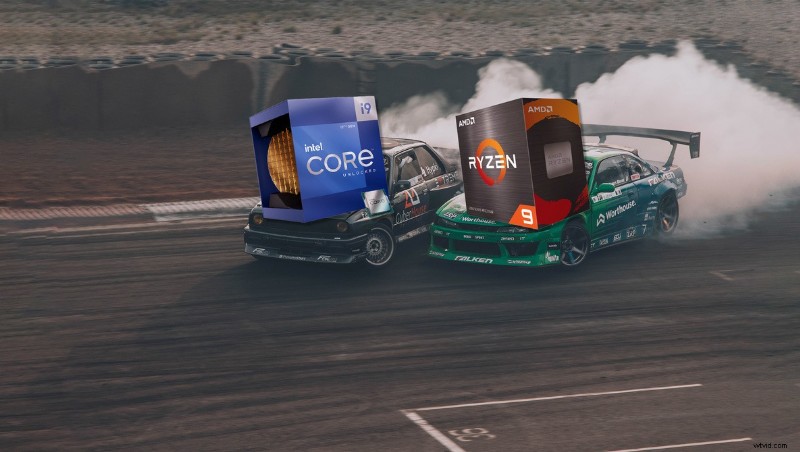
The reviews on Intel’s 12th Gen Core desktop processors, named Alder Lake, have all come in, and the results are surprising. Whether you’re looking to upgrade your computer or just want to stay up to date on tech trends, you’ve got to see how these chips performed.
Puget Systems, a high-end custom PC builder with a focus on professional workflows, has always been one of my favorite authorities on testing. Unlike many tech reviewers, who emphasize gaming performance in their testing, Puget focuses on professional applications and suitable testing conditions for real-world performance (i.e. not overclocked).
The 12th Gen processors from Intel come at an important time for the brand. AMD’s 5000 series chips have proven to be monsters in both IPC and thread count, yielding great results in both lightly threaded and highly parallel-izable tasks. With 12th Gen, however, Intel has made progress on both fronts. Core counts have gone up, with even i5 chips offering 6+4 cores (more on this odd architecture in a second). Meanwhile, the top end 12900k now has 8+8 cores, drawing closer to the 5950x’s 16-core arrangement, at least on paper.
What makes those core counts odd is that Intel has pursued a hybrid approach, combining two different core “layouts” on one chip. 12th Gen cores can be a mix of performance and efficiency cores. The performance cores are larger and draw more power, but offer the best performance in single-threaded applications. Meanwhile, the efficiency cores take up 1/4th the space on the die, but only give up 1/2 the performance over the performance cores, making them a great way to squeeze more multi-threaded performance into the same space. Consider how putting four efficiency cores into one performance core’s “spot” results in the same MT performance as two performance cores.
Testing Matters
Between these changes to core counts, the ever-more complex nature of clock speed boosting, and evolving standards like DDR5 and PCIe Gen 5, real-world benchmarking is more important than ever. Real-world benches can help cut through the marketing noise, particularly when they’re well run and tailored to your workflow.
In this case, Puget delivers. Their benchmarking of the 12th Gen CPUs puts them up against AMD’s 5000 series and Intel’s older 11th Gen chips in Photoshop, Lightroom, Premiere, Resolve, Unreal, Cinema 4D, and more. For photographers, I particularly like that their Lightroom and Photoshop testing methodologies are so in depth. They cover importing, library ops, develop module ops, preview building, panoramas, HDR, and exporting; other benchmarks often just cover something easy like exporting, leading to blind spots in the testing.
Puget further separates results for Lightroom into an active and passive metric. Active tasks, like scrolling through the library module or working in development, can greatly impact how your machine feels in day-to-day use, while slow performance in passive tasks like exporting can be brutal for high volume shooters like wedding photographers.
The Results
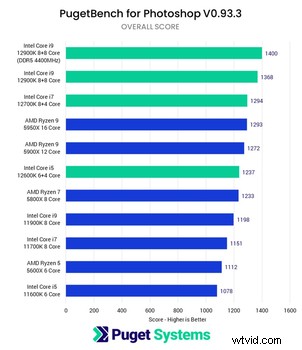
In both Photoshop and Lightroom, Intel’s 12th Gen chips like the 12900K and 12700K represent the high-water mark in performance. Even the i5-12600K can trade blows with Ryzen 7 and 9 chips. Although these victories aren’t huge, with Intel delivering about 5 to 10% better performance in Photoshop over similarly priced AMD chips, they represent a win nonetheless.
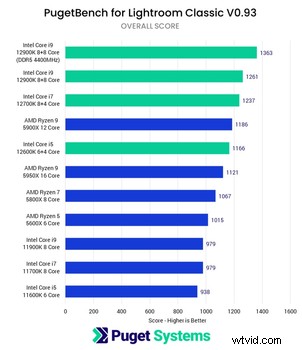
In Lightroom, an important result comes from the 12900K. While the 12th Gen chips can use both common DDR4 memory and the newer DDR5 memory, only Lightroom yielded a significant performance difference when working with photos. The 12900K, with DDR5, came in 15% above the previous winner, the 5900x. The 12700K and 12600K also yielded about 15% performance improvements over the 5800x and 5600x respectively.
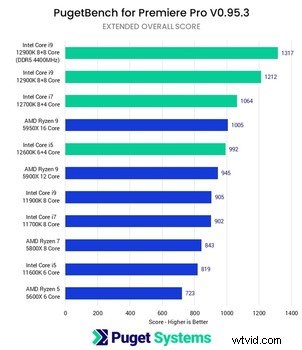
For video users, the choice of chip comes down to whether you’re editing in Premiere or Resolve. Premiere gave a 25-40% performance lead to Intel over similarly priced AMD chips, with the odd note that Windows 11 yielded 8% slower results for the 12900K over Windows 10. Regardless of that bug, the difference in performance was so great that the i5-12600K was able to score similarly to the 16-core 5950x, a very surprising result.
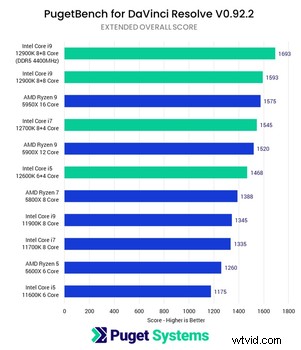
On the Resolve side, the performance is less startling. Intel’s top-end chips still sit on top, but the performance-per-dollar gaps are closer to 10%. The i5 does still stand out as a low-priced powerhouse for video work, though.
Of note is how this generation also brings a number of opportunities for improvement in these results. As the first real hybrid architecture for Windows, there are several areas ripe for optimization. Thread scheduling, the process by which work gets assigned to the actual cores, is one of the clearest areas. Additionally, Windows 11 offers a big performance bump in Photoshop, with Puget noting a 28% improvement over Windows 10 in their testing. If you’re not interested in moving to 11 right now, this can be a huge factor.
Also, the expected improvements in DDR5 memory, including both price and performance, can be a significant factor. The early modules in every memory generation are more expensive and less performant than modules later in the generation, and DDR5 looks to be the same. This means that holding off just a while on the upgrade, or even rolling over your DDR4 kit can yield performance improvements down the line.
At the lower end, the i5 and i7 chips have a significant lead over the Ryzen 5 and 7 chips, often thanks to Intel’s higher effective core count. At the higher end, the 12900K is the new performance king for both Lightroom and Photoshop, although DDR5 is necessary to open a noticeable gap. As a result, if you’re looking to build a new workstation, you’ll probably want to go Team Blue this time around. If instead of building, you’re looking to get a computer delivered, consider checking out Puget System’s rigs. Their workstations are tailored to real-world workflows like Photoshop and Lightroom, making them a great choice for users who just want a high-performance system, without having to stress over specs.
Header image courtesy of Ralfs Blumbergs.