
With a 12K camera entering the market, is there a reason for such high resolution beyond massive images? Let’s take a look.
During a summer live-stream, Blackmagic announced the URSA Mini 12K, an unprecedented move that few were expecting—if at all. While the news of a 12K camera indeed dropped a few jaws, it also made several people hysterical, as was previously the case when RED announced their 8K camera a few years back.
Social media was alight with hot takes about how pointless 12K is, as were user groups on Facebook. For days after the announcement, there was an endless spray of comments, such as:
- “I’ve only just adjusted to a 6K workflow.”
- “What’s the point in 12K when you can only watch 4K?”
- “Nobody needs 12K.”
- “Who is even going to be able to edit 12K?”
As a side note, I should mention that the Blackmagic RAW codec is exceptionally workable. So, you’ll find that most people will be able to edit 12K natively, but the rest of the comments hold valid reasoning. Why is there a need for a 12K sensor?
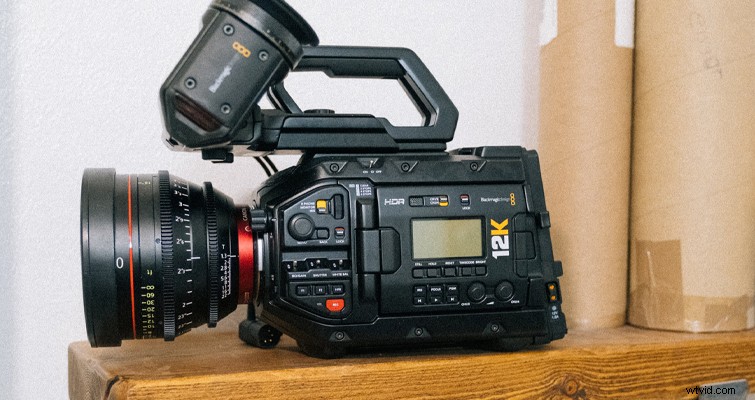
Most of the online content is viewed through a mobile device which is usually a 720p stream. Only in 2018 did we first see that the number of UHD TVs purchased in a year exceeded 1080p TVs. However, for the most part, a majority of households still have a 1080p TV. Even then, for consumers with UHD devices, our 4K and 6K cameras should be more than sufficient to deliver superb image quality, right? Is 12K overkill?
Well, the concept of the new propriety 12K sensor from Blackmagic isn’t just to deliver 12K content. In fact, that might not be the point at all. Let’s take a look at what the sensor is offering us. However, I’ll look to simplify the information as much as possible. We have a large base of new filmmakers reading the blog, and the technicality surrounding the learning of sensors can sometimes be overwhelming. Even I find myself recollecting the memories of math class when looking at the influx of new information (I didn’t like math class)!
New Sensor Design
The URSA 12K doesn’t use a Bayer pattern filter for its sensor, which nearly every CMOS camera has. Instead, it uses a new custom filter array (CFA) with the same number of red, green, and blue photosites and additional white photosites throughout.
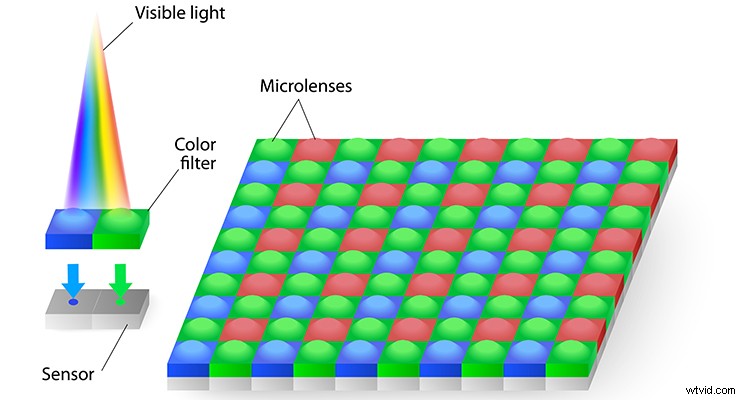
The Bayer pattern has a one red, two green, one blue, two-by-two grid. In contrast, the 12K sensor has a six-by-six grid consisting of six red, six green, six blue, eighteen white photosites (there are no official images of the design just yet).
This, by nature, does several things. It should first render colors more accurately and offer greater perceived sharpness and clarity. While the 12K doesn’t have a built-in OPLF filter, the RGBW sensor will limit the amount of aliasing and false coloring, which is a prominent issue in GGRB sensors.
Additionally, the symmetrical sensor design allows for a unique scaling feature. If, for example, you decide to shoot in a lower resolution to conserve media space, usually, when opting for a lower resolution aside from the camera’s highest resolution, the camera will use a smaller sensor area resulting in a cropped image with a tighter field of view. On the 12K, thanks to the symmetrical design, the field of view doesn’t change throughout 4K, 8K, and 12K resolutions. Therefore, if you do opt to shoot at 4K to conserve media space, you’re not going to need a different set of lenses to accommodate for the new and tighter field of view. This scaling feature isn’t possible with this new sensor design from Blackmagic.
On the topic of resolution, let’s talk about why you’d want to shoot 12K.
12K for Greater 4K & 8K Delivery
Four years ago, I wrote about recording 4K to deliver 1080p on the GH5. While the article uses the GH5 as an example, it was more of a primer on the nature of oversampling. In it, I wrote:
Now, if you were to swap 4K for 12K and full HD/1080 to 4K, the statement still rings true. But, at a grander level, because we’re getting 4x the data at a resolution of 4K itself, in theory, this will also give you a better range of dynamic range. As when downscaling, it’s going to bury any visible noise (to a degree) and allow you to raise the blacks further than you’d be able to with a native 4K image.
At this point in the article, I did have a series of images to illustrate the oversampling. But, due to the limit in the width and height of images here on the blog, it felt fruitless in trying to demonstrate differences as they were hardly apparent. Instead, I implore you to check out CVP’s video (below) on the 12K that has 4K visual examples.
With the oversampled image, you’re getting extraordinary detail and color with extremely sharp images without the harsh edges, which is typically found in 4K that has gone through demosaicing.
Reframing
While not the primary selling point of a 12K sensor, the extra-large image also presents us with the ability to punch-in and reframe our composition to a degree that hasn’t been seen since 4K was first introduced at a consumer level.
Around 2014, YouTube was inundated with tutorials and information on how users of 4K cameras could take heed of the extra resolution by reframing, punching in, and opting for better post stabilization, because YouTube and other platforms were primarily a 1080p platform. However, in 2021, it’s a different story. 4K is almost the norm for most final delivery and, likewise, even most YouTube content can be viewed in 4K.
While there are low-budget 6K options, like the BMPCC6K, the 6K resolution doesn’t offer that same adjustability level from 4K to 1080p. The 12K offers this and more. Of course, there would be a slight loss of clarity when punching into a 12K image instead of downsampling.
So, the TL;DR. The 12K isn’t a camera that’s been engineered solely for 12K images, but to obtain greater colors and sharpness at 4K and 8K.
If you’d like to read a more in-depth and thorough approach to understanding the new sensor, I recommend reading John Brawley‘s article on the camera. John Brawley is a DP who has worked with Blackmagic for several years and is likely the one person outside of Blackmagic themselves who will know most about the sensor.
For additional gear tips and advice, check out these articles:
- Filmmaking Gear Highlights of 2020 – Indie Edition
- The Best Mobile Filmmaking Gear for Making Videos on Your Phone
- Essential Gear You Need to Start Your Own Production Company
- Gear Roundup: The Best Laptops for Video Editing
- The 10 Best YouTube Channels to Follow for Filmmakers in 2021