
If you’re producing video after video, you need to know how well they’re doing.
Are they effective? Is there room for improvement? Do they cover everything they need to?
You won’t know unless you measure and analyze your videos!
Elizabeth Pierce, Senior Director of Learning Experience and Consulting at TaskUs, joined The Visual Lounge to share her thoughts behind measuring video engagement.
Elizabeth has 20 plus years of experience working in the learning and development space as a fantastic leader and advisor. She’s dedicated to driving a progressive learning culture throughout organizations to meet company, customer, and employee goals for strategic growth. She’s worked with big names such as Walmart, Oracle, Uber, Eventbrite, and Glassdoor.
Getting clear on company goals
One of the biggest areas of focus for Elizabeth is to get clear on the goals of your leadership team or client. When trying to achieve any real change with learning, you need to figure out the potential roadblocks to reaching those goals.
Elizabeth likes to dive into the details here. She says the best way to deliver training is to look at the goals for each company division and get clear on what behavior changes and knowledge checks the company needs.
A good collaborative team effort is key
When it comes to producing effective instructional videos for businesses, it’s always a team effort. Elizabeth works with some fantastic instructional designers and content writers who collaborate really well together.
According to Elizabeth, one of the most important things to remember as a leader is that your team needs to know what they’re working towards. That’s where communication becomes key.
How to test for engagement
How do you ensure that the viewers of your video have absorbed the information?
Elizabeth says: quiz them!
The simplest way to check that the information has been absorbed is to have a knowledge check at the end of the video. This achieves three key things:
- It ensures they paid attention
- It means it sunk in
- It reinforces that training is not just a one-and-done experience
If you really want the information to sink in, an even better way to test it is to do a little refresher a few days later with a new mini knowledge check quiz.
How to deliver content that drives engagement
Another thing to bear in mind if you’re trying to boost engagement is how you deliver the information. Throwing together a slideshow with hundreds of slides isn’t going to lead to high engagement and knowledge retention.
Elizabeth says that the knowledge check is only part of the work. The content itself needs to be engaging enough so people can retain the information.
Video vs. PowerPoint vs. eLearning modules
300-slide PowerPoint presentations are probably not the best way to deliver information, but is video always the solution?
Elizabeth loves video because it can tell a story. While you can do something similar with static images on a PowerPoint presentation, it’s just not the same. Video, she says, is much more entertaining and easier to remember.
What true engagement looks like
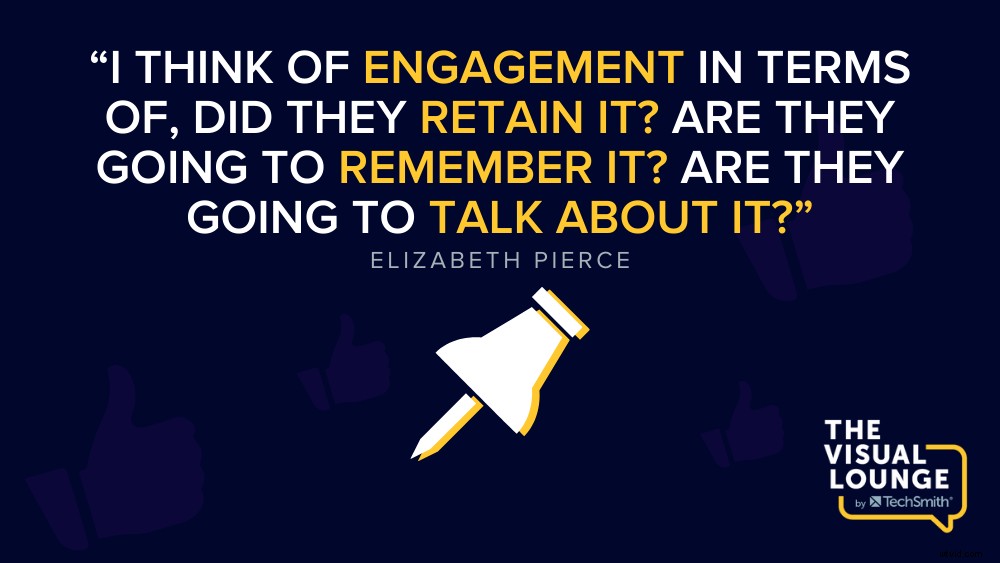
The word engagement can mean a few different things. For some, it means interactivity. It means sharing the video, responding to it, putting the ideas into action. But interactivity isn’t the only way to measure engagement.
Elizabeth’s definition of engagement in this context is “engagement in terms of the space.”
She defines it by asking, “is that person staying in the experience? Are they clicking around and moving around to different spaces? Are they retaining something? And they able to answer a quiz question?”
She gives an example of an anti-harassment training session she found that had highly engaged, scenario-based videos that were also a bit funny because the scenarios were so obviously wrong.
This led to them recommending other managers to take the training, when usually, HR would have to track people down to get them to take it.
Other ways to measure engagement
Oftentimes, measuring the effects of videos and training is hard to put into hard numbers. There’s always a qualitative aspect to it.
However, there’s plenty of data ready to look at. It’s just not always immediately apparent. Elizabeth talks a little about hidden data points that you can look at in the wider business.
For example, if a business has a high staff turnover rate, better training can help to reduce that, which is something that can be clearly measured.
What to consider before creating a learning management system
There are lots of things to consider before creating an LMS. Elizabeth takes us through some of the most important questions to ask ourselves.
- Who is the client, and what does the company need?
- Who is the audience?
- What is the skill set of the learning team?
- What’s the complexity of the training?
- How will the training be rolled out, and to how many people?
The challenges of remote training
In the era of COVID, the way many companies conduct training changed drastically overnight. In some cases, there were layoffs in training teams, and there was a lack of experts delivering the training.
Another way things have changed is that companies now rely on eLearning to replace what would have been in-person training. But the content itself wasn’t built for eLearning, so it didn’t have the same effect.
So this is definitely something to be aware of because training sessions are going to look different, and the level of engagement has changed. There are all sorts of distractions to contend with when people are at home, such as children or pets running around.
That’s why TaskUs prioritizes wellness and breaks training up into more manageable chunks. This helps engagement rather than hinders it because it’s more realistic for people to manage.
If you’re ready to start creating engaging videos that get the results that you want (either in-person or remotely), be sure to check out TechSmith Academy. It’s full of resources to help you get started and create amazing videos.
For more expert advice and tips visit TechSmith Academy on YouTube or listen to the Podcast.