
We may earn revenue from the products available on this page and participate in affiliate programs. Learn more >
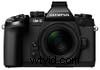
Olympus’s launch of the OM‑D E‑M1 marks a pivotal moment for the Micro Four‑Thirds system. Building on the success of the E‑M5, the new flagship offers a robust, weather‑sealed design and a suite of upgraded features that cater to both enthusiasts and professionals.
The E‑M1 houses a 16.3‑megapixel Live MOS sensor—slightly lower in resolution than its predecessor—but the camera compensates with significant improvements across the board. Users will notice enhanced ergonomics, faster autofocus, and expanded creative options.
For a comprehensive evaluation, check out the full Camera Test on PopPhoto.com.
Ergonomics are a key strength. The camera’s pronounced grip replaces the E‑M5’s modest bump, providing a comfortable hold that many shooters appreciate. Extensive weather sealing ensures dust and splash resistance, while the Supersonic Wave Filter mitigates dust ingress during lens changes. The sensor‑based five‑axis stabilization delivers reliable performance at slower shutter speeds, independent of the attached lens.
Control flexibility is another highlight. The 2×2 dial system allows the photographer to toggle between aperture, shutter speed, ISO, and white balance with a single lever, granting instant access to core settings on a compact body. The new 2.36‑million‑dot electronic viewfinder (EVF) offers a 1.48× magnification, equivalent to 0.74× on a full‑frame DSLR—an excellent framing aid.
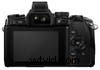
The lever beside the auto‑exposure/AF lock button switches between two command‑dial presets.
The most impactful upgrade is the Dual‑Fast autofocus system, which merges 81 contrast‑detection points with 37 phase‑detection points directly on the imaging sensor. In our hands‑on test with a pre‑production unit, this combination delivered markedly faster focus with Four‑Thirds lenses, especially when paired with the 160 mm MMF‑3 adaptor. Continuous AF and metering allow shooting at 6.5 fps for up to 50 RAW frames; without continuous AF the rate climbs to 10 fps for 41 RAW shots.
Connectivity has also been enhanced. Built‑in Wi‑Fi and the updated Olympus Image Share 2.0 app give full manual control from smartphones and tablets, including the Live‑Bulb mode that visualizes long‑exposure progress. Creative features such as automatic HDR merge, time‑lapse creation (up to 1.67 minutes), and interval shooting (1 second to 24 hours, up to 999 frames) are now available.
Olympus complements the E‑M1 with two new M.Zuiko Pro lenses. The 12–40 mm f/2.8 (24–80 mm equivalent) will ship in the initial kit; the 40–150 mm f/2.8 (80–300 mm equivalent) follows in the second half of 2014. Both lenses share the camera’s rugged, weather‑sealed construction.
The body is priced at $1,400, while the kit with the 12–40 mm f/2.8 lens is estimated at $2,200.
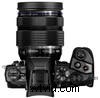
The 12–40 mm f/2.8 M.Zuiko Pro lens matches the OM‑D E‑M1’s durability.
Key Specifications:
SENSOR 16.3 MP Live MOS (Four‑Thirds format)
ISO 100–25,600
AF 81 contrast‑detection + 37 phase‑detection points (on‑sensor)
Shutter 1/8000–60 s (1/3‑, 1/2‑, or 1‑EV steps); Bulb/Time: 8 min default; 1, 2, 4, 8, 15, 20, 25, or 30 min selectable
EVF 2.36 million‑dot LCD; 1.48× magnification
LCD 3.0‑inch tilting, 1.037 million‑dot touch screen
Memory cards SD, SDHC, SDXC; single slot
Video up to 1920×1080 p 30 fps H.264 MOV
Dimensions 5.1 × 3.7 × 2.5 in. (130.4 × 93.5 × 63.1 mm)
Price $1,400 (body) / $2,200 (kit with 12–40 mm lens); visit getolympus.com