
We may earn revenue from the products available on this page and participate in affiliate programs. Learn more ›
The full-frame EF 24–70mm f/4L IS USM ($1,399, street) is Canon’s first in this popular focal-length range to have an image stabilizer. Unveiled in late 2012, it boasts two expensive UD glass elements, an internal focusing design, a nonrotating barrel, and a reversible hood with a push-button locking mechanism. Like most Canon L-series glass, it offers desirable features such as a constant aperture (f/4), a fluorine coating for easy cleaning, rugged construction, and extra moisture and dust protection.
This new f/4 is more than 3/4 of an inch shorter and 12 ounces lighter than Canon’s classic nonstabilized EF 24–70mm f/2.8 II ($2,299, street). In the field, it handled with all the aplomb we’ve come to expect from an L-series zoom.
It deals with close-up shooting in an odd way, entering a special macro range via the zoom ring and a three-way barrel switch. One setting locks the lens to 24mm; another gives access to the full zoom range. The third setting, reached by pressing and holding the switch and turning the zoom ring past 70mm, locks it into the macro mode.
Even more unusual? A sweet-spot macro focusing zone that Canon indicates on the subject distance scale with a bold yellow line. When we shot within the recommended focusing distances, our images looked significantly sharper than when we shot outside of these distances. Magnification reaches 1:1.33, although sharpness maxes out at about 1:2. The close-focus distance at 1:1.33 put the front lens element about an inch from our subjects!
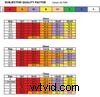
In our lab, the lens produced Excellent-range SQF scores which promise sharp, contrasty images. At the widest focal length, barrel distortion was a Visible 0.44% as measured in DxO Analyzer 5.0 tests. This compares favorably with the stabilized Tamron 24–70mm f/2.8 VC zoom’s 0.60% pincushioning. Canon’s image stabilization system proved optimal, giving an average of 3.25 extra stops of sharpness.
Canon shooters may be tempted by that Tamron, which saves you $200 and is a full stop brighter. But it lacks the Canon’s distortion control, magnifying power, compact proportions, and slightly stronger IS system (3.25 versus 3 stops). Which to buy? You decide!
SPECIFICATIONS
24–70mm (24.88–69.99mm tested), f/4 (f/3.89–4.24 tested), 15 elements in 12 groups. Focus ring turns 80 degrees; zoom ring turns 60 degrees. Focal length marked at 24-, 35-, 50-, and 70mm.
Diagonal view angle: 84–34°
Weight: 1.41 lbs Filter size: 77mm
Mounts: Canon AF
Included: Lenshood, lens pouch.
Street price: $1,399
Website: canonusa.com
TEST RESULTS
Distortion: At 24mm, 0.44% (Visible) barrel; at 50mm, 0.08% (Imperceptible) pincushion; at 70mm, 0.14% (Slight) pincushion
Macro Distortion: At 70mm, 0.08% (Imperceptible) barrel
Light Falloff: At 24mm, gone by f/5.6; at 50mm, by f/5; at 70mm, by f/5.6
Macro Falloff: At 70mm, gone by f/5
Close-focusing: 14.66 inches
Maximum Magnification Ratio: At 24mm, 1:11.06; at 50mm, 1:5.72; at 70mm, 1:1.33
Stabilization: 3.25 stops (macro: 2)
 Julia Silber